Magnetic Flux Density
CSCA Magnetic Flux Density study guide organized around the publicly available CSCA syllabus. Practice Physics questions on aicsca.com.
Before planning this topic, check the CSCA Exam Guide 2026 for exam dates, registration, fees, and subject requirements.
Syllabus Alignment
This study guide is organized around the publicly available CSCA syllabus for international undergraduate applicants.
Who It Is For
International students preparing for CSCA Math, Physics, Chemistry, or Chinese exams.
Related Practice
CSCA Practice · Go to questions
Past papers and worked video solutions · Timed mock exams · All subject video lessons
Practice by Topic
Jump from this tutorial to filtered practice questions for the same knowledge point.
Related formulas, concepts, and glossary terms
Physics Formula & Concept Reference
- Definition of Magnetic Induction (Magnetic Flux Density)
- Magnetic Field on the Axis of a Current-Carrying Circular Loop
- Ampere's Circuital Law (for Magnetic Fields)
- Magnetic Field of an Infinite Straight Wire
- Magnetic Field of an Infinite Straight Current-Carrying Wire
- Biot-Savart Law (Magnetic Field from a Current Element)
- Biot-Savart Law
- Definition of Magnetic Induction Intensity
Physics Exam Glossary
Tutorial Content
Topic: Electromagnetism > Magnetic Field > Magnetic Flux Density
1. Core Concept: Magnetic Flux Density ($B$)
**Magnetic Flux Density** describes the strength and direction of a magnetic field (Vector).
* **Physical Meaning**: Analogous to Electric Field Strength $E$, it describes the **force nature** of the magnetic field.
* **Direction Rule**: The direction the **North Pole of a compass** points when at rest.
* **Unit**: **Tesla (T)**.
* $1 T = 1 \frac{N}{A \cdot m} = 1 \frac{Wb}{m^2}$.
---
2. Definition vs. Determination Formula
For the CSCA exam, distinguish clearly between "How to define B" and "What determines B".
(1) Definition Formula
$$B = \frac{F}{IL}$$
* **Condition**: The wire must be placed **perpendicular** to the magnetic field.
* **Understanding**:
* This is a **Ratio Definition**.
* The magnitude of $B$ is determined by the field itself, **independent of $I, L$ or $F$**.
* If the wire is parallel to the field, $F=0$, but $B \neq 0$ at that point.
(2) Determination Formula
For magnetic fields produced by specific current geometries:
| Source | Formula (Vacuum $\mu_0$) | Notes |
| :--- | :--- | :--- |
| **Long Straight Wire** | $$B = \frac{\mu_0 I}{2\pi r}$$ | $r$: Perpendicular distance.<br>Closer to wire $\to$ Stronger B. |
| **Solenoid** | $$B = \mu_0 n I$$ | $n = N/L$: Turns per unit length.<br>Interior field is approx. **Uniform**. |
| **Center of Loop** | $$B = \frac{\mu_0 I}{2R}$$ | $R$: Radius of loop. |
**Constant**: Permeability of vacuum $\mu_0 = 4\pi \times 10^{-7} T\cdot m/A$.
---
3. Magnetic Field Lines
Imaginary curves to visualize the magnetic field.
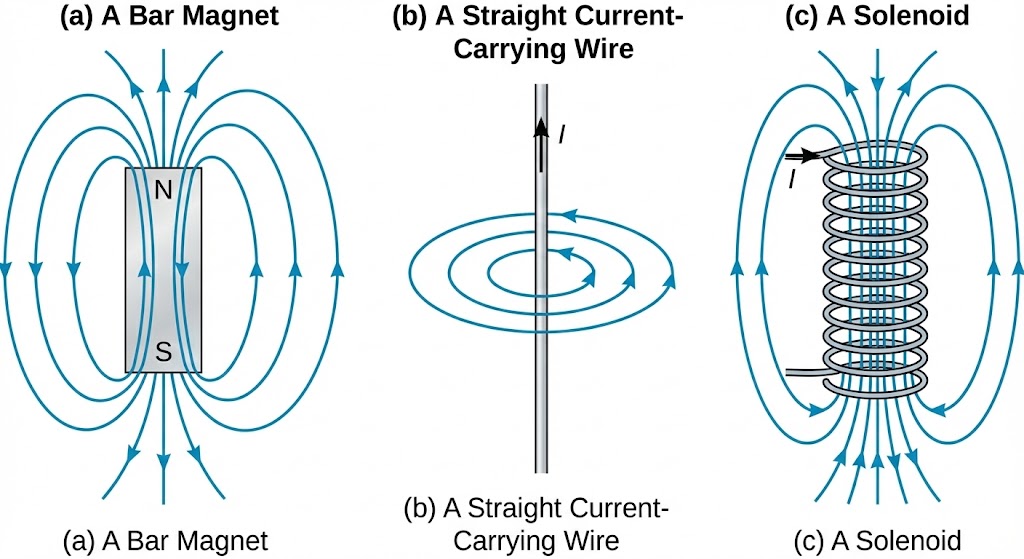
**Three Key Features**:
1. **Closed Loops**: No start or end points.
* **External**: N Pole $\to$ S Pole.
* **Internal**: S Pole $\to$ N Pole (Major difference from Electric Field Lines).
2. **No Intersection**: The field direction at any point is unique.
3. **Density = Strength**: Denser lines mean larger $B$.
---
4. Superposition of Magnetic Fields
$B$ is a **Vector**. If multiple fields exist, use **Vector Addition**.
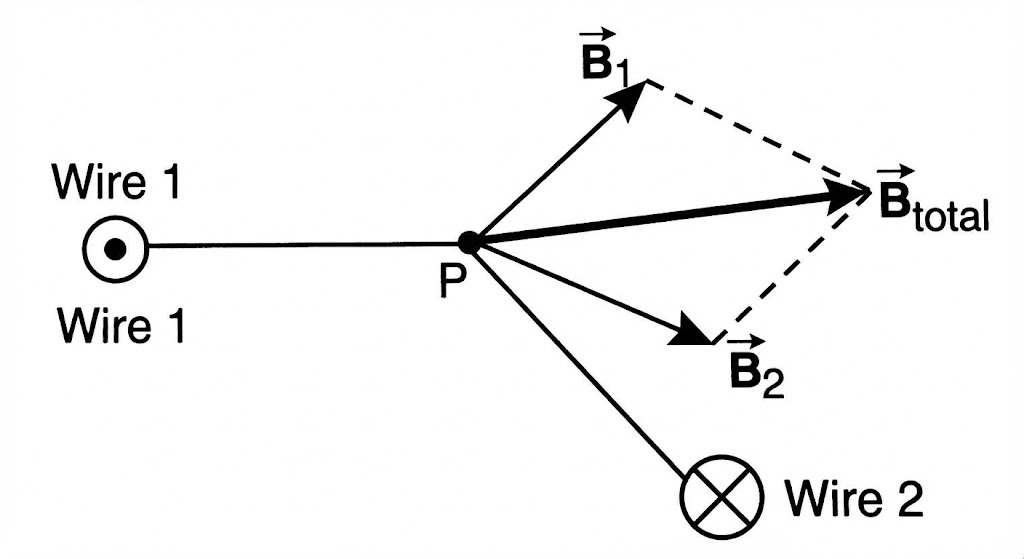
**Steps**:
1. **Direction**: Use **Ampere's Right-Hand Grip Rule** to draw the direction of each $B$ component.
2. **Magnitude**: Calculate each magnitude using formulas.
3. **Resultant**: Use geometry (Pythagoras, components) to find the total vector.
---
5. Typical Examples
**Example 1: Applying Definition**
**Problem**: A $0.2m$ wire is perpendicular to a field. Current $I=2A$, Force $F=0.4N$. Find:
(1) $B$;
(2) If $I$ becomes $4A$, what are the Force and $B$?
**Solution**:
(1) $$B = \frac{F}{IL} = \frac{0.4}{2 \times 0.2} = 1 T$$
(2) $B$ is a field property, **unchanged** at $1T$.
$$F' = B I' L = 1 \times 4 \times 0.2 = 0.8 N$$
**Example 2: Superposition (Parallel Wires)**
**Problem**: Two parallel long wires, distance $2d$, carry opposite currents $I$. Find $B$ at the midpoint $O$.
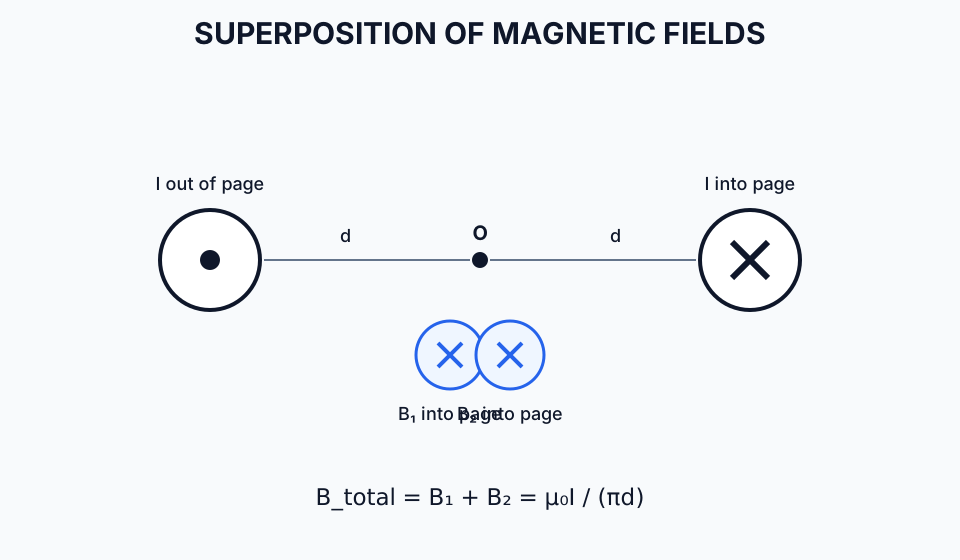
**Solution**:
1. **Direction**:
* Left Wire (Up current): $B_1$ at $O$ is **Into Page**.
* Right Wire (Down current): $B_2$ at $O$ is **Into Page**.
2. **Magnitude**:
$$B_1 = B_2 = \frac{\mu_0 I}{2\pi d}$$
3. **Total**:
$$B_{total} = B_1 + B_2 = \frac{\mu_0 I}{\pi d}$$ (Direction: Into Page)
**Example 3: 3D Superposition**
**Problem**: Two perpendicular non-touching wires. Find total B direction at equidistant points.
**Solution**: Draw a 3D or top-down view, determine component vectors using Right-Hand Rule, and add them.