Applications of Derivatives
CSCA Applications of Derivatives study guide organized around the publicly available CSCA syllabus. Practice Mathematics questions on aicsca.com.
Before planning this topic, check the CSCA Exam Guide 2026 for exam dates, registration, fees, and subject requirements.
Syllabus Alignment
This study guide is organized around the publicly available CSCA syllabus for international undergraduate applicants.
Who It Is For
International students preparing for CSCA Math, Physics, Chemistry, or Chinese exams.
Related Practice
CSCA Practice · Go to questions
Past papers and worked video solutions · Timed mock exams · All subject video lessons
Practice by Topic
Jump from this tutorial to filtered practice questions for the same knowledge point.
Related formulas, concepts, and glossary terms
Mathematics Formula & Concept Reference
- Inflection Point of a Curve
- Second Derivative Test for Concavity of a Curve
- Second Derivative Test for Concavity of a Function
- Maximum and Minimum Values of a Function (Continuous on a Closed Interval)
- Derivative Test for Monotonicity of a Function
- Necessary Condition for Local Extrema (Fermat's Lemma)
- Second Sufficient Condition for Local Extrema (Second Derivative Test)
- Second Sufficient Condition for Local Extrema (Second Derivative Test)
Mathematics Exam Glossary
Tutorial Content
Applications of Derivatives
1. Core Logic & Visualization
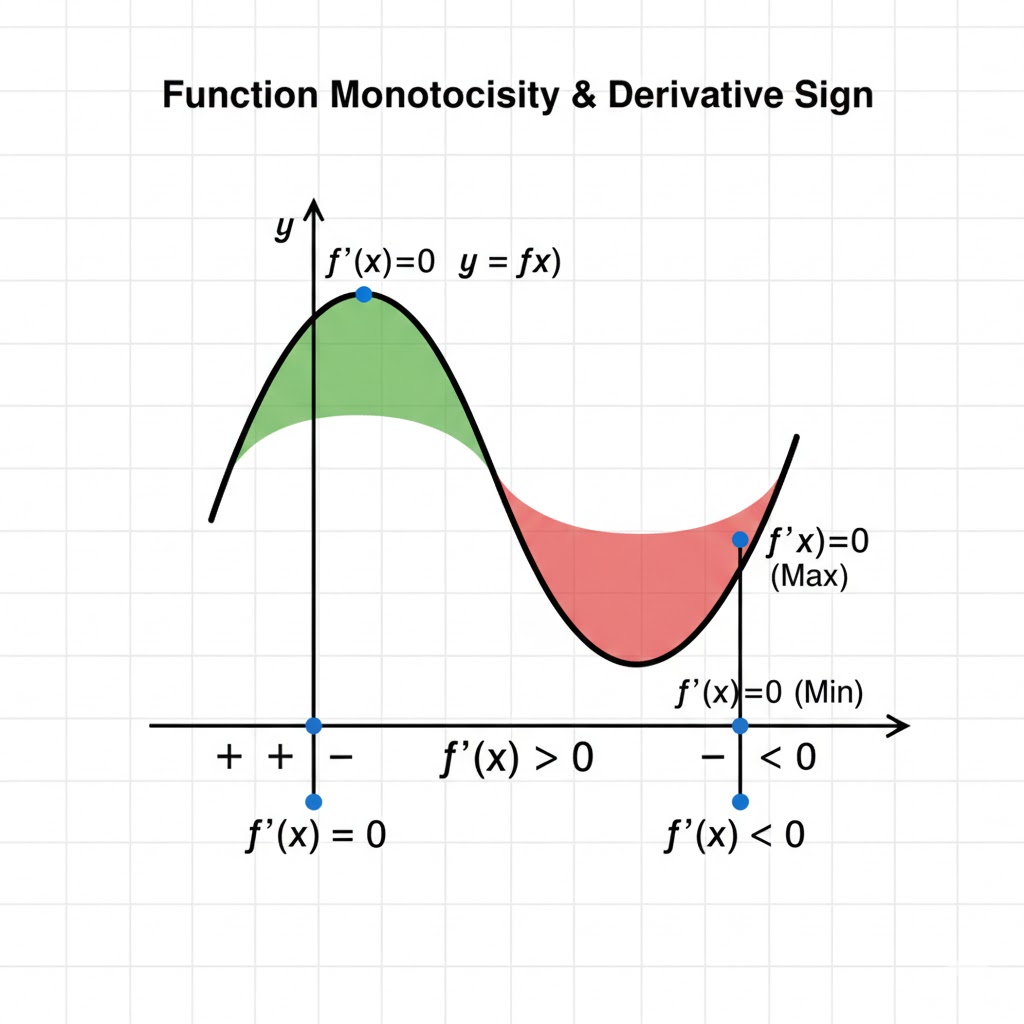
The derivative $f'(x)$ acts as a "barometer" for the function $f(x)$, indicating its trend:
* **Sign of $f'(x)$** $\longleftrightarrow$ **Monotonicity (Increasing/Decreasing)**
* **Zeros of $f'(x)$** $\longleftrightarrow$ **Extrema (Max/Min points)**
| Sign of $f'(x)$ | Behavior of $f(x)$ | Visual |
| :--- | :--- | :--- |
| **Positive (+)** | **Increasing** | 📈 Uphill |
| **Negative (-)** | **Decreasing** | 📉 Downhill |
| **Zero (0)** | **Stationary** | ➖ Flat (Possible Extrema) |
 ---
---
2. Key Topics & Methods
#### Topic 1: Finding Intervals of Monotonicity
**Steps**:
1. **Domain**: Always consider the domain first.
2. **Differentiate**: Find $f'(x)$.
3. **Solve Inequalities**:
* $f'(x) > 0 \Rightarrow$ **Intervals of Increase**.
* $f'(x) < 0 \Rightarrow$ **Intervals of Decrease**.
#### Topic 2: Finding Local Extrema
**Steps**:
1. Find **Critical Points**: Where $f'(x)=0$ or is undefined.
2. **Sign Chart (First Derivative Test)**: Check the sign change of $f'(x)$ around critical points.
* **+ to -** $\Rightarrow$ **Local Maximum** (Peak)
* **- to +** $\Rightarrow$ **Local Minimum** (Valley)
* No change $\Rightarrow$ No extrema.
#### Topic 3: Absolute Extrema on Closed Interval $[a, b]$
**Steps**:
1. Find all critical points inside $(a, b)$.
2. Evaluate the function at these critical points **AND** at endpoints $a$ and $b$.
3. **Compare**: The highest value is the Absolute Max; the lowest is the Absolute Min.
---
3. Examples
**Example 1: Monotonicity & Extrema**
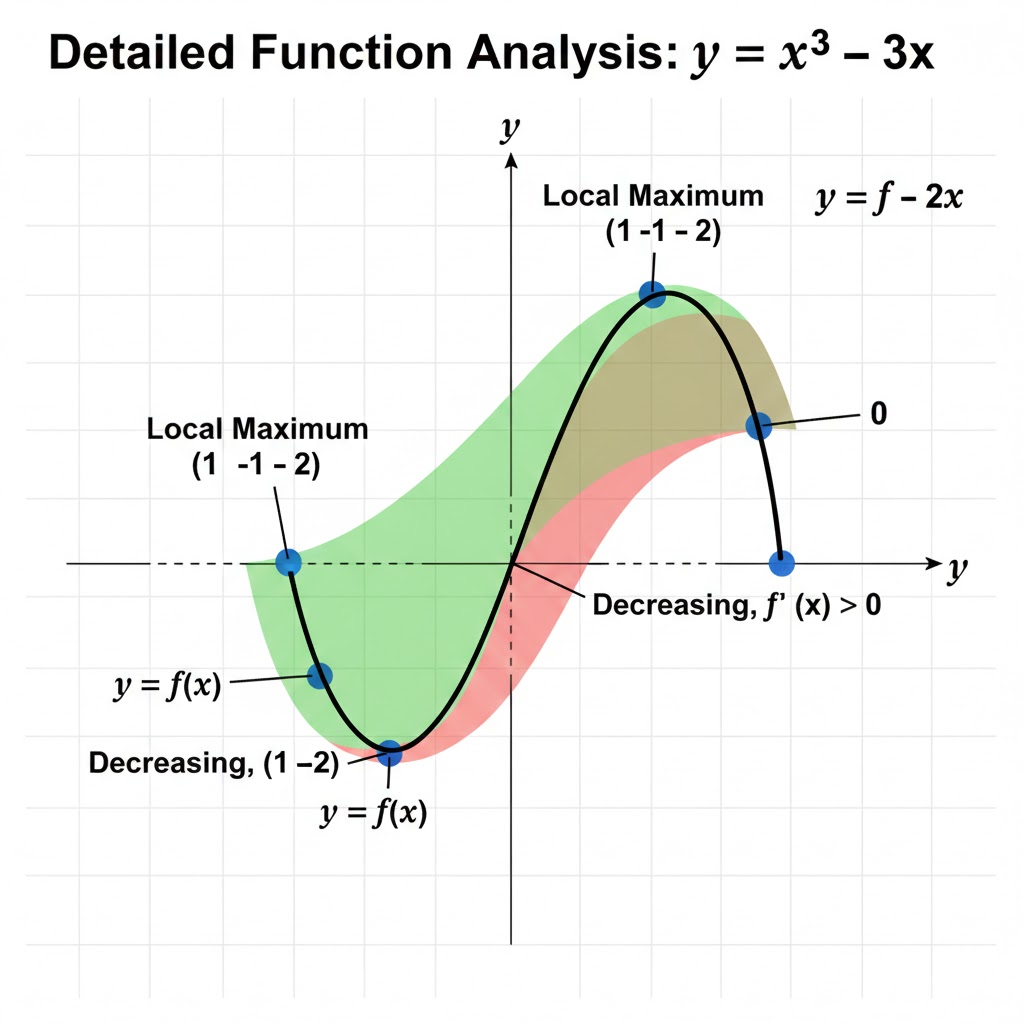
Analyze $f(x) = x^3 - 3x$.
**Solution**:
1. **Derivative**: $f'(x) = 3x^2 - 3 = 3(x+1)(x-1)$.
2. **Critical Points**: $x = \pm 1$.
3. **Sign Chart**:
| $x$ | $(-\infty, -1)$ | $-1$ | $(-1, 1)$ | $1$ | $(1, +\infty)$ |
| :--- | :---: | :---: | :---: | :---: | :---: |
| $f'(x)$ | $+$ | $0$ | $-$ | $0$ | $+$ |
| $f(x)$ | $\nearrow$ | **Max (2)** | $\searrow$ | **Min (-2)** | $\nearrow$ |
* Increasing: $(-\infty, -1]$ and $[1, +\infty)$
* Decreasing: $[-1, 1]$
* Local Max: $f(-1)=2$; Local Min: $f(1)=-2$.
 **Example 2: Absolute Extrema**
Find max/min of $f(x) = x^3 - 3x + 1$ on $[-2, 2]$.
**Solution**:
1. Critical points $x=\pm 1$ are inside the interval.
2. Evaluate:
* Endpoints: $f(-2) = -1$, $f(2) = 3$
* Critical Pts: $f(-1) = 3$, $f(1) = -1$
3. Compare: Absolute Max = 3, Absolute Min = -1.
**Example 3: Optimization**
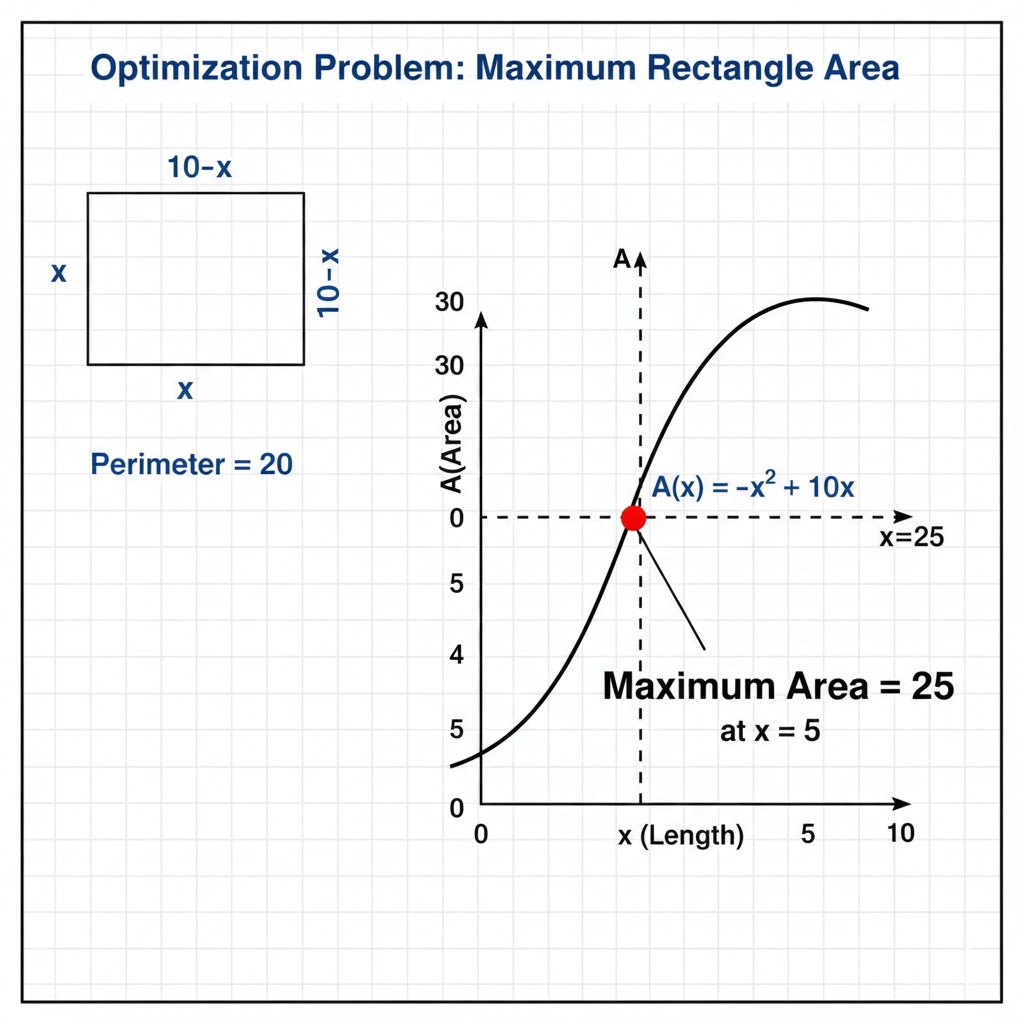
Maximize the area of a rectangle with perimeter 20.
**Solution**:
1. **Model**: Let length be $x$, width is $10-x$. Area $S(x) = 10x - x^2$ ($0<x<10$).
2. **Derivative**: $S'(x) = 10 - 2x$.
3. **Solve**: $S'(x)=0 \Rightarrow x=5$.
4. **Test**: Since graph is a parabola opening down, vertex ($x=5$) is the max.
5. **Result**: Area is max ($25$) when $x=5$ (Square).
 ---
---
4. Common Pitfalls
* **Notation**: Do not use the union symbol ($\cup$) to combine monotonic intervals. List them separately.
* **Local vs. Absolute**: A local max is a peak; the absolute max is the highest point overall. Always check **endpoints** for closed interval problems.
* **Domain**: In word problems (optimization), ensure your answer lies within the physical constraints (e.g., length must be positive).