Arithmetic Operations on Complex Numbers
CSCA Arithmetic Operations on Complex Numbers study guide organized around the publicly available CSCA syllabus. Practice Mathematics questions on aicsca.com.
Before planning this topic, check the CSCA Exam Guide 2026 for exam dates, registration, fees, and subject requirements.
Syllabus Alignment
This study guide is organized around the publicly available CSCA syllabus for international undergraduate applicants.
Who It Is For
International students preparing for CSCA Math, Physics, Chemistry, or Chinese exams.
Related Practice
CSCA Practice · Go to questions
Past papers and worked video solutions · Timed mock exams · All subject video lessons
Practice by Topic
Jump from this tutorial to filtered practice questions for the same knowledge point.
Related formulas, concepts, and glossary terms
Mathematics Formula & Concept Reference
- Complex Number Division Formula
- Complex Number Subtraction Formula
- Complex Number Addition Formula
- Complex Number Multiplication Formula
Mathematics Exam Glossary
Tutorial Content
Arithmetic Operations on Complex Numbers
Operations on complex numbers combine algebra and geometry. In the CSCA exam, **Division** (rationalizing the denominator) and **Multiplication** (using $i^2=-1$) are high-frequency calculation topics. Additionally, understanding the **geometric meaning** of addition and subtraction helps solve related geometric problems.
1. Core Concepts Review
* **Definition**: $z = a + bi$ ($a, b \in \mathbb{R}$), where $i$ is the imaginary unit and $i^2 = -1$.
* **Classification**:
* $b=0$: Real number.
* $b \neq 0$: Imaginary number.
* $a=0, b \neq 0$: Pure imaginary number.
* **Equality**: $a+bi = c+di \iff a=c$ and $b=d$.
2. Rules for Arithmetic Operations
Let $z_1 = a + bi$, $z_2 = c + di$.
#### 2.1 Addition and Subtraction
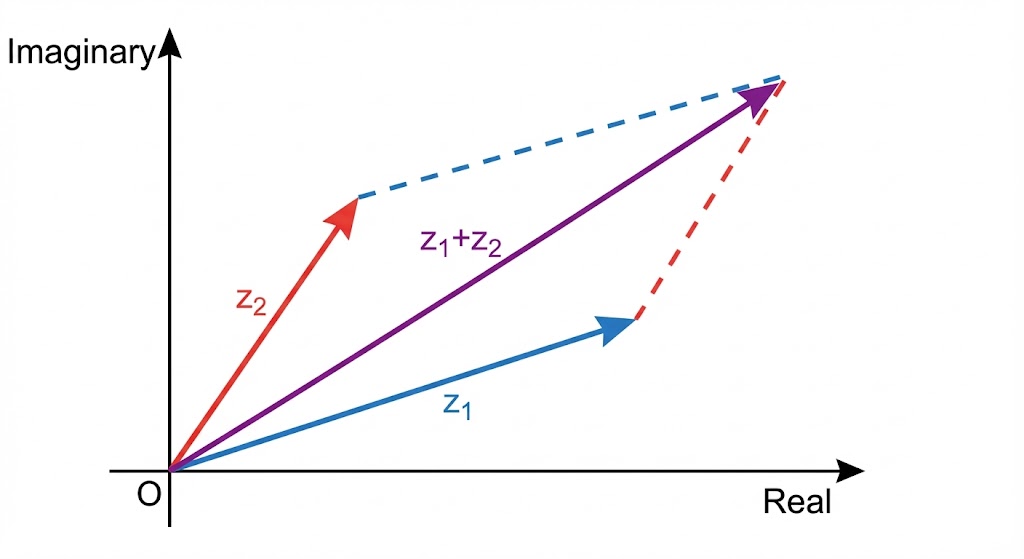
Follow the principle: "Real with Real, Imaginary with Imaginary".
* **Formula**: $(a+bi) \pm (c+di) = (a \pm c) + (b \pm d)i$
* **Geometric Meaning**: Corresponds to the **Parallelogram Rule** or Triangle Rule of vectors.
#### 2.2 Multiplication
Expand like polynomial multiplication, replacing $i^2$ with $-1$.
* **Derivation**:
$$(a+bi)(c+di) = ac + adi + bci + bdi^2$$
$$= (ac - bd) + (ad + bc)i$$
#### 2.3 Division
The core of division is **Rationalizing the Denominator**.
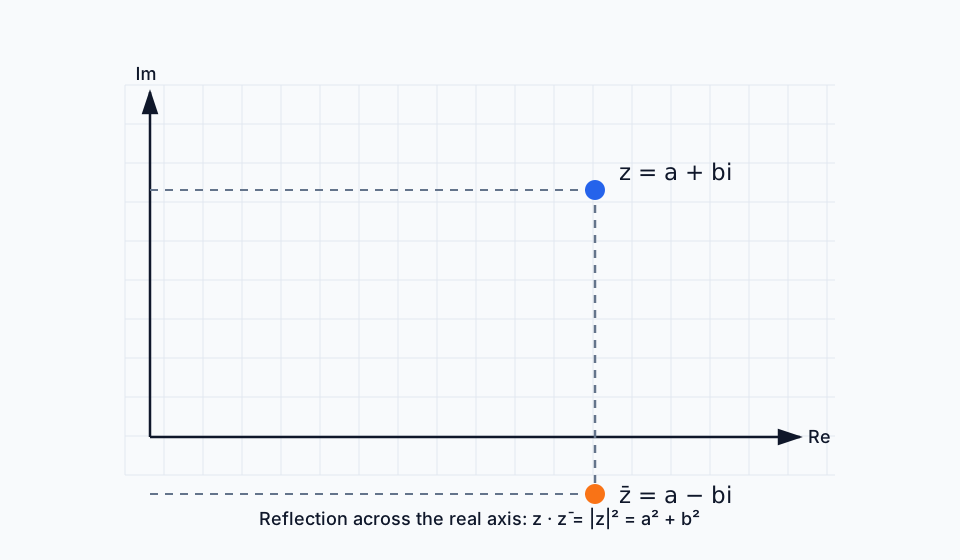
* **Method**: Multiply both the numerator and denominator by the **Conjugate** of the denominator.
* **Complex Conjugate**: The conjugate of $z = c+di$ is $\bar{z} = c-di$. Geometrically, they are symmetric about the Real axis.
* **Key Property**: $z \cdot \bar{z} = c^2 + d^2$ (The result is a real number).
* **Process**:
$$\frac{a+bi}{c+di} = \frac{(a+bi)(c-di)}{(c+di)(c-di)} = \frac{(ac+bd)+(bc-ad)i}{c^2+d^2}$$
3. Practice Examples
**Example 1** (Mixed Add/Sub): Calculate $(3+2i) - (4-3i) + (-1+5i)$.
**Solution**:
Real parts: $3 - 4 + (-1) = -2$
Imaginary parts: $2 - (-3) + 5 = 2 + 3 + 5 = 10$
Result: $-2 + 10i$
**Example 2** (Multiplication): Calculate $(2-3i)(1+4i)$.
**Solution**:
Expand: $2(1) + 2(4i) - 3i(1) - 3i(4i)$
$= 2 + 8i - 3i - 12i^2$
Note that $i^2 = -1$, so $-12i^2 = +12$.
$= (2+12) + (8-3)i = 14 + 5i$
**Example 3** (Division): Calculate $\frac{1+2i}{3-4i}$.
**Solution**:
The denominator is $3-4i$, its conjugate is $3+4i$.
$$\frac{1+2i}{3-4i} = \frac{(1+2i)(3+4i)}{(3-4i)(3+4i)}$$
Denominator: $3^2 + 4^2 = 9 + 16 = 25$
Numerator: $1(3) + 1(4i) + 2i(3) + 2i(4i) = 3 + 4i + 6i - 8 = -5 + 10i$
Result: $\frac{-5+10i}{25} = -\frac{1}{5} + \frac{2}{5}i$
4. Common Errors
* **Sign Errors**: Forgetting to change the sign when calculating $i^2$ (e.g., calculating $-3i \cdot 4i$ as $-12$ instead of $+12$).
* **Conjugate Confusion**: Forgetting to multiply the numerator by the conjugate as well.
* **Order of Operations**: Always multiply/divide before adding/subtracting.