Equations and Properties of Circles
Find circle centers and radii, distinguish a circle from a single point or an empty set, and test tangency using distance formulas. Three worked examples.
Before planning this topic, check the CSCA Exam Guide 2026 for exam dates, registration, fees, and subject requirements.
Syllabus Alignment
This study guide is organized around the publicly available CSCA syllabus for international undergraduate applicants.
Who It Is For
International students preparing for CSCA Math, Physics, Chemistry, or Chinese exams.
Related Practice
CSCA Practice · Go to questions
Past papers and worked video solutions · Timed mock exams · All subject video lessons
Practice by Topic
Jump from this tutorial to filtered practice questions for the same knowledge point.
Related formulas, concepts, and glossary terms
Mathematics Formula & Concept Reference
- Equation of a Circle Centered at the Origin
- Positional Relationship between a Point and a Circle
- Standard Equation of a Circle
- Positional Relationship between a Line and a Circle (Discriminant Method)
- Equation of the Tangent Line to a Circle (Given Point of Tangency)
- Determining the Position of a Point Relative to a Circle
- General Equation of a Circle
- Diameter Form Equation of a Circle
Mathematics Exam Glossary
Tutorial Content
Equations and Properties of Circles
A circle's equation connects its center and radius with its geometric properties. This tutorial covers the standard and general forms, then uses distance formulas to locate points and lines relative to a circle.
1. Definition and standard form
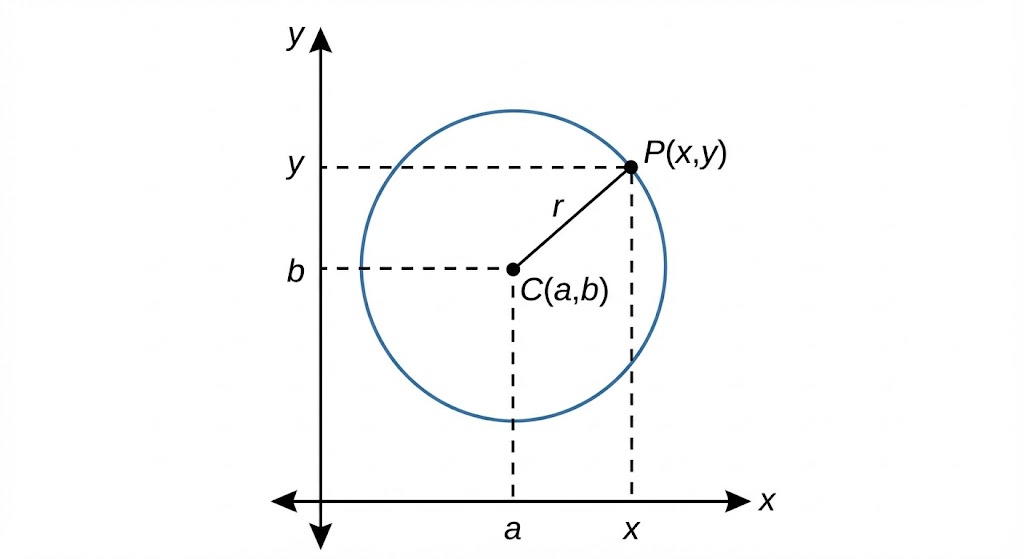
A circle is the set of points in a plane at a fixed positive distance from a given point. The given point is the center, and the distance is the radius.
For center and radius , the distance formula gives
If the center is the origin, this reduces to .
2. General form: three possible cases
Expanding the standard form gives
Completing the square gives
The left side is a sum of squares of real numbers, so first check the sign of the right side:
| Condition | Set of points described |
|---|---|
| A circle with positive radius | |
| The single point | |
| No real points; the solution set is empty |
In the first case, the center is and the radius is
The zero case is sometimes called a “point circle,” but it is not a circle with positive radius. In the negative case, the square root does not give a real radius.
3. Points and lines relative to a circle
Throughout this section, assume the circle has radius .
A point and a circle
Calculate the distance from the point to the center:
- If , the point lies outside the circle.
- If , it lies on the circle.
- If , it lies inside the circle.
A line and a circle
Write the line as , where and are not both zero. The distance from the center to the line is
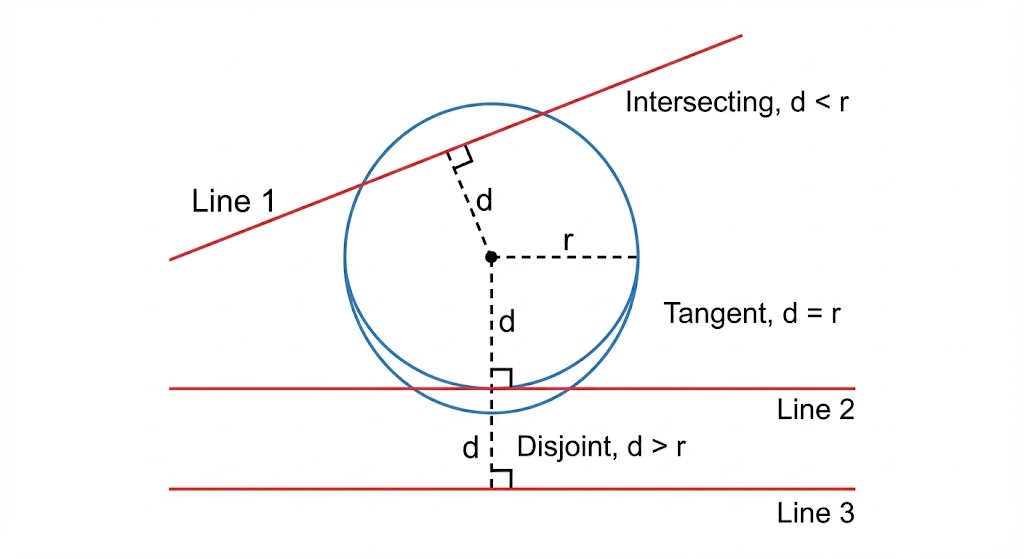
- If , there are two intersection points; the line is a secant.
- If , there is one intersection point; the line is tangent to the circle.
- If , there are no intersection points.
4. Tangent lines
The tangent at a point on the circle
If lies on , the tangent at is
For a circle centered at , the formula becomes
Check that is on the circle before using the formula. The tangent is perpendicular to the radius at the point of contact.
Tangents through an external point
For an external point , write a nonvertical candidate line as . Solve for by setting the distance from the center to the line equal to .
Slope form does not include vertical lines, so also check separately. This line is tangent precisely when .
5. Worked examples
Example 1: Use a center and a point on the circle
Find the equation of the circle centered at and passing through .
The radius is
The equation is therefore
Example 2: Determine whether a line is tangent
Determine how meets the circle .
The center is and the radius is . The distance from the center to the line is
Since , the line is tangent to the circle.
Example 3: Find the center and radius from general form
Find the center and radius of .
Using the formulas: With , , and , the center is and
Completing the square:
which gives
The center is and the radius is , agreeing with the first method.
Sources and review
Content reviewed: 12 September 2026.