Coulomb's Law
CSCA Coulomb's Law study guide organized around the publicly available CSCA syllabus. Practice Physics questions on aicsca.com.
Before planning this topic, check the CSCA Exam Guide 2026 for exam dates, registration, fees, and subject requirements.
Syllabus Alignment
This study guide is organized around the publicly available CSCA syllabus for international undergraduate applicants.
Who It Is For
International students preparing for CSCA Math, Physics, Chemistry, or Chinese exams.
Related Practice
CSCA Practice · Go to questions
Past papers and worked video solutions · Timed mock exams · All subject video lessons
Practice by Topic
Jump from this tutorial to filtered practice questions for the same knowledge point.
Related formulas, concepts, and glossary terms
Physics Formula & Concept Reference
- What are the applicable conditions for Coulomb's Law?
- Vector Form of Coulomb's Law
- How to determine the direction of the force between two point charges using Coulomb's Law?
- Electrostatic Force Constant in Coulomb's Law
- What is the value of the electrostatic constant k in the International System of Units (SI)?
- Scalar Form of Coulomb's Law
- What is the mathematical expression of Coulomb's Law?
Physics Exam Glossary
Tutorial Content
Topic: Electromagnetism > Electrostatics > Coulomb's Law
1. Core Definition
**Coulomb's Law** is the foundation of electrostatics. It quantitatively describes the interaction force (Electrostatic Force or Coulomb Force) between two **stationary point charges** in a **vacuum**.
* **Conditions**:
1. **Vacuum** (Approximately valid in air).
2. **Point Charge**: The size/shape of the object is negligible compared to the distance ($r \gg$ size).
3. **Stationary**.
---
2. Core Formula
$$F = k \frac{|q_1 q_2|}{r^2}$$
| Symbol | Meaning | Unit | Note |
| :---: | :--- | :---: | :--- |
| $F$ | Magnitude of Force | $N$ | Obeys Newton's 3rd Law (Action-Reaction) |
| $q$ | Charge Magnitude | $C$ | **Use Absolute Values for calculation** |
| $r$ | Distance | $m$ | Distance between **centers** of charges |
| $k$ | Coulomb's Constant | - | $k \approx 9.0 \times 10^9 \, N\cdot m^2/C^2$ |
**CSCA Exam Tips**:
1. **Unit Traps**: Problems often use micro-Coulombs ($\|mu C$) or centimeters ($cm$). You **must** convert to $C$ ($1\|mu C = 10^{-6}C$) and $m$ before calculating.
2. **Absolute Value**: The formula calculates magnitude only. Determine direction separately based on signs.
---
3. Determining Direction
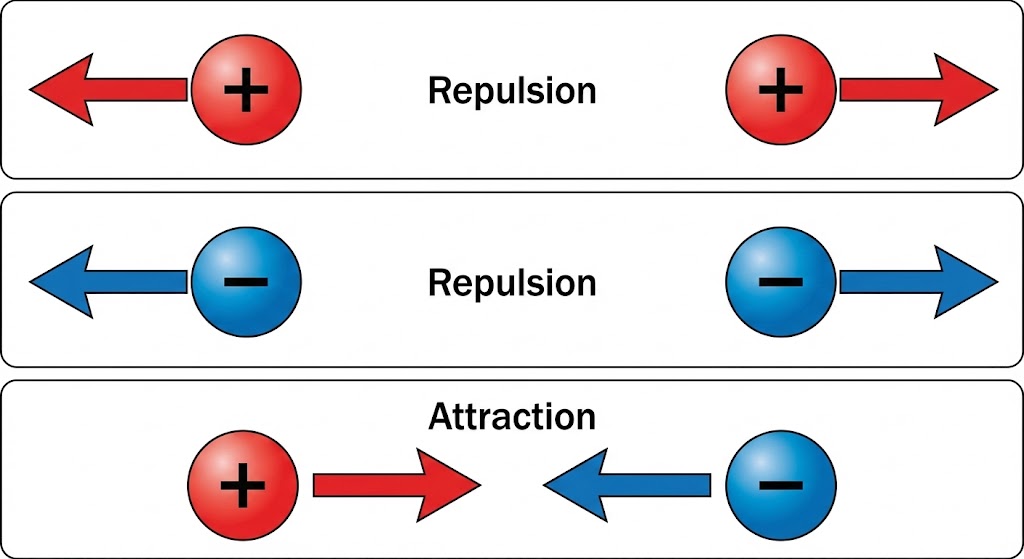
Follow the rule: **"Like charges repel, Unlike charges attract"**. The force acts along the line connecting the charges.
* **Repulsion**: $++$ or $--$
* **Attraction**: $+-$ or $-+$
---
4. Key Method: Superposition of Forces
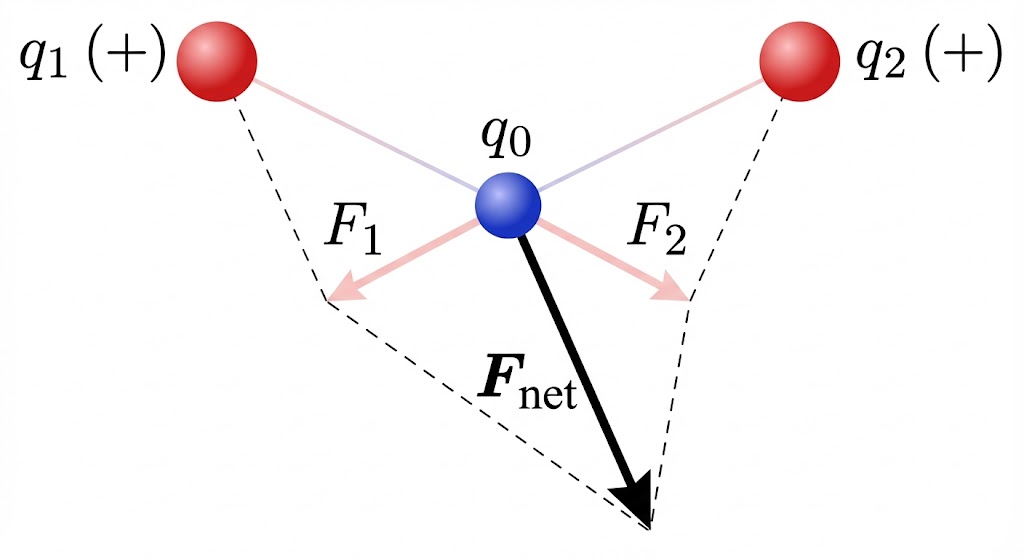
When a charge is acted upon by multiple charges, use the **Vector Superposition Principle** (Parallelogram Rule).
**Standard Steps:**
1. **Free Body Diagram**: Identify the object and draw force vectors.
2. **Calculate Magnitudes**: Use $F = k|q_1 q_2|/r^2$ for each pair.
3. **Determine Directions**: Mark the direction of each force vector.
4. **Vector Addition**:
* **Collinear**: Add or subtract algebraically.
* **Non-Collinear**: Use geometry (Pythagorean theorem, trigonometry) or component analysis.
---
5. Typical Examples
**Example 1: Basic Calculation (Collinear)**
**Problem**: Three point charges are fixed on the x-axis. $q_A = +2.0 \times 10^{-9}C$ at $x=0$, $q_B = -3.0 \times 10^{-9}C$ at $x=0.1m$, $q_C = +4.0 \times 10^{-9}C$ at $x=0.2m$. Find the net force on $q_B$.
**Solution**:
1. **Analyze $q_B$**:
* $A$ on $B$ (Attraction): $F_{AB}$ points to $A$ (Left).
* $C$ on $B$ (Attraction): $F_{CB}$ points to $C$ (Right).
2. **Calculate Magnitudes**:
$$F_{AB} = 5.4 \times 10^{-6} N$$
$$F_{CB} = 1.08 \times 10^{-5} N$$
3. **Net Force**:
Taking right as positive.
$$F_{net} = F_{CB} - F_{AB} = 5.4 \times 10^{-6} N$$
Direction: **Right**.
**Example 2: Vector Property (Newton's 3rd Law)**
**Problem**: Charge $A$ is 3 times larger than $B$ ($q_A = 3q_B$). If the force exerted by $A$ on $B$ is $F_1$, and by $B$ on $A$ is $F_2$, compare $F_1$ and $F_2$.
**Solution**: According to Newton's 3rd Law, **$F_1$ is always equal to $F_2$**, regardless of the charge magnitudes.
**Example 3: Non-Collinear (Right Triangle)**
**Problem**: In a vacuum, $q_1=+Q$ is at $(0, a)$ and $q_2=+Q$ is at $(a, 0)$. Find the net force on a charge $-q$ placed at the origin $O(0,0)$.
**Solution**:
1. $q_1$ pulls $-q$ Up ($+y$) with $F_1 = kQq/a^2$.
2. $q_2$ pulls $-q$ Right ($+x$) with $F_2 = kQq/a^2$.
3. $F_1 \perp F_2$, so $F_{net} = \sqrt{F_1^2 + F_2^2} = \sqrt{2} k \frac{Qq}{a^2}$.
Direction: $45^\circ$ (towards the first quadrant bisector).