Ideal Gas Law
CSCA Ideal Gas Law study guide organized around the publicly available CSCA syllabus. Practice Physics questions on aicsca.com.
Before planning this topic, check the CSCA Exam Guide 2026 for exam dates, registration, fees, and subject requirements.
Syllabus Alignment
This study guide is organized around the publicly available CSCA syllabus for international undergraduate applicants.
Who It Is For
International students preparing for CSCA Math, Physics, Chemistry, or Chinese exams.
Related Practice
CSCA Practice · Go to questions
Past papers and worked video solutions · Timed mock exams · All subject video lessons
Practice by Topic
Jump from this tutorial to filtered practice questions for the same knowledge point.
Related formulas, concepts, and glossary terms
Physics Formula & Concept Reference
- Universal Gas Constant R (Common Value)
- Ideal Gas Law (in terms of molar mass)
- Ideal Gas Law (in terms of density)
- Boltzmann Constant k_B (Common Value)
- Ideal Gas Law (Alternative Form using Molecular Number N )
- Ideal Gas Law (Basic Form)
- Ideal Gas Law
- Ideal Gas Law (in terms of molecule number)
Physics Exam Glossary
Tutorial Content
Ideal Gas Law
1. The Ideal Gas Model
An Ideal Gas is a theoretical model established to simplify calculations. It ignores minor factors to capture the main characteristics. **In the CSCA exam, gases are generally treated as ideal gases.**
* **Three Core Assumptions**:
1. **Negligible Volume**: Molecules are treated as point masses.
2. **No Intermolecular Forces**: No attraction or repulsion (except during collisions). This means Internal Energy depends *only* on Temperature.
3. **Perfectly Elastic Collisions**: No loss of kinetic energy during collisions.
2. Core Formulas
#### A. Clapeyron Equation
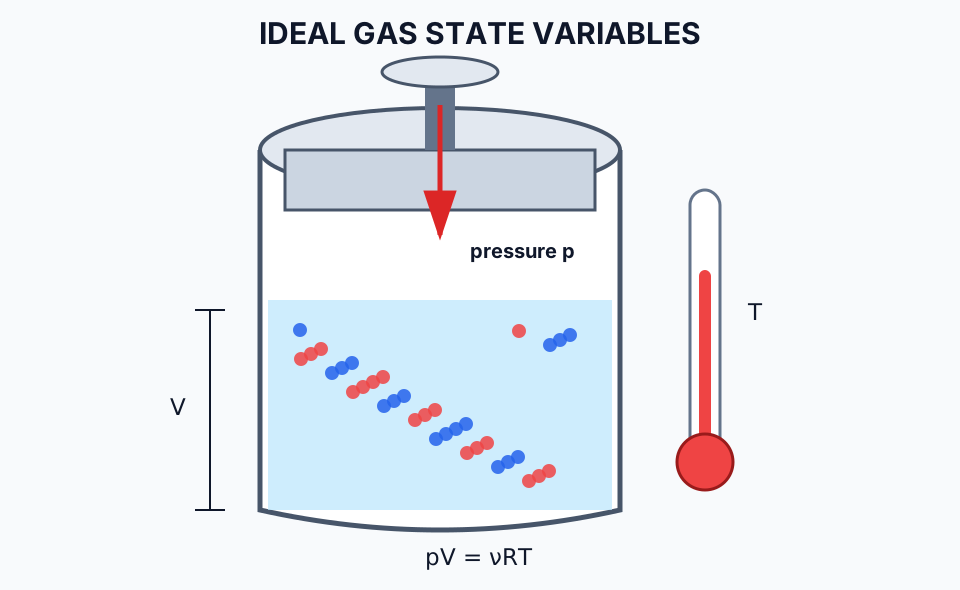
Describes the relationship between state parameters in a **single equilibrium state**:
$$ pV = \nu R T $$
* **$p$ (Pressure)**: Unit **Pa** (Pascal).
* **$V$ (Volume)**: Unit **m³** (Cubic meter).
* **$T$ (Temperature)**: **Thermodynamic Temperature**, Unit **K** (Kelvin). **Crucial:** $T = t(^{\circ}\text{C}) + 273.15$.
* **$\nu$ (Amount of substance)**: Unit **mol**. *(Note: Sometimes denoted as $n$, but $\nu$ is often used in physics to distinguish from number density)*.
* **$R$**: Universal Gas Constant, $R \approx 8.31 \, \text{J/(mol\cdot K)}$.
#### B. Experimental Laws & Graphs (Special Processes)
When the mass ($\nu$) of the gas is constant, we use the **Combined Gas Law**:
$$ \frac{p_1 V_1}{T_1} = \frac{p_2 V_2}{T_2} = C $$
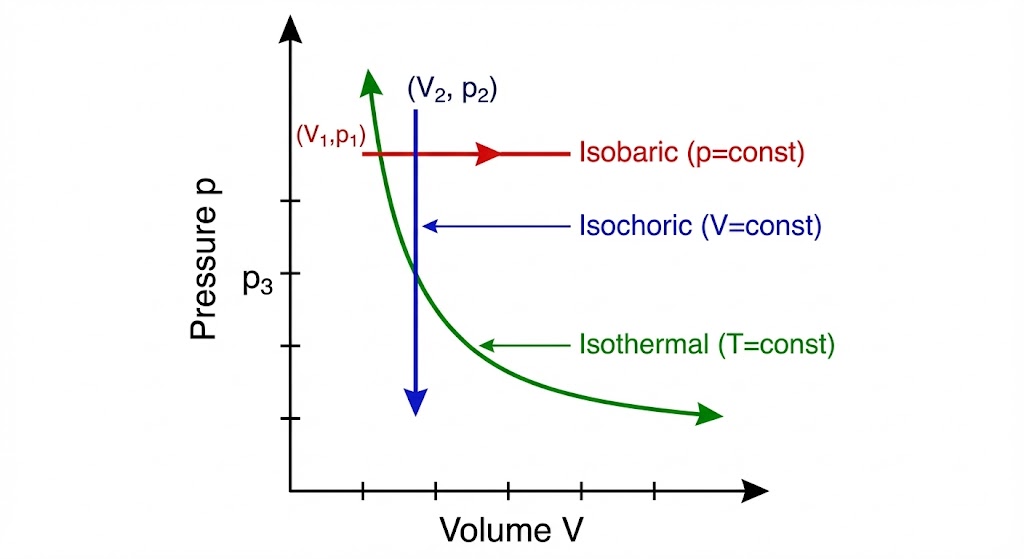
You must master the **$p-V$ graph** characteristics for three special processes:
1. **Isothermal (Constant $T$)**: $pV = C$. The graph is a **hyperbola** curve.
2. **Isobaric (Constant $p$)**: $V/T = C$. The graph is a **horizontal line**.
3. **Isochoric (Constant $V$)**: $p/T = C$. The graph is a **vertical line**.
3. Useful Derivations
* **Density Form**: $pM = \rho RT$ (where $\rho$ is density, $M$ is molar mass). Useful for finding molar mass from density.
* **Microscopic Form**: $pV = NkT$ ($N$ is total number of molecules, $k$ is Boltzmann constant).
4. Typical Examples
**Example 1: Process Analysis & Graphs**
An ideal gas of fixed mass starts at State A, expands isobarically to State B, and then cools isochorically to State C. Describe the path on a $p-V$ diagram.
**Analysis**:
* A $\rightarrow$ B (Isobaric Expansion): $p$ constant, $V$ increases. Horizontal line to the right.
* B $\rightarrow$ C (Isochoric Cooling): $V$ constant, $T$ decreases. Since $p/T=C$, $p$ must decrease. Vertical line downwards.
**Example 2: Calculation**
An oxygen tank has volume $V=32\text{L}$, pressure $p=1.3 \times 10^7 \text{Pa}$, and temperature $27^{\circ}\text{C}$. Calculate the mass $m$ of the oxygen. ($M_{O_2} = 32 \text{g/mol}$)
**Solution**:
1. **Unit Conversion**:
* $V = 0.032 \, \text{m}^3$
* $T = 300 \, \text{K}$ (Don't forget to convert to Kelvin!)
* $M = 0.032 \, \text{kg/mol}$
2. **Substitute into** $pV = \frac{m}{M}RT$:
$$ m = \frac{pVM}{RT} = \frac{1.3 \times 10^7 \times 0.032 \times 0.032}{8.31 \times 300} \approx 5.34 \, \text{kg} $$