Atomic Structure
CSCA Atomic Structure study guide organized around the publicly available CSCA syllabus. Practice Physics questions on aicsca.com.
Before planning this topic, check the CSCA Exam Guide 2026 for exam dates, registration, fees, and subject requirements.
Syllabus Alignment
This study guide is organized around the publicly available CSCA syllabus for international undergraduate applicants.
Who It Is For
International students preparing for CSCA Math, Physics, Chemistry, or Chinese exams.
Related Practice
CSCA Practice · Go to questions
Past papers and worked video solutions · Timed mock exams · All subject video lessons
Practice by Topic
Jump from this tutorial to filtered practice questions for the same knowledge point.
Related formulas, concepts, and glossary terms
Physics Formula & Concept Reference
- Hydrogen Atom Electron Orbital Angular Momentum Quantization Condition
- Bohr Atomic Model: Energy Level Formula
- Bohr Atomic Model: Orbital Radius Formula
- De Broglie Matter Wave Hypothesis (Applied to Electrons in Atoms)
- Bohr Atomic Model: Orbital Energy Formula
- Rydberg Formula (Atomic Spectra)
- Angular Momentum Quantization Condition (Bohr Model)
- Rydberg Formula (Hydrogen Atomic Spectrum)
Physics Exam Glossary
Tutorial Content
Modern Physics: Atomic Structure
1. Evolution of Atomic Models
Understanding the atom has been a progressive journey. For the CSCA exam, you must distinguish between these three historical models:
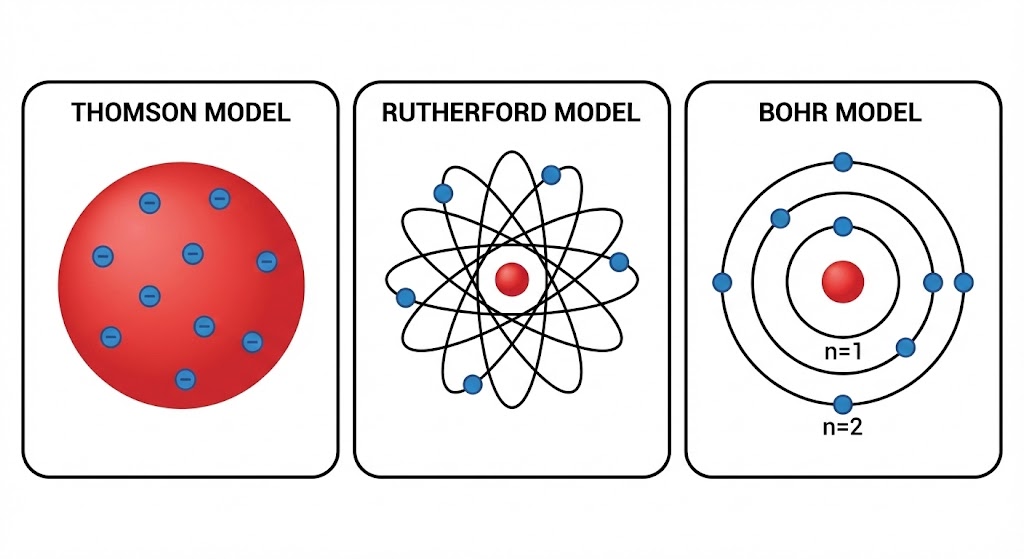
1. **Thomson's "Plum Pudding Model" (1897)**:
* Envisioned the atom as a sphere of positive charge with electrons embedded like raisins in a pudding.
* **Flaw**: Could not explain the large-angle deflection in the $\alpha$-particle scattering experiment.
2. **Rutherford's "Nuclear Model" (1911)**:
* Based on the **$\alpha$-particle Scattering Experiment** (Gold Foil Experiment).
* **Core Conclusion**: A tiny, massive, positively charged **Nucleus** exists at the center, with electrons orbiting it.
* **Flaw**: Could not explain atomic stability (orbiting electrons should radiate energy and crash) and discrete spectra.
3. **Bohr Model (1913)**:
* **Status**: The core of calculation problems. Introduced quantum theory to successfully explain the Hydrogen spectrum.
---
2. Core Topic: Bohr's Hydrogen Theory
Bohr proposed three postulates that broke away from classical physics. Memorize these with the help of diagrams:
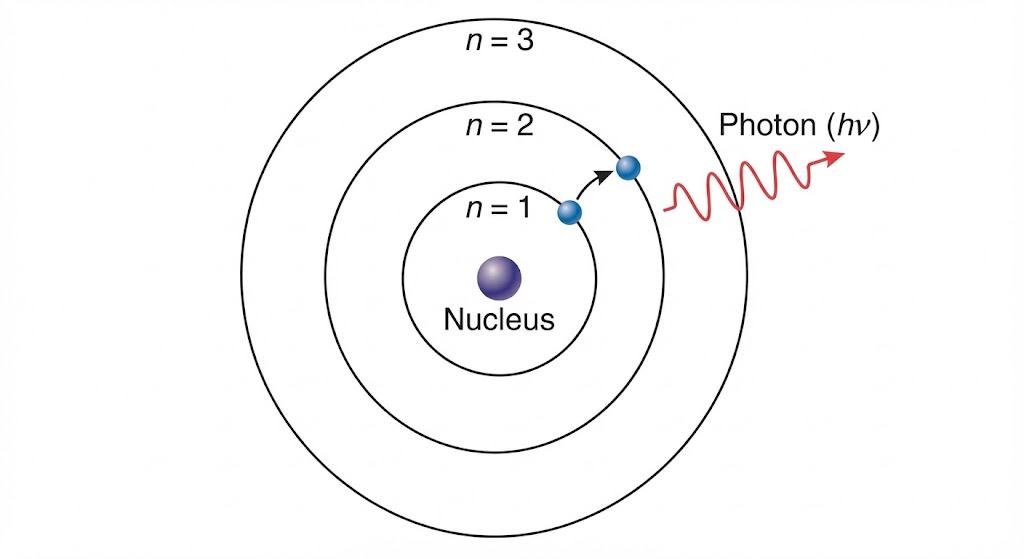
(1) Stationary States
Electrons can only move in specific, **discrete** orbits. In these orbits, electrons orbit without radiating energy.
(2) Quantization of Orbits
The orbital radius is not arbitrary but satisfies specific conditions. For Hydrogen:
$$ r_n = n^2 r_1 $$
* $n = 1, 2, 3...$ is the **Principal Quantum Number**.
* $r_1 = 0.53 \mathring{A}$ (or $0.053 \text{nm}$) is the **Bohr Radius** (Ground State).
* **Rule**: Radii increase in the ratio $1:4:9$.
(3) Energy Levels & Transitions
Atomic energy is also discrete. The energy of the $n$-th level in Hydrogen is:
$$ E_n = \frac{E_1}{n^2} $$
* $E_1 = -13.6 \text{eV}$ (**Ground State Energy**, memorize this).
* $E_{\infty} = 0$ (Ionized State).
* **Rule**: As $n$ increases, energy increases (gets closer to 0), and levels become closer together.
**Frequency Condition (Transition Formula)**:
When an electron jumps between levels, it absorbs or emits a photon with energy equal to the difference:
$$ h\nu = |E_m - E_n| $$
* $E_{\text{high}} \to E_{\text{low}}$: **Emits** photon (Light).
* $E_{\text{low}} \to E_{\text{high}}$: **Absorbs** photon (Requires external energy).
---
3. Hydrogen Spectrum & Energy Level Diagram
Mapping the quantized energies creates an Energy Level Diagram. This is your map for solving problems.
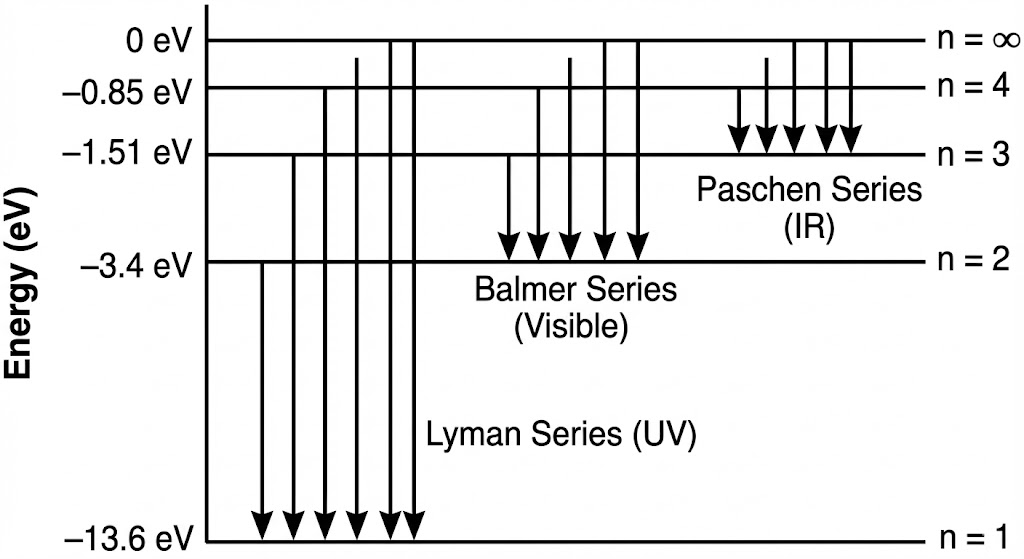
* **Lyman Series**: Transitions down to $n=1$. Emits **Ultraviolet** (High Energy).
* **Balmer Series**: Transitions down to $n=2$. Emits **Visible Light**.
* **Paschen Series**: Transitions down to $n=3$. Emits **Infrared**.
---
4. Problem-Solving Strategies
(1) Counting Transitions
For a group of atoms in state $n$, how many different photon frequencies can be emitted when falling to the ground state?
* **Formula**: Combination $C_n^2 = \frac{n(n-1)}{2}$.
* **Example**: For $n=4$, calculation is $\frac{4 \times 3}{2} = 6$ types.
(2) The 13.6 eV Rule
* **Ionization Energy**: Energy needed to remove an electron from the ground state ($n=1$) to infinity ($n \to \infty$) is $13.6 \text{eV}$.
* **Photon vs. Particle Collision**:
* **Photon Absorption**: Photon energy must **exactly equal** the energy difference (unless ionizing), or it passes through.
* **Electron Collision**: External electron energy just needs to be **greater** than the difference; excess becomes kinetic energy.
(3) Typical Example
**Problem**: Hydrogen atom transitions from $n=3$ to $n=2$.
**Solution**:
1. Find Energy Difference: $\Delta E = E_3 - E_2 = \frac{-13.6}{9} - \frac{-13.6}{4} \approx -1.51 - (-3.40) = 1.89 \text{eV}$.
2. Find Wavelength: $\lambda = \frac{hc}{\Delta E} \approx \frac{1240 \text{eV}\cdot\text{nm}}{1.89 \text{eV}} \approx 656 \text{nm}$.
3. Conclusion: This is red light, part of the Balmer series.