Newton's Laws of Motion and Their Applications
Apply Newton's laws with free-body diagrams, signed force components, and clear system boundaries. Includes horizontal surfaces, inclines, and kinetic friction.
Before planning this topic, check the CSCA Exam Guide 2026 for exam dates, registration, fees, and subject requirements.
Syllabus Alignment
This study guide is organized around the publicly available CSCA syllabus for international undergraduate applicants.
Who It Is For
International students preparing for CSCA Math, Physics, Chemistry, or Chinese exams.
Related Practice
CSCA Practice · Go to questions
Past papers and worked video solutions · Timed mock exams · All subject video lessons
Practice by Topic
Jump from this tutorial to filtered practice questions for the same knowledge point.
Related formulas, concepts, and glossary terms
Physics Formula & Concept Reference
- Newton's Third Law (Action-Reaction Law)
- Newton's First Law (Law of Inertia)
- Maximum Static Friction Formula
- Newton's Second Law (Law of Motion)
- Kinetic Friction Formula
- Law of Universal Gravitation
Physics Exam Glossary
Tutorial Content
Newton's Laws of Motion and Their Applications
Newton's laws connect the forces acting on an object with changes in its motion. Start by choosing the object or system you want to study, then draw its forces. A clear free-body diagram is more useful than trying to select a formula from the wording of the question.
The equations below use an inertial reference frame and the usual constant-mass model of introductory mechanics. Newtonian mechanics is a good approximation for ordinary macroscopic objects moving much more slowly than light.
1. What each law tells you
First law: zero net force means constant velocity
When the net external force is zero, an object remains at rest or continues with constant velocity in a straight line. Forces may still act on it; their vector sum is zero.
Mass measures an object's resistance to acceleration. In this model, inertia is not a force and does not increase just because the object is moving faster.
Second law: use the net force on the same object
The mass, acceleration, and forces must refer to the same chosen object. Resolve the equation along each axis:
Set only when . The vertical direction is not automatically in equilibrium. Also, acceleration need not point in the direction of velocity: a slowing object can have acceleration opposite to its motion.
Third law: paired forces act on different objects
If object A exerts a force on B, B exerts an equal and opposite force on A:
These two forces do not cancel in the free-body diagram of either object, because only one acts on that object. If A and B are treated as one system, the pair is internal and cancels when their force equations are added.
For a book resting on a table, the normal force on the book and its weight can balance, but they are not a third-law pair. The partner of the table's force on the book is the book's force on the table.
2. Build the equations from a free-body diagram
- Choose one object or a clearly defined system.
- Draw only forces acting on it: for example, weight, contact forces, friction, tension, and an applied force. Do not add an extra “force of motion.”
- Choose convenient axes. On a straight incline, axes parallel and perpendicular to the surface often simplify the calculation.
- Resolve each force into signed components.
- Write the net-force equation on each axis and use the stated motion to determine the acceleration components.
3. A block on a horizontal surface
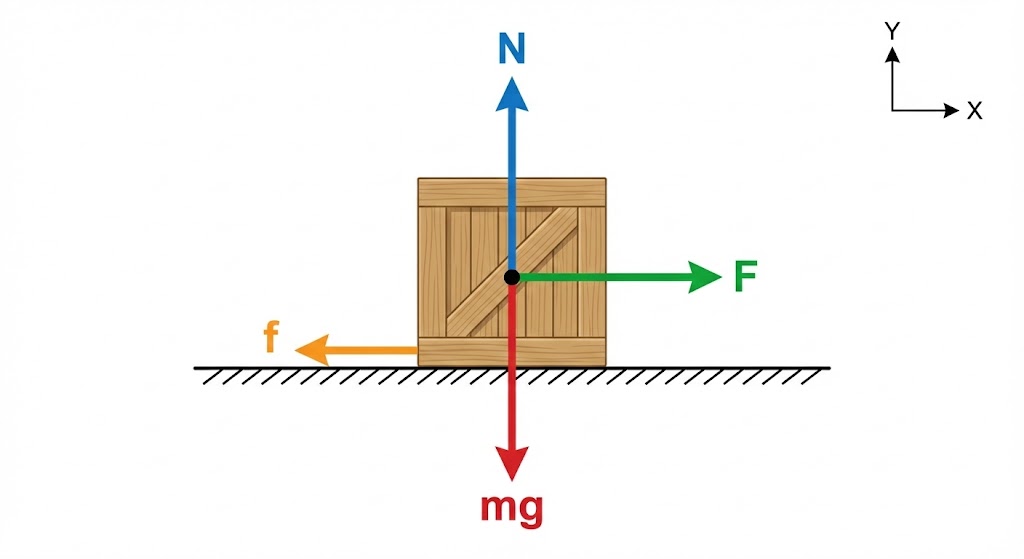
For the horizontal applied force shown, assume the block stays in contact with the surface and has no vertical acceleration. Then
If the block slides to the right, kinetic friction acts leftward and . Static friction is different: its magnitude adjusts as needed up to its limit, .
An angled applied force changes the normal force. With upward positive and the signed vertical component of that force, vertical equilibrium gives
An upward pull reduces ; a downward push increases it. Do not use or without defining the force direction. If the calculated normal force is negative, the assumed contact cannot be maintained.
4. A block on a straight incline
Choose the positive direction down the slope, whose angle to the horizontal is . With no additional force perpendicular to the plane and no acceleration through it,
The component of weight down the slope is . For frictionless motion,
For a block sliding downward with kinetic friction,
This last equation assumes friction acts up the plane. If the block slides upward, friction points down the plane instead.
Worked example: sliding at constant velocity
A block slides down a straight incline at constant velocity. Only gravity, the normal force, and kinetic friction act. Find .
Constant velocity means , so
Cancel and divide by :
Mass cancels in this model. The result describes a block already sliding under the stated forces; it does not determine whether a block initially at rest will start to slide.
Further reading
Content reviewed: 9 September 2026.