Electromagnetic Induction
CSCA Electromagnetic Induction study guide organized around the publicly available CSCA syllabus. Practice Physics questions on aicsca.com.
Before planning this topic, check the CSCA Exam Guide 2026 for exam dates, registration, fees, and subject requirements.
Syllabus Alignment
This study guide is organized around the publicly available CSCA syllabus for international undergraduate applicants.
Who It Is For
International students preparing for CSCA Math, Physics, Chemistry, or Chinese exams.
Related Practice
CSCA Practice · Go to questions
Past papers and worked video solutions · Timed mock exams · All subject video lessons
Practice by Topic
Jump from this tutorial to filtered practice questions for the same knowledge point.
Related formulas, concepts, and glossary terms
Physics Formula & Concept Reference
- Faraday's Law of Electromagnetic Induction (Induced EMF Formula)
- Definition of Magnetic Flux
- Motional EMF Formula (Conductor Cutting Magnetic Field Lines)
- Faraday's Law of Electromagnetic Induction (with Lenz's Law sign)
- Motional Electromotive Force Formula
- Induced EMF for an N-turn Coil
- Definition of Magnetic Flux
- Statement of Lenz's Law
Physics Exam Glossary
Tutorial Content
Topic: Electromagnetism > Electromagnetic Induction
1. Core Concept: Magnetism produces Electricity
**Electromagnetic Induction** is the phenomenon where an electric current (induced current) is generated in a closed circuit whenever the **magnetic flux through it changes**.
**CSCA Exam Focus**:
* **Condition**: Key is $\Delta \Phi \neq 0$ (Change in Flux).
* **Two Fundamental Laws**:
1. **Faraday's Law**: Calculates Magnitude (How much?).
2. **Lenz's Law**: Determines Direction (Which direction?).
---
2. Quantitative Calculation: Faraday's Law
(1) Flux Change Type
General case where magnetic field or area changes.
$$ \mathcal{E} = N \frac{\Delta \Phi}{\Delta t} $$
* $\mathcal{E}$: Induced EMF (V).
* $N$: Number of turns.
* $\frac{\Delta \Phi}{\Delta t}$: **Rate of change** of flux (Wb/s).
(2) Cutting Magnetic Lines Type
Conductor moving through a magnetic field.
$$ \mathcal{E} = B L v \sin\theta $$
* $L$: **Effective cutting length** (m).
* $v$: Relative velocity (m/s).
* $\theta$: Angle between velocity $\vec{v}$ and field $\vec{B}$.
* **$v \perp B$ ($\\theta=90^\circ$)**:$\mathcal{E} = BLv$ (**Most Common**).
* **$v \parallel B$ ($\\theta=0^\circ$)**:$\mathcal{E} = 0$ (No cutting).
---
3. Direction Judgment: Lenz's Law & Right-Hand Rule
Be sure to distinguish which hand to use for "Force" vs. "Current"!
| Rule | Usage | Scenario |
| :--- | :--- | :--- |
| **Lenz's Law** | Direction of Induced Current | General (Flux Change) |
| **Right-Hand Rule** | Direction of Induced Current | **Cutting Lines ONLY** |
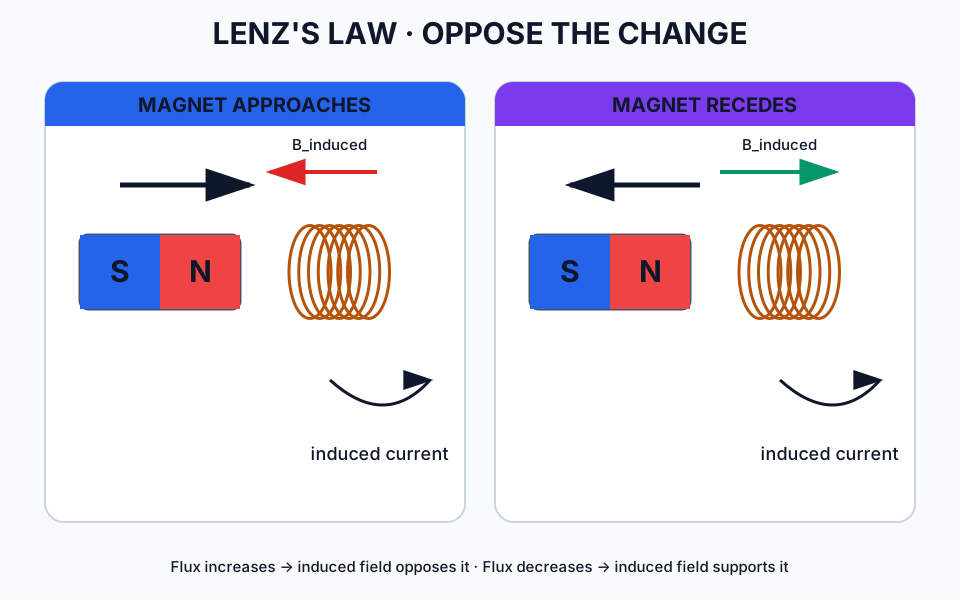
(1) The "Opposition" Philosophy of Lenz's Law
**Key Mnemonic: Increase-Oppose, Decrease-Same**.
* **Increase**: Original flux $\uparrow$ $\rightarrow$ Induced B-field **Opposite** to Original B (Oppose increase).
* **Decrease**: Original flux $\downarrow$ $\rightarrow$ Induced B-field **Same** as Original B (Oppose decrease).
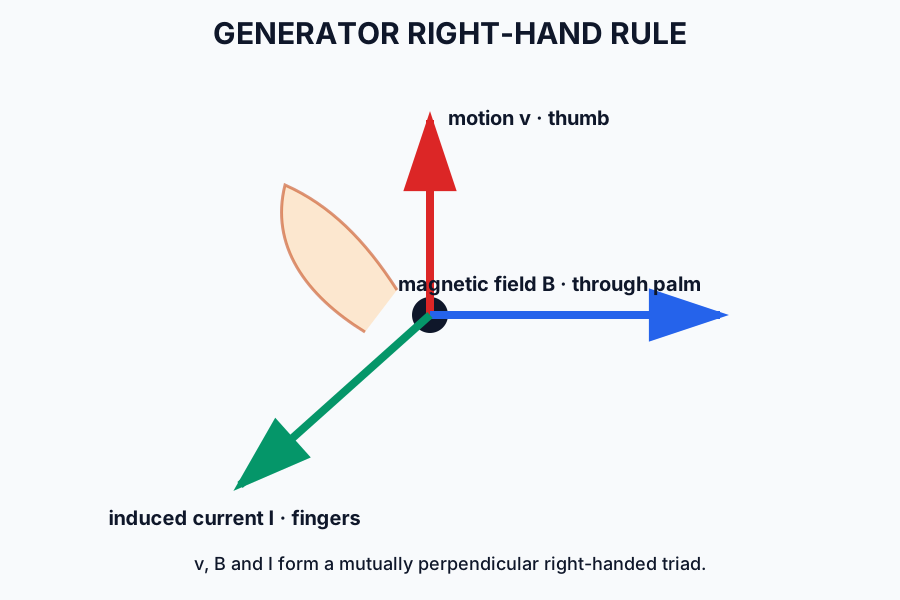
(2) Right-Hand Rule (Generator Rule)
**Open Right Hand**:
* Magnetic Field ($B$) **pierces palm**.
* **Thumb** points to **Motion** ($v$).
* **Fingers** point to **Induced Current** ($I$).
**Tip**: **Left-Force, Right-Electricity**. Use Left Hand for Forces (Motors), Right Hand for Induction (Generators).
---
4. Typical Examples
**Example 1: Faraday's Law**
**Problem**: A 100-turn coil, area $0.1 m^2$, perpendicular to B-field. B increases from $0.1T$ to $0.5T$ in $2s$. Find EMF.
**Solution**:
$$ \mathcal{E} = N \frac{\Delta \Phi}{\Delta t} = N \frac{(B_2 - B_1)S}{\Delta t} $$
$$ \mathcal{E} = 100 \times \frac{(0.5 - 0.1) \times 0.1}{2} = 100 \times \frac{0.04}{2} = 2 V $$
**Example 2: Lenz's Law**
**Problem**: A bar magnet (N pole down) is dropped into a coil. Viewed from above, is the induced current clockwise or counter-clockwise?
**Solution**:
1. **Original B**: Down (N pole).
2. **Change**: Magnet enters $\rightarrow$ Downward flux **Increases**.
3. **Oppose**: Induced B must be **Up** (Opposite).
4. **Rule**: Right-Hand Grip Rule, Thumb Up $\rightarrow$ Fingers **Counter-Clockwise**.
**Answer**: Counter-Clockwise.
**Example 3: Cutting Lines & Force**
**Problem**: Wire $L=0.5m$ moves at $v=4m/s$ perpendicular to $B=0.5T$. Resistance $R=0.2\Omega$. Find: (1) EMF; (2) Current; (3) Pulling Force for constant speed.
**Solution**:
(1) $\mathcal{E} = BLv = 0.5 \times 0.5 \times 4 = 1 V$.
(2) $I = \mathcal{E}/R = 1 / 0.2 = 5 A$.
(3) Ampere's Force $F_A = BIL = 0.5 \times 5 \times 0.5 = 1.25 N$.
Constant speed $\rightarrow$ Pulling Force $F_{pull} = F_A = 1.25 N$.
---
5. CSCA Common Pitfalls
1. **Flux Calculation**: In $\Phi = BS \cos\theta$, $\theta$ is the angle between the **Normal** and B-field. If given angle $\alpha$ between Coil Plane and B, use $\sin\alpha$.
2. **EMF vs Current**: Cutting lines always creates EMF (like a battery), but Current flows only if the circuit is **closed**.
3. **Right Hand vs Left Hand**:
* Find **Induced EMF/Current** (Generator) $\rightarrow$ **Right Hand**.
* Find **Magnetic Force/Motion** (Motor) $\rightarrow$ **Left Hand**.