Kinematics
CSCA Kinematics study guide organized around the publicly available CSCA syllabus. Practice Physics questions on aicsca.com.
Before planning this topic, check the CSCA Exam Guide 2026 for exam dates, registration, fees, and subject requirements.
Syllabus Alignment
This study guide is organized around the publicly available CSCA syllabus for international undergraduate applicants.
Who It Is For
International students preparing for CSCA Math, Physics, Chemistry, or Chinese exams.
Related Practice
CSCA Practice · Go to questions
Past papers and worked video solutions · Timed mock exams · All subject video lessons
Practice by Topic
Jump from this tutorial to filtered practice questions for the same knowledge point.
Related formulas, concepts, and glossary terms
Physics Formula & Concept Reference
- Displacement formula for uniformly accelerated rectilinear motion (time-independent)
- Average velocity formula for uniformly accelerated rectilinear motion
- Velocity formula for uniformly accelerated rectilinear motion
- Displacement formula for uniformly accelerated rectilinear motion (without final velocity)
- Average Velocity Formula
- Definition of Instantaneous Velocity
- Difference Between Average Speed and Average Velocity
- Definition of Average Velocity
Physics Exam Glossary
Tutorial Content
Kinematics
1. Core Concepts & Models
Kinematics is the foundation of mechanics. It describes **how** objects move (position, velocity over time) without considering **why** (forces).
* **Particle Model**: An idealized object with mass but no size/shape. This simplification is valid when the object's size is negligible compared to the travel distance.
2. Three Core Physical Quantities
For the CSCA exam, you must strictly distinguish between Scalars and Vectors.
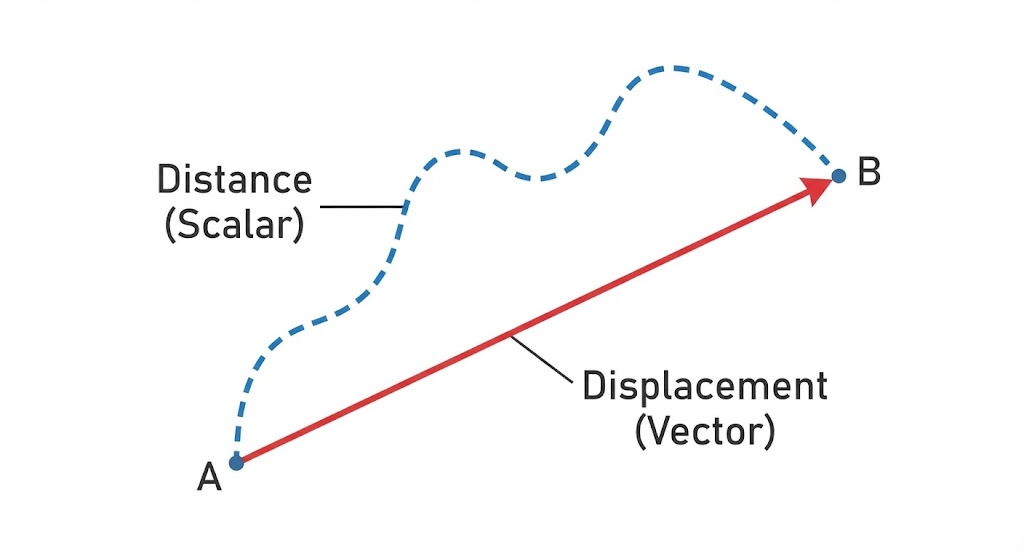
* **Displacement ($\vec{x}$ or $\vec{s}$)**:
* **Definition**: The vector pointing from the initial position to the final position.
* **Vs. Distance**: Distance is the total length of the path traveled. **Displacement depends only on start and end points; Distance depends on the path.**
* 
* **Velocity ($\vec{v}$)**:
* **Definition**: Rate of change of displacement ($v = \frac{dx}{dt}$).
* **Vs. Speed**: Speed is a scalar (Rate of change of distance).
* **Acceleration ($\vec{a}$)**:
* **Definition**: Rate of change of velocity ($a = \frac{dv}{dt}$).
3. Uniformly Accelerated Rectilinear Motion (UARM)
This is the most frequent topic. The prerequisite is that **Acceleration ($a$) is constant**.
#### A. The SUVAT Equations
Memorize these four equations and choose the right one based on known variables:
1. **Velocity-Time**: $$ v = v_0 + at $$
2. **Displacement-Time**: $$ x = v_0 t + \frac{1}{2}at^2 $$
3. **Velocity-Displacement** (No time $t$): $$ v^2 - v_0^2 = 2ax $$
4. **Average Velocity**: $$ \bar{v} = \frac{v_0 + v}{2} = \frac{x}{t} $$
#### B. Graphical Analysis
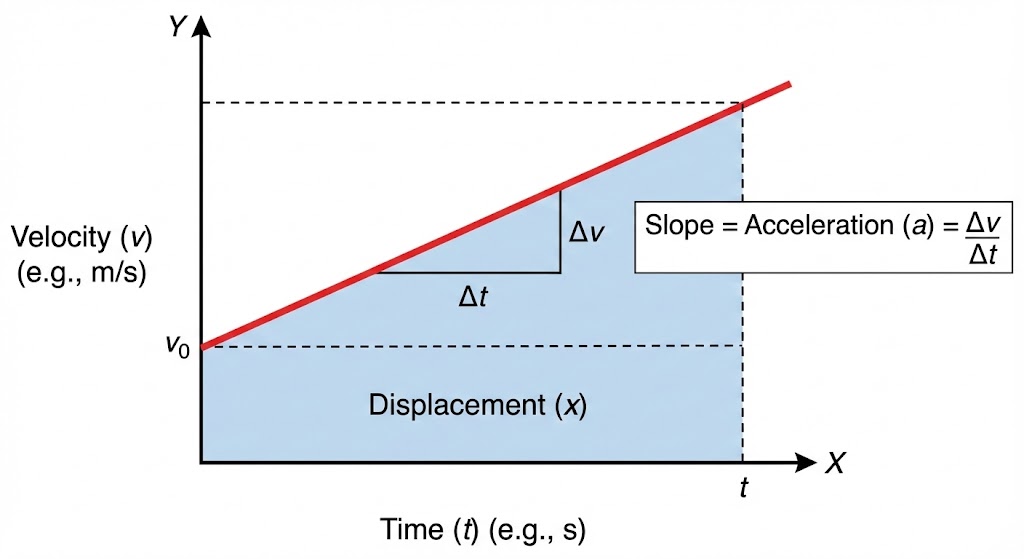
Graphs are shortcuts for solving problems, especially the **Velocity-Time (v-t) graph**:
* **Slope**: Represents Acceleration ($a$).
* **Area**: The area under the curve represents Displacement ($x$).
4. Typical Models & Traps
**Example: The Braking Trap**
A car travels at $20 \, \text{m/s}$ and brakes with an acceleration of $-4 \, \text{m/s}^2$. Find the displacement in the first $6 \, \text{s}$.
**Solution Strategy**:
1. **Check Stop Time**: Always calculate how long it takes to stop first.
$$ t_{stop} = \frac{0 - v_0}{a} = \frac{0 - 20}{-4} = 5 \, \text{s} $$
2. **Compare**: The question asks for $6 \, \text{s}$. Since $6 \, \text{s} > 5 \, \text{s}$, the car stops at $5 \, \text{s}$ and stays still for the last second.
3. **Calculate**: Calculate displacement for $5 \, \text{s}$ (not 6).
$$ x = \frac{v_0 + 0}{2} \cdot t_{stop} = \frac{20}{2} \times 5 = 50 \, \text{m} $$
*(Plugging in $t=6$ directly gives the incorrect answer of $48m$)*
5. Exam Tips
* **Sign Convention**: Always define a positive direction first (usually the direction of initial velocity). If speeding up, $a$ is positive; if slowing down, $a$ is negative.
* **Multi-stage Motion**: The final velocity of the first stage is the initial velocity of the second stage. This is the bridge connecting different parts of a problem.