Fundamentals of Nuclear Physics
CSCA Fundamentals of Nuclear Physics study guide organized around the publicly available CSCA syllabus. Practice Physics questions on aicsca.com.
Before planning this topic, check the CSCA Exam Guide 2026 for exam dates, registration, fees, and subject requirements.
Syllabus Alignment
This study guide is organized around the publicly available CSCA syllabus for international undergraduate applicants.
Who It Is For
International students preparing for CSCA Math, Physics, Chemistry, or Chinese exams.
Related Practice
CSCA Practice · Go to questions
Past papers and worked video solutions · Timed mock exams · All subject video lessons
Practice by Topic
Jump from this tutorial to filtered practice questions for the same knowledge point.
Related formulas, concepts, and glossary terms
Physics Formula & Concept Reference
- Average Binding Energy (Binding Energy per Nucleon)
- Einstein's Mass-Energy Equivalence
- Nuclear Binding Energy Formula
- Relationship between Half-life and Decay Constant
- Average Binding Energy per Nucleon (Specific Binding Energy)
- Law of Radioactive Decay
Physics Exam Glossary
Tutorial Content
Modern Physics: Fundamentals of Nuclear Physics
1. Composition of the Nucleus
The nucleus consists of **Nucleons**, which are **Protons** and **Neutrons**.
**Notation**:
$$_Z^A\text{X}$$
* **$X$**: Element symbol.
* **$Z$**: **Proton Number** (Atomic Number). Determines chemical properties.
* **$A$**: **Mass Number**. $A = Z + N$ (where $N$ is Neutron Number).
**Isotopes**: Nuclei with same $Z$ but different $N$ (e.g., $^{1}\text{H}, ^{2}\text{H}, ^{3}\text{H}$).
---
2. Radioactive Decay
Exams often test the properties of three types of rays and their deflection in magnetic fields.
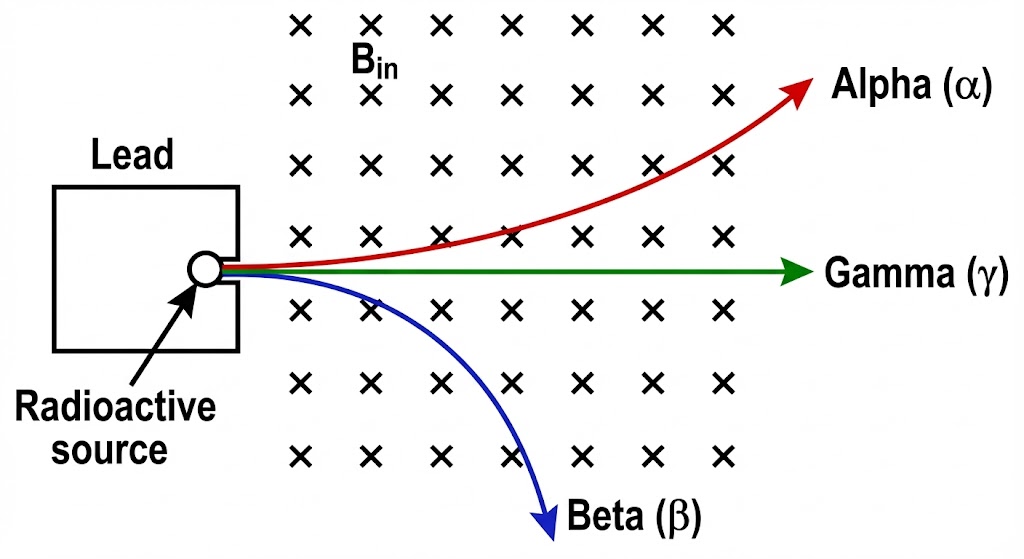
(1) Types of Decay
| Type | Symbol | Nature | Charge | Penetration | Equation Example |
| :--- | :--- | :--- | :--- | :--- | :--- |
| **$\alpha$ Decay** | $_2^4\text{He}$ | Helium Nuclei | $+2e$ | Weak (Paper) | $_Z^A\text{X} \rightarrow _{Z-2}^{A-4}\text{Y} + _2^4\text{He}$ |
| **$\beta$ Decay** | $_{-1}^0\text{e}$ | Fast Electrons | $-1e$ | Medium (Aluminum) | $_Z^A\text{X} \rightarrow _{Z+1}^{A}\text{Y} + _{-1}^0\text{e}$ |
| **$\gamma$ Decay** | $\gamma$ | High Energy Photon | $0$ | Strong (Lead) | Accompanies $\alpha$ or $\beta$, no change in $A, Z$ |
**Notes**:
* The mechanism of $\beta$ decay is a **neutron** converting into a **proton** and an **electron**: $_0^1\text{n} \rightarrow _1^1\text{p} + _{-1}^0\text{e}$.
* In a magnetic field, $\alpha$ and $\beta$ deflect in opposite directions (Lorentz force), while $\gamma$ goes straight. $\beta$ usually has a smaller radius of curvature due to its tiny mass.
(2) Half-life ($T$)
The time required for half the nuclei to decay. **Independent of temperature, pressure, or chemical state**.
**Formula**:
$$ N = N_0 \left( \frac{1}{2} \right)^{\frac{t}{T}} $$
Or using mass: $m = m_0 (1/2)^{t/T}$.
---
3. Nuclear Reactions & Conservation Laws
All nuclear reactions (decay, fission, fusion) must obey two conservation laws:
1. **Conservation of Mass Number** (Sum of superscripts stays constant).
2. **Conservation of Charge Number** (Sum of subscripts stays constant).
**Exam Tip**:
Set the unknown particle as $_Z^A\text{X}$ and solve simple linear equations for $A$ and $Z$.
---
4. Nuclear Energy & Mass-Energy Equation
(1) Mass-Energy Equivalence
$$ E = mc^2 $$
Change in energy: $\Delta E = \Delta m c^2$.
(2) Mass Defect ($\Delta m$)
The mass of a nucleus is always **less** than the sum of its constituent nucleons. The difference becomes **Binding Energy**.
$$ \Delta m = (Z m_p + N m_n) - m_{\text{nucleus}} $$
(3) Specific Binding Energy ($\epsilon$)
Also called **Average Binding Energy per Nucleon**: $\epsilon = \frac{\Delta E}{A}$.
* Higher $\epsilon$ means the nucleus is more **stable**.
* Nuclei near **Iron ($^{56}\text{Fe}$)** have the highest $\epsilon$ (most stable).
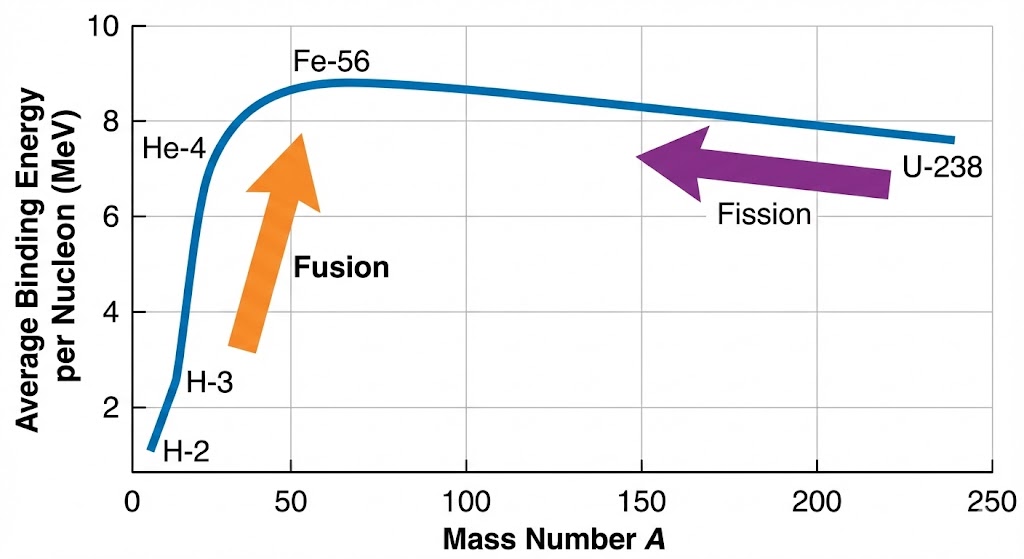
* **Fission**: Heavy nuclei (U) split into medium nuclei. $\epsilon$ increases $\rightarrow$ **Energy Released**.
* **Fusion**: Light nuclei (H) combine into heavier nuclei. $\epsilon$ increases drastically $\rightarrow$ **Energy Released**.
(4) Calculation Shortcut (Crucial for CSCA)
When mass defect is given in **atomic mass units (u)**, use:
$$ \Delta E (\text{MeV}) = \Delta m (\text{u}) \times 931.5 $$
This is much faster than using kg and $c^2$.