First Law of Thermodynamics
CSCA First Law of Thermodynamics study guide organized around the publicly available CSCA syllabus. Practice Physics questions on aicsca.com.
Before planning this topic, check the CSCA Exam Guide 2026 for exam dates, registration, fees, and subject requirements.
Syllabus Alignment
This study guide is organized around the publicly available CSCA syllabus for international undergraduate applicants.
Who It Is For
International students preparing for CSCA Math, Physics, Chemistry, or Chinese exams.
Related Practice
CSCA Practice · Go to questions
Past papers and worked video solutions · Timed mock exams · All subject video lessons
Practice by Topic
Jump from this tutorial to filtered practice questions for the same knowledge point.
Related formulas, concepts, and glossary terms
Physics Formula & Concept Reference
- For an isothermal process of an ideal gas, what is the form of the First Law of Thermodynamics?
- For an isobaric process of an ideal gas, what is the form of the First Law of Thermodynamics?
- In a quasi-static process, what is the expression for work in the First Law of Thermodynamics?
- For an isochoric process, what is the expression of the First Law of Thermodynamics?
- What is the formula for the change in internal energy of an ideal gas?
- For an isobaric process, what are the expressions of the First Law and the enthalpy change?
- For an adiabatic process, what is the form of the First Law of Thermodynamics?
- What is the mathematical expression of the First Law of Thermodynamics?
Physics Exam Glossary
Tutorial Content
First Law of Thermodynamics
1. Core Concepts & Sign Convention
The First Law of Thermodynamics is essentially the **Law of Conservation of Energy** applied to thermal processes. For a system (like gas in a cylinder), the change in internal energy $\Delta U$ equals the sum of heat $Q$ supplied to the system and work $W$ done *on* the system.
**Formula**:
$$ \Delta U = Q + W $$
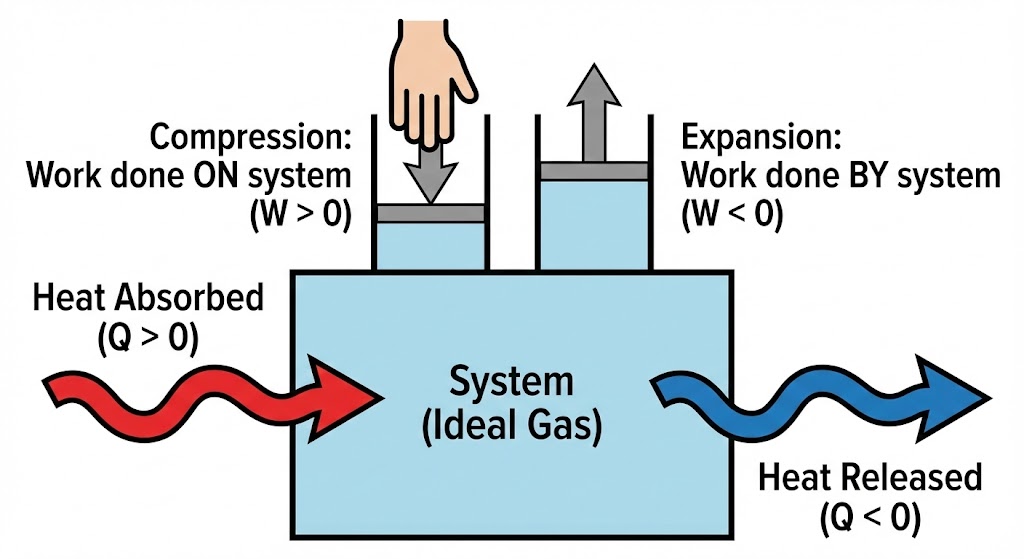
**The sign convention is the most common pitfall. Memorize this with the diagram below:**
* **$\{Q\}$ (Heat)**:
* **Absorbed** (Heat In): System gains energy $\rightarrow Q > 0$
* **Released** (Heat Out): System loses energy $\rightarrow Q < 0$
* **$\{W\}$ (Work)**:
* **Work done ON gas** (Compression): System gains energy $\rightarrow W > 0$
* **Work done BY gas** (Expansion): System spends energy $\rightarrow W < 0$
* **$\{\Delta U\}$ (Internal Energy)**:
* Increase $\rightarrow \Delta U > 0$
* Decrease $\rightarrow \Delta U < 0$
2. Judgment Criteria for Variables
For Ideal Gases (common in CSCA exams), follow this sequence:
1. **Internal Energy $\Delta U$** $\rightarrow$ **Check Temperature $T$**
* Depends ONLY on Temperature. $T \uparrow \Rightarrow \Delta U > 0$; $T \downarrow \Rightarrow \Delta U < 0$; Isothermal $\Rightarrow \Delta U = 0$.
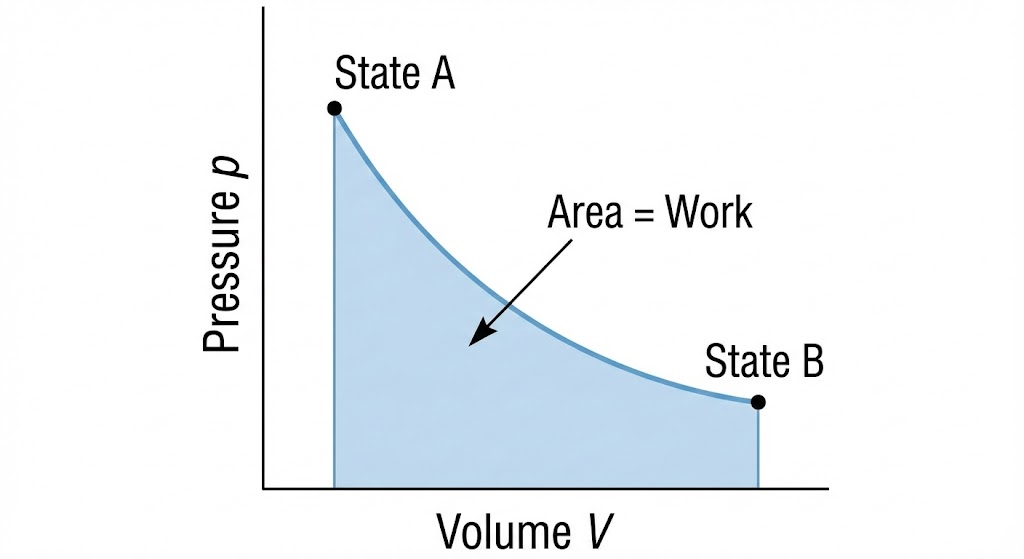
2. **Work $W$** $\rightarrow$ **Check Volume $V$**
* $V$ decreases (Compression) $\Rightarrow$ Work done ON gas ($W > 0$).
* $V$ increases (Expansion) $\Rightarrow$ Work done BY gas ($W < 0$).
* $V$ constant $\Rightarrow W = 0$.
* **Graphical Method**: The **Area** under the curve in a $p-V$ diagram represents the magnitude of Work.
3. **Heat $Q$** $\rightarrow$ **Calculate Last**
* Usually calculated using the law: $Q = \Delta U - W$.
* Exception: Adiabatic process $Q=0$.
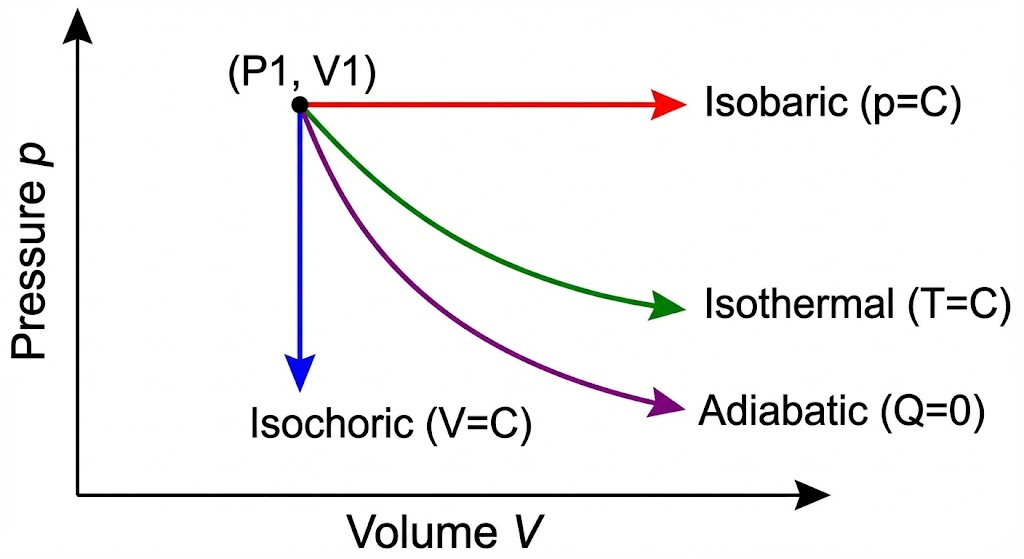
3. Summary of Special Processes
| Process | Condition | $\Delta U$ | $W$ (Work on gas) | $Q$ (Heat In) | Energy Conversion |
| :--- | :--- | :--- | :--- | :--- | :--- |
| **Isochoric** | Const $V$ ($W=0$) | $\Delta U > 0$ (if heating) | $0$ | $Q = \Delta U$ | Heat entirely increases Internal Energy |
| **Isothermal**| Const $T$ ($\Delta U=0$) | $0$ | $W < 0$ (Expansion) | $Q = -W$ | Heat entirely converted to Work Out |
| **Adiabatic** | No Heat ($Q=0$) | $\Delta U = W$ | $W > 0$ (Compression) | $0$ | Work done on gas increases Internal Energy (T rises) |
| **Isobaric** | Const $p$ | $\Delta U \propto \Delta T$ | $W = -p\Delta V$ | $Q = \Delta U - W$ | Mixed conversion |
4. Typical Examples
**Example 1: Qualitative Analysis**
An ideal gas undergoes an **Adiabatic Expansion**. How does its temperature change?
**Solution**:
1. **Adiabatic** $\Rightarrow Q = 0$.
2. **Expansion** $\Rightarrow$ Gas does work, so Work done *on* gas is negative ($W < 0$).
3. From $\Delta U = Q + W = 0 + W < 0$, Internal Energy decreases.
4. For ideal gases, decreased Internal Energy means Temperature **drops**.
**Example 2: Quantitative Calculation**
2 moles of monatomic ideal gas at initial temperature $300 \text{K}$ expand isobarically to double their volume. Find the heat $Q$ absorbed. (Given $C_{V,m} = \frac{3}{2}R$)
**Solution**:
1. **Process**: Isobaric, $V_2 = 2V_1$. From $V_1/T_1 = V_2/T_2$, we get $T_2 = 2T_1 = 600 \text{K}$, so $\Delta T = 300 \text{K}$.
2. **Find $\Delta U$**: $\Delta U = \nu C_{V,m} \Delta T = 2 \times \frac{3}{2}R \times 300 = 900R$.
3. **Find $W$**: Work done BY gas $W' = p\Delta V = \nu R \Delta T = 2R \times 300 = 600R$. Thus work ON gas $W = -600R$.
4. **Find $Q$**: Using $Q = \Delta U - W$.
$Q = 900R - (-600R) = 1500R$.
With $R \approx 8.31$, $Q \approx 12465 \text{J}$.