Faraday's Law
CSCA Faraday's Law study guide organized around the publicly available CSCA syllabus. Practice Physics questions on aicsca.com.
Before planning this topic, check the CSCA Exam Guide 2026 for exam dates, registration, fees, and subject requirements.
Syllabus Alignment
This study guide is organized around the publicly available CSCA syllabus for international undergraduate applicants.
Who It Is For
International students preparing for CSCA Math, Physics, Chemistry, or Chinese exams.
Related Practice
CSCA Practice · Go to questions
Past papers and worked video solutions · Timed mock exams · All subject video lessons
Practice by Topic
Jump from this tutorial to filtered practice questions for the same knowledge point.
Related formulas, concepts, and glossary terms
Physics Formula & Concept Reference
- Definition of Magnetic Flux
- Motional Electromotive Force Formula
- Faraday's Law of Electromagnetic Induction
Physics Exam Glossary
Tutorial Content
Topic: Electromagnetism > Electromagnetic Induction > Faraday's Law
1. Core Formulas
Faraday's Law solves the problem of "**Magnitude of Induced EMF**".
(1) General Formula (Flux Change)
Applies to all induction phenomena, calculates **Average EMF**.
$$ \mathcal{E} = N \frac{\Delta \Phi}{\Delta t} $$
* $\mathcal{E}$: Induced EMF (V).
* $N$: Number of turns (**Don't forget to multiply by N!**).
* $\frac{\Delta \Phi}{\Delta t}$: Rate of change of flux.
**Tip**: For magnitude calculations, ignore the negative sign. Use Lenz's Law for direction.
(2) Cutting Formula (Motional EMF)
Applies to conductors cutting magnetic lines, calculates **Instantaneous EMF**.
$$ \mathcal{E} = B L v \sin\theta $$
* **$L$**: **Effective Length** (m).
* *Curved wire*: Straight line distance between ends.
* **$v$**: Relative velocity (m/s).
* **$\theta$**: Angle between $v$ and $B$.
* Most common ($v \perp B, L \perp B, v \perp L$): **$\mathcal{E} = BLv$**.
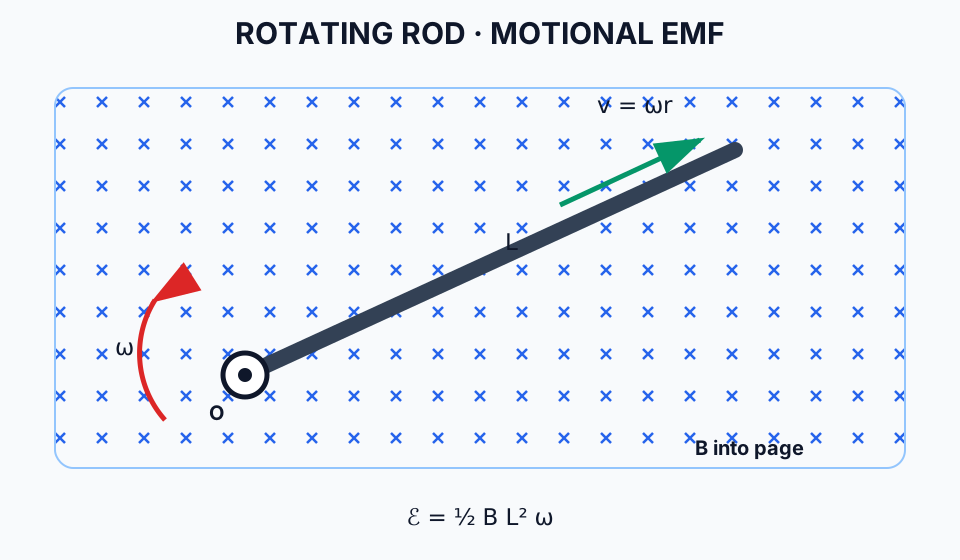
(3) Rotational Cutting Formula (Extension)
A rod rotating around one end in a perpendicular field.
$$ \mathcal{E} = \frac{1}{2} B L^2 \omega $$
* $\omega$: Angular velocity (rad/s).
* *Derivation*: Using average velocity $\bar{v} = \frac{0 + \omega L}{2}$ in $BL\bar{v}$.
---
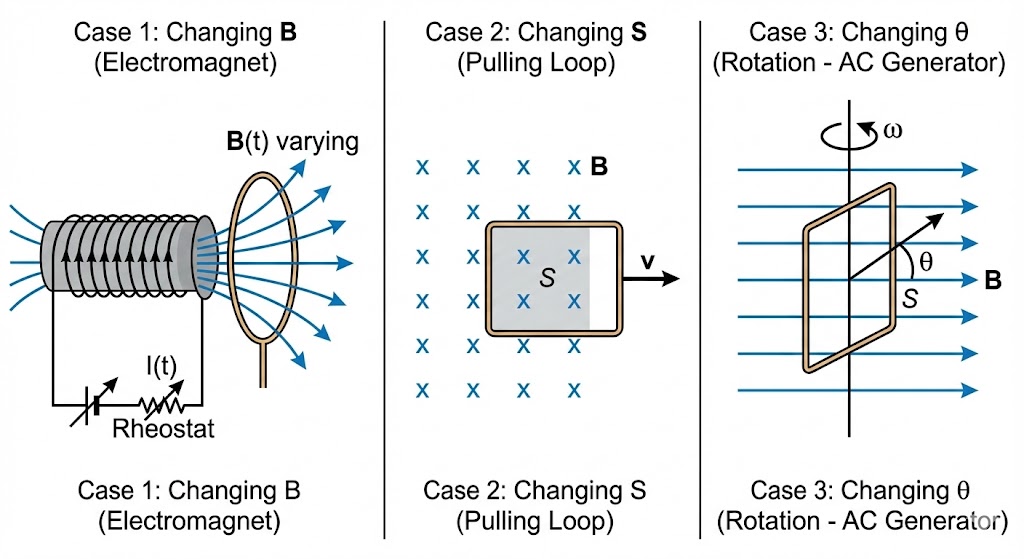
2. Three Models for $\Delta \Phi$
Determined by $\Phi = B S \cos\theta$:
1. **B changes, S constant**:
$$ \mathcal{E} = N S \frac{\Delta B}{\Delta t} $$
* *Graph Problem*: $\frac{\Delta B}{\Delta t}$ is the **Slope** of the B-t graph.
2. **S changes, B constant**:
$$ \mathcal{E} = N B \frac{\Delta S}{\Delta t} $$
3. **$\theta$ changes (Rotation)** (AC Generator):
Produces Sine wave. Instantaneous $\mathcal{E} = NBS\omega \sin(\omega t)$.
---
3. Typical Examples
**Example 1: B-t Graph (Slope Method)**
**Problem**: Coil $N=100$, Area $S=0.1 m^2$. B decreases uniformly from 2T to 0T in 2s. Find EMF.
**Solution**:
1. **Model**: S constant, B changes.
2. **Slope**: $\frac{\Delta B}{\Delta t} = 1 T/s$ (magnitude).
3. **Calc**:
$$ \mathcal{E} = N S \left| \frac{\Delta B}{\Delta t} \right| = 100 \times 0.1 \times 1 = 10 V $$
**Example 2: Rotating Coil (Average vs Max)**
**Problem**: A coil rotates from "Neutral Plane" ($\perp$ B) by $90^\circ$ to Parallel position.
(1) Find Average EMF $\bar{\mathcal{E}}$.
(2) Find Instantaneous EMF at the end $\mathcal{E}_{max}$.
**Solution**:
* **Average**: Use Faraday's Law.
$\Delta \Phi = BS - 0 = BS$. Time $\Delta t = \frac{\pi/2}{\omega}$.
$$ \bar{\mathcal{E}} = N \frac{BS}{\pi/2 / \omega} = \frac{2NBS\omega}{\pi} $$
* **Instantaneous** (Max): Use $NBS\omega$.
At parallel, cutting speed is max, $\mathcal{E}_{max} = NBS\omega$.
* **Note**: Distinguish between Average and Instantaneous requests!
**Example 3: Rotational Cutting (Rod)**
**Problem**: Rod $L=1m$, fixed at one end, rotates at $\omega=2 rad/s$ in $B=0.5T$. Find Voltage.
**Solution**:
$$ \mathcal{E} = \frac{1}{2} B L^2 \omega = 0.5 \times 0.5 \times 1^2 \times 2 = 0.5 V $$
---
4. CSCA Common Pitfalls
1. **Units**: Convert $cm^2$ to $10^{-4} m^2$ immediately!
2. **Turns N**: Look for "coil" vs "single loop". Don't miss multiplying by $N$.
3. **Effective Area S**: If coil radius $r >$ Magnetic field radius $R$, use the **smaller area** ($\pi R^2$) for flux calculation.