Interference
CSCA Interference study guide organized around the publicly available CSCA syllabus. Practice Physics questions on aicsca.com.
Before planning this topic, check the CSCA Exam Guide 2026 for exam dates, registration, fees, and subject requirements.
Syllabus Alignment
This study guide is organized around the publicly available CSCA syllabus for international undergraduate applicants.
Who It Is For
International students preparing for CSCA Math, Physics, Chemistry, or Chinese exams.
Related Practice
CSCA Practice · Go to questions
Past papers and worked video solutions · Timed mock exams · All subject video lessons
Practice by Topic
Jump from this tutorial to filtered practice questions for the same knowledge point.
Related formulas, concepts, and glossary terms
Physics Formula & Concept Reference
- Bright Fringe Condition for Young's Double-Slit Interference
- Optical Path Difference Formula for Thin-Film Interference (Equal Thickness Interference)
- Optical Path Difference for Thin-Film Interference (Normal Incidence)
- General Condition for Constructive Interference (Bright Fringe)
- Dark Fringe Condition for Young's Double-Slit Interference
- General Condition for Destructive Interference (Dark Fringe)
- Relationship between Optical Path Difference and Phase Difference
- Fringe Spacing Formula (Young's Double-Slit)
Physics Exam Glossary
Tutorial Content
Topic: Optics > Physical Optics > Interference
Interference
1. Conceptual Definition
Interference is the core of wave optics, referring to the phenomenon where two or more **coherent waves** superimpose in space to form stable patterns of bright and dark fringes.
**Key Exam Point: Coherence Conditions**
To produce stable interference, light sources must satisfy three conditions:
1. **Same Frequency** ($f_1 = f_2$)
2. **Same Vibration Direction**
3. **Constant Phase Difference**
2. Core Principles & Formulas
#### A. Optical Path Difference (OPD)
In physical optics, distance is not just geometry; the refractive index matters.
* **Optical Path (L)**: $L = n \cdot l$ (Refractive Index $\times$ Geometric Path).
* **Optical Path Difference ($\delta$)**: The difference in optical paths between two coherent beams, $\delta = L_2 - L_1$.
#### B. Conditions for Maxima/Minima
* **Constructive Interference (Bright)**: OPD is an integer multiple of the wavelength.
$$\delta = k\lambda \quad (k=0, \pm 1, \pm 2...)$$
* **Destructive Interference (Dark)**: OPD is an odd multiple of half-wavelengths.
$$\delta = (k + 0.5)\lambda \quad (k=0, \pm 1, \pm 2...)$$
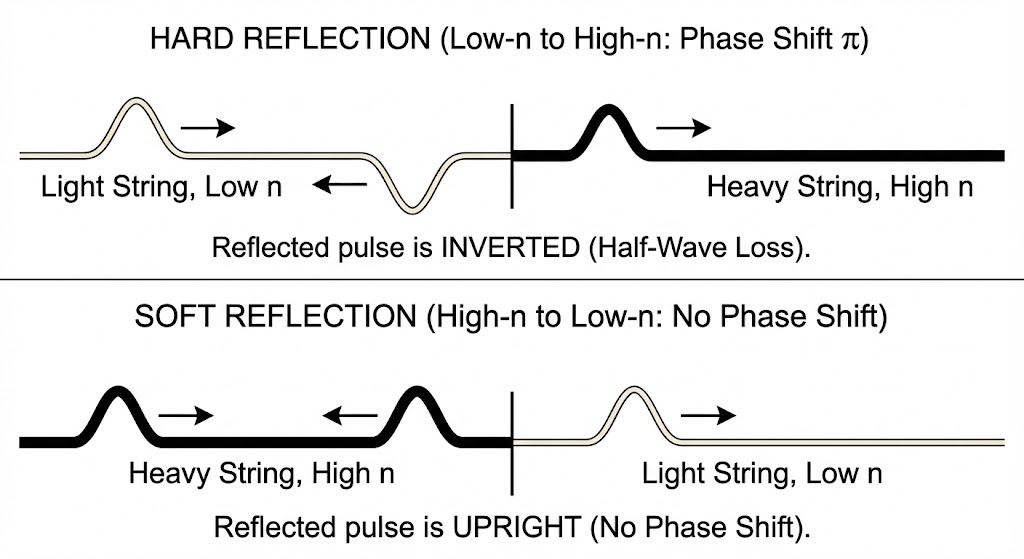
#### C. Half-Wave Loss (Phase Change upon Reflection)
**Most Common Trap!**
When light reflects from a **Rarer Medium** ($low \, n$) off a **Denser Medium** ($high \, n$), the phase shifts by $\pi$, effectively adding $\frac{\lambda}{2}$ to the optical path.
* **Rule**: Low $n$ $\to$ High $n$ reflection = Half-Wave Loss.
* **Note**: Transmitted light never suffers half-wave loss.
3. Typical Models
#### Model 1: Young's Double Slit
Interference by Wavefront Splitting.
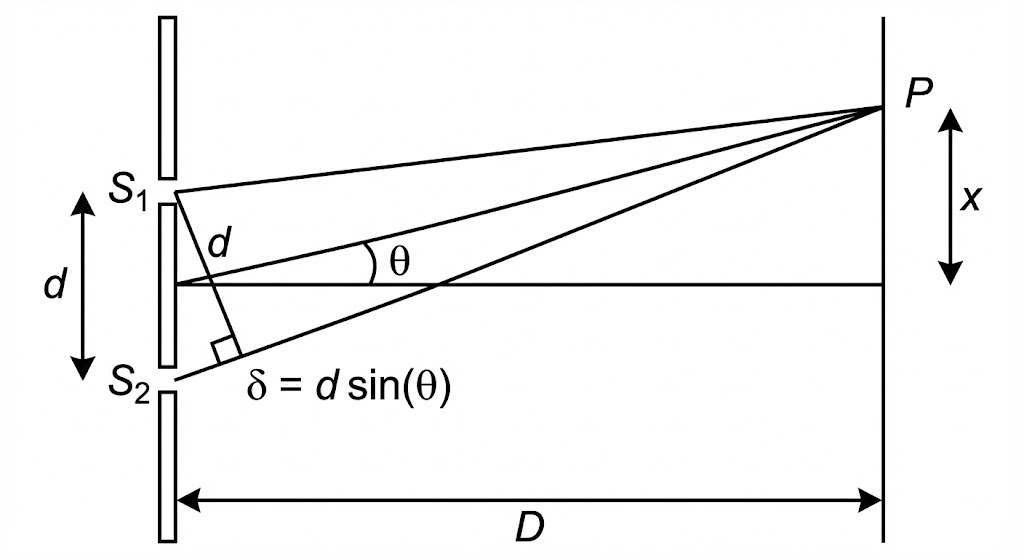
* **Geometric Relation**: $\delta \approx d \sin\theta \approx d \frac{x}{D}$.
* **Fringe Spacing Formula**:
$$\Delta x = \frac{D\lambda}{d}$$
($D$: Distance to screen, $d$: Slit separation, $\lambda$: Wavelength).
#### Model 2: Thin Film Interference
Interference by Amplitude Splitting (e.g., soap bubbles, anti-reflective coatings).
* **OPD Formula**:
$$\delta = 2n_2 e \pm \frac{\lambda}{2} \quad (\text{Depends on Half-Wave Loss})$$
($e$: Thickness, $n_2$: Refractive index of film).
4. Typical Examples
**Example 1: Young's Double Slit Calculation**
Slit separation $d = 0.50 mm$, screen distance $D = 1.00 m$, fringe spacing $\Delta x = 1.20 mm$. Find wavelength $\lambda$.
* **Solution**:
Rearranging $\Delta x = \frac{D\lambda}{d}$:
$$\lambda = \frac{\Delta x \cdot d}{D} = \frac{(1.20 \times 10^{-3}) \times (0.50 \times 10^{-3})}{1.00} = 6.0 \times 10^{-7} m = 600 nm$$
**Example 2: Anti-Reflective Coating (Trap Question)**
Glass ($n_g = 1.52$) is coated with Magnesium Fluoride ($n_f = 1.38$). Find the minimum thickness for destructive interference of green light ($\lambda = 550 nm$).
* **Analyze Phase Change**:
1. Air ($n=1$) $\to$ Film ($n=1.38$): **Yes**, half-wave loss.
2. Film ($n=1.38$) $\to$ Glass ($n=1.52$): **Yes**, half-wave loss.
3. **Conclusion**: Both reflections shift, so the effects cancel. Total OPD $\delta = 2n_f e$.
* **Calculation**:
Destructive condition $\delta = (k+0.5)\lambda$. Min thickness ($k=0$) implies $2n_f e = 0.5\lambda$.
$$e = \frac{\lambda}{4n_f} = \frac{550}{4 \times 1.38} \approx 99.6 nm$$
**Example 3: Fringe Shift due to Thin Sheet**
A mica sheet ($n=1.58$) covers one slit $S_1$ in a double-slit setup. The central bright fringe shifts by 4 fringe spacings. Find the sheet thickness $t$.
* **Principle**: Inserting the sheet adds optical path. A shift of 4 fringes means the added path difference equals $4\lambda$.
* **Equation**:
Added OPD $\Delta L = (n-1)t = 4\lambda$
$$t = \frac{4\lambda}{n-1} = \frac{4 \times 550 nm}{1.58 - 1} \approx 3793 nm \approx 3.79 \mu m$$