Law of Reflection
CSCA Law of Reflection study guide organized around the publicly available CSCA syllabus. Practice Physics questions on aicsca.com.
Before planning this topic, check the CSCA Exam Guide 2026 for exam dates, registration, fees, and subject requirements.
Syllabus Alignment
This study guide is organized around the publicly available CSCA syllabus for international undergraduate applicants.
Who It Is For
International students preparing for CSCA Math, Physics, Chemistry, or Chinese exams.
Related Practice
CSCA Practice · Go to questions
Past papers and worked video solutions · Timed mock exams · All subject video lessons
Practice by Topic
Jump from this tutorial to filtered practice questions for the same knowledge point.
Related formulas, concepts, and glossary terms
Physics Formula & Concept Reference
Physics Exam Glossary
Tutorial Content
Topic: Optics > Geometrical Optics > Law of Reflection
Law of Reflection
1. Conceptual Definition
The Law of Reflection is the cornerstone of geometrical optics, describing how light changes direction when it encounters a smooth interface (like a mirror). Though simple, it is the foundation for analyzing complex optical systems (e.g., periscopes, optical fibers, reflecting telescopes).
2. Core Law
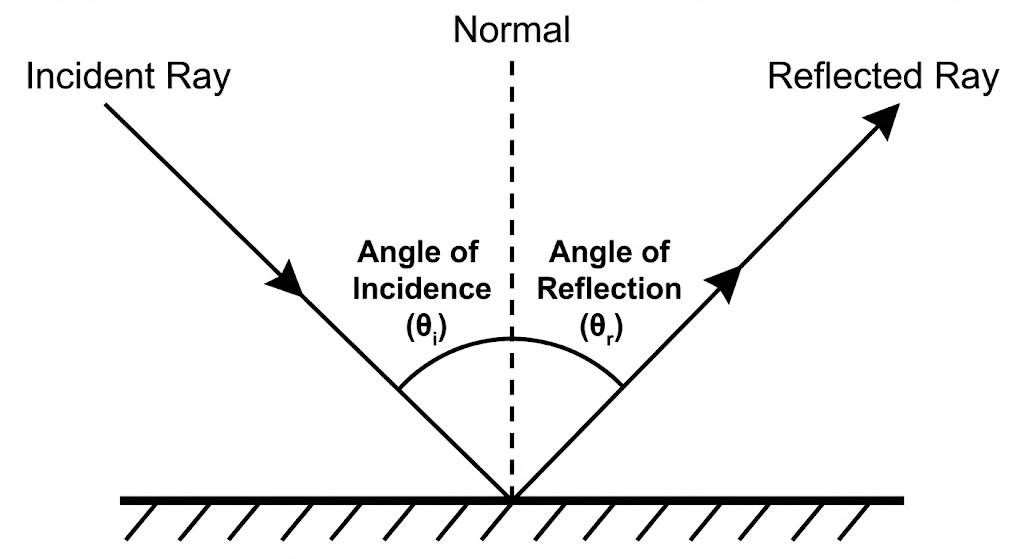
* **Coplanarity**: The incident ray, the reflected ray, and the normal lie in the same plane.
* **Equality of Angles**: The angle of reflection equals the angle of incidence.
$$\theta_r = \theta_i$$
**Key Definitions (Common Pitfalls)**:
* **Normal**: An imaginary line drawn through the point of incidence, **perpendicular to the mirror surface**. It is the reference for all angle measurements.
* **Angle of Incidence/Reflection**: The angle between the ray and the **Normal**, **NEVER** the angle with the mirror surface.
3. Key Exam Points
#### A. Principle of Reversibility
If a light ray is sent along the path of the reflected ray (reversed direction), it will reflect back along the path of the original incident ray.
#### B. Rotation Effect (Double Angle Rule)
This is a high-frequency topic in CSCA exams.
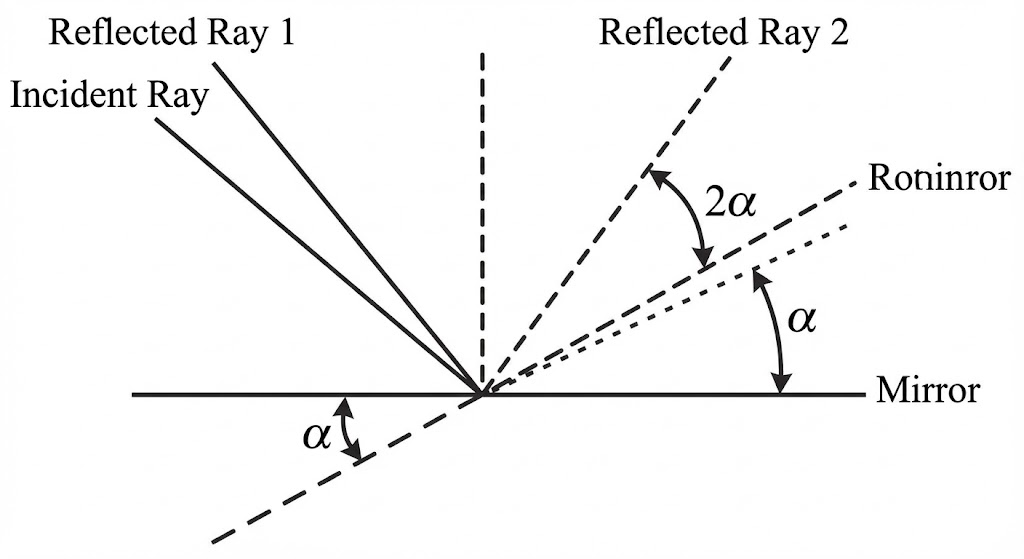
**Conclusion**: If the incident ray is fixed and the plane mirror rotates by an angle $\alpha$, the reflected ray will rotate by an angle of **$2\alpha$**.
* **Derivation**: Mirror rotates $\alpha$ $\rightarrow$ Normal rotates $\alpha$ $\rightarrow$ Angle of incidence changes by $\alpha$ $\rightarrow$ Angle of reflection changes by $\alpha$ $\rightarrow$ Total change in reflected ray is $2\alpha$.
4. Typical Examples
**Example 1: Basic Angle Calculation (Trap Question)**
A light ray strikes a plane mirror at an angle of $30^\circ$ to the mirror surface. Find the angle between the reflected ray and the incident ray.
* **Analysis**: The question gives the angle with the *mirror*, not the angle of incidence.
* **Steps**:
1. Calculate Angle of Incidence: $\theta_i = 90^\circ - 30^\circ = 60^\circ$.
2. Calculate Angle of Reflection: $\theta_r = 60^\circ$.
3. Calculate Total Angle: $\theta_{total} = \theta_i + \theta_r = 120^\circ$.
**Example 2: Optical Lever Principle**
A laser beam strikes a horizontal plane mirror, forming a spot on a wall $L=10m$ away. If the mirror rotates by $3^\circ$ (small angle), how far does the spot move on the wall?
* **Analysis**:
1. Mirror rotation $\alpha = 3^\circ$.
2. According to the Double Angle Rule, the reflected ray rotates by $\theta = 2\alpha = 6^\circ$.
3. Use geometry to calculate the distance.
* **Calculation**:
$$d \approx L \cdot \tan(2\alpha) \approx L \cdot \tan(6^\circ)$$
$$d \approx 10 \cdot 0.105 = 1.05m$$
* **Conclusion**: The spot moves approximately $1.05m$. This demonstrates how reflection can amplify small rotations (Optical Lever).