Mechanics
CSCA Mechanics study guide organized around the publicly available CSCA syllabus. Practice Physics questions on aicsca.com.
Before planning this topic, check the CSCA Exam Guide 2026 for exam dates, registration, fees, and subject requirements.
Syllabus Alignment
This study guide is organized around the publicly available CSCA syllabus for international undergraduate applicants.
Who It Is For
International students preparing for CSCA Math, Physics, Chemistry, or Chinese exams.
Related Practice
CSCA Practice · Go to questions
Past papers and worked video solutions · Timed mock exams · All subject video lessons
Practice by Topic
Jump from this tutorial to filtered practice questions for the same knowledge point.
Related formulas, concepts, and glossary terms
Physics Formula & Concept Reference
- Newton's Third Law (Action-Reaction Law)
- Newton's First Law (Law of Inertia)
- Maximum Static Friction Formula
- Newton's Second Law (Law of Motion)
- Kinetic Friction Formula
- Law of Universal Gravitation
- Gravitational Potential Energy
- Gravitational Potential Energy Formula
Physics Exam Glossary
Tutorial Content
Introduction to Mechanics
Module Framework
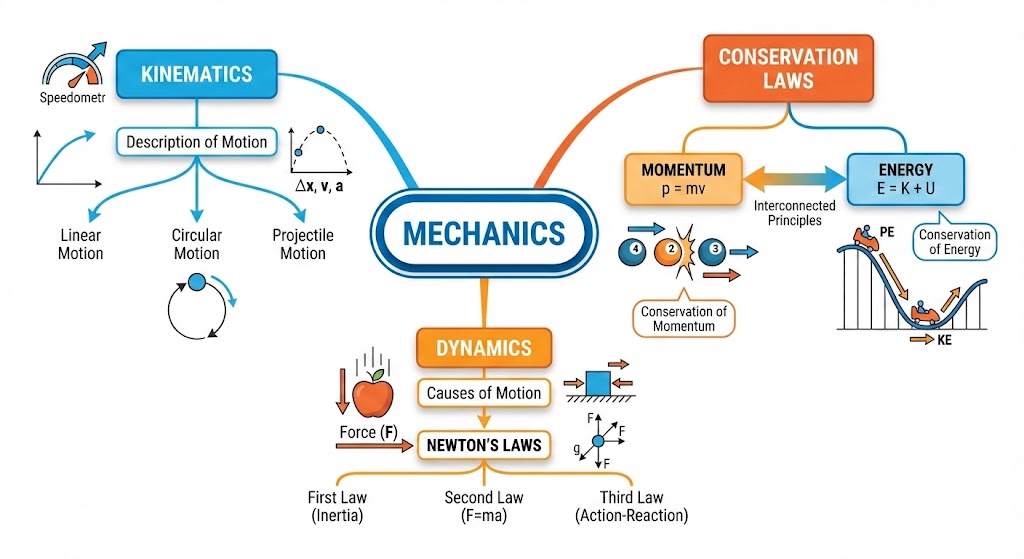
Mechanics is the cornerstone of physics and the most heavily weighted section in the CSCA exam. It studies not only the laws governing the motion of objects in space (Kinematics) but also the fundamental reasons for changes in their state of motion (Dynamics).
This module will help you build a rigorous logical system: starting from the simple **Point Mass Model**, extending to **Rigid Bodies** and **Fluids**; from instantaneous **Force Analysis** to the process-oriented conservation of **Energy and Momentum**. The core logic of this module is illustrated below:
Learning Objectives
To meet the CSCA exam requirements, upon completion of this module, you should be able to:
1. **Deeply Understand Vector Nature**: Always maintain directional awareness when calculating displacement, velocity, force, and momentum. Proficiently apply vector addition and decomposition.
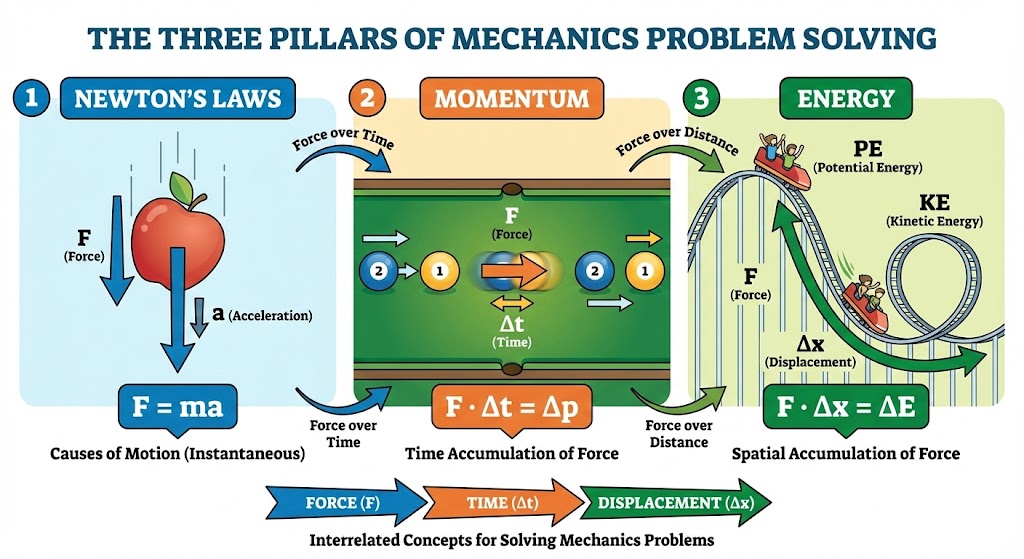
2. **Switch Flexibly Between Three Solving Tools**: Rapidly choose the optimal approach among "Newton's Laws," "Momentum Theorem/Conservation," and "Work-Energy Theorem/Conservation" based on given conditions (involving time, displacement, or instantaneous state).
3. **Analyze Typical Models**: Master the force and motion equations for incline models, conveyor belt models, block-on-block models, circular motion, and celestial motion.
4. **Apply Calculus Concepts and Graphical Methods**: Learn to use $v-t$, $F-t$, and $F-x$ graphs to analyze variable acceleration motion and work done.
Content Overview
The module unfolds in a "Description - Cause - Tools - Application" sequence, with each chapter representing an upgrade in your understanding of the physical world:
* **1. Kinematics**
* **Core Task**: Precisely describe *how* objects move.
* **Focus**: Definitions of displacement, velocity, and acceleration; the five key formulas of Uniformly Accelerated Linear Motion (UALM). Pay attention to the application of Graphs in problem-solving.
* **2. Newton's Laws of Motion**
* **Core Task**: Explain *why* objects move that way.
* **Focus**: Free-Body Diagrams (Isolation and System methods), composition and resolution of forces, and the instantaneous nature of Newton's Second Law ($F=ma$).
* **3. Momentum and Impulse**
* **Core Perspective**: The **Time** accumulation effect of force.
* **Focus**: Momentum Theorem and Law of Conservation of Momentum. This is the preferred tool for handling impacts, collisions, recoil, and variable-mass problems.
* **4. Work and Energy**
* **Core Perspective**: The **Spatial** (Displacement) accumulation effect of force.
* **Focus**: Work-Energy Theorem, Gravitational Potential Energy, Law of Conservation of Mechanical Energy. The energy perspective often bypasses complex intermediate processes to directly link initial and final states.
* **5. Circular Motion & Gravitation**
* **Core Task**: Apply Newton's laws to curvilinear motion.
* **Focus**: Analysis of centripetal force sources, Kepler's Laws, cosmic velocities, and satellite orbit changes.
* **6. Oscillations and Waves**
* **Core Task**: Study periodic motion.
* **Focus**: Dynamics of Simple Harmonic Motion (SHM), the simple pendulum model, and the propagation, interference, and diffraction of mechanical waves.