Displacement
CSCA Displacement study guide organized around the publicly available CSCA syllabus. Practice Physics questions on aicsca.com.
Before planning this topic, check the CSCA Exam Guide 2026 for exam dates, registration, fees, and subject requirements.
Syllabus Alignment
This study guide is organized around the publicly available CSCA syllabus for international undergraduate applicants.
Who It Is For
International students preparing for CSCA Math, Physics, Chemistry, or Chinese exams.
Related Practice
CSCA Practice · Go to questions
Past papers and worked video solutions · Timed mock exams · All subject video lessons
Practice by Topic
Jump from this tutorial to filtered practice questions for the same knowledge point.
Related formulas, concepts, and glossary terms
Physics Formula & Concept Reference
- Displacement in One-Dimensional Linear Motion
- Definition of Displacement
- Difference Between Displacement and Distance
Physics Exam Glossary
Tutorial Content
Displacement
1. Core Concept: Displacement vs. Distance
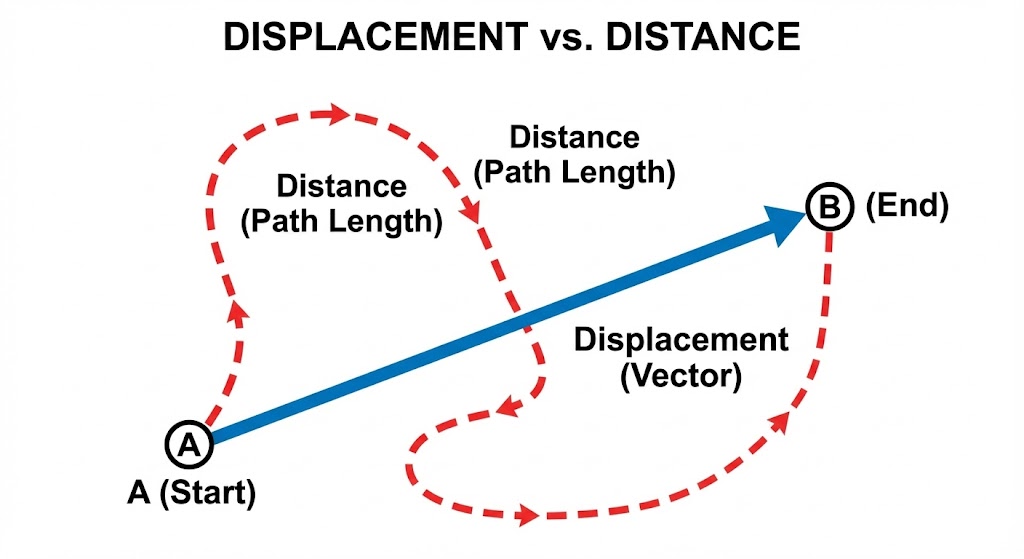
This is the most fundamental yet easily confused concept in kinematics. You must distinguish between "change in position" and "actual path traveled."
| Aspect | Displacement ($\vec{s}$ or $\vec{x}$) | Distance (Path Length, $d$) |
| :--- | :--- | :--- |
| **Definition** | Directed line segment from **Initial** to **Final** position | The total length of the actual **trajectory** |
| **Nature** | **Vector**: Has both magnitude and direction | **Scalar**: Has magnitude only, no direction |
| **Sign (+/-)** | Indicates Direction (in 1D motion) | Always Positive (Non-negative) |
| **Dependence** | Depends only on Start and End points | Depends on the specific path taken |
| **Relationship** | $|\text{Displacement}| \le \text{Distance}$ | Equal only in **Single-Direction Linear Motion** |
**⚠️ CSCA Exam Trap**:
If the motion involves a "U-turn" or "reversal" (e.g., vertical throw turning back down, or a car braking and reversing), **Distance is strictly greater than Displacement magnitude**. You must calculate distance in segments, whereas displacement only cares about the start and end.
2. Representation and Calculation
#### A. One-Dimensional (1D) Motion
In a linear coordinate system, displacement is calculated by the difference in coordinates. **The sign (+/-) indicates direction.**
$$ \Delta x = x_{\text{final}} - x_{\text{initial}} $$
* $\Delta x > 0$: Displacement is in the positive direction.
* $\Delta x < 0$: Displacement is in the negative direction.
#### B. Two-Dimensional (2D) Motion
In 2D, displacement is the result of vector addition. We typically use the Pythagorean theorem and trigonometry.
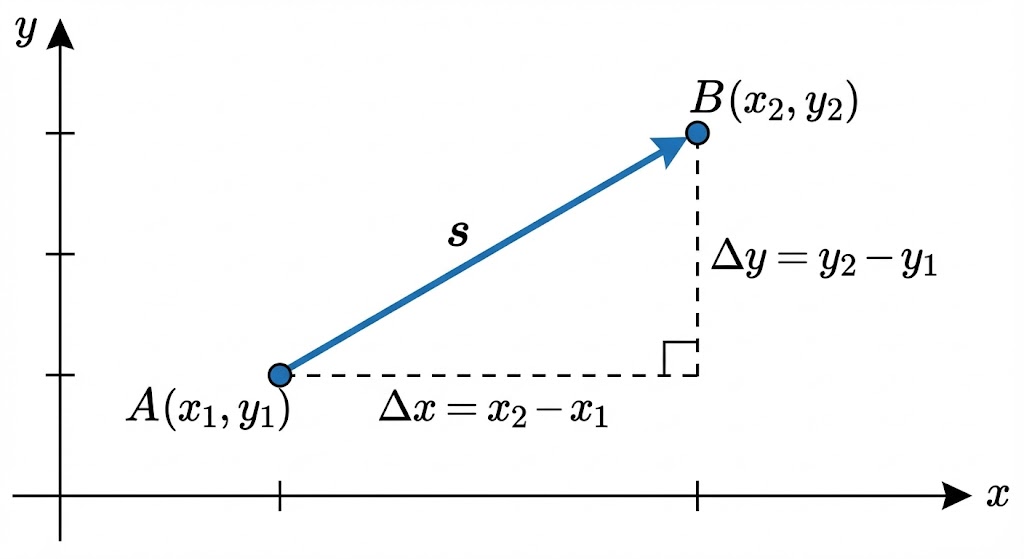
Given Initial Position $A(x_1, y_1)$ and Final Position $B(x_2, y_2)$:
* **Vector Form**: $\vec{s} = (x_2 - x_1)\hat{i} + (y_2 - y_1)\hat{j}$
* **Magnitude**: $$ |\vec{s}| = \sqrt{(x_2 - x_1)^2 + (y_2 - y_1)^2} $$
* **Direction**: If $\theta$ is the angle with the x-axis, then $\tan \theta = \frac{\Delta y}{\Delta x}$ (check quadrants).
3. Typical Examples
**Example 1: The "Turning Point" Trap in 1D**
A particle moves along the x-axis with position function $x(t) = 2t^2 - 4t + 1$ (m). Find (1) Displacement and (2) Distance from $t=0$ to $t=3\text{s}$.
**Strategy**:
1. **Displacement**: Just check endpoints.
2. **Distance**: Find the "Turning Point" (where velocity $v=0$).
**Solution**:
(1) **Displacement**:
$$x(0) = 1\text{m}, \quad x(3) = 2(3)^2 - 4(3) + 1 = 7\text{m}$$
$$\Delta x = x(3) - x(0) = 7 - 1 = +6\text{m} \quad (\text{Direction: +x})$$
(2) **Distance**:
Find velocity: $v(t) = x'(t) = 4t - 4$.
Set $v(t) = 0 \Rightarrow t=1\text{s}$. The particle **turns around** at $t=1\text{s}$.
* **Segment 1 ($0-1\text{s}$)**: $x(1) = -1\text{m}$. Displacement $\Delta x_1 = -1 - 1 = -2\text{m}$. Distance $d_1 = |-2| = 2\text{m}$.
* **Segment 2 ($1-3\text{s}$)**: $x(3) = 7\text{m}$. Displacement $\Delta x_2 = 7 - (-1) = 8\text{m}$. Distance $d_2 = |8| = 8\text{m}$.
* **Total Distance**: $d = d_1 + d_2 = 2 + 8 = 10\text{m}$.
**Example 2: 2D Vector Addition**
A person walks $40\text{m}$ East, then $30\text{m}$ North. Find total displacement and distance.
**Solution**:
* **Distance (Scalar)**: $40 + 30 = 70\text{m}$.
* **Displacement (Vector)**: Hypotenuse of the right triangle.
* Magnitude: $s = \sqrt{40^2 + 30^2} = 50\text{m}$.
* Direction: $\tan \theta = \frac{30}{40} = 0.75 \Rightarrow \theta \approx 37^\circ$ (North of East).