Velocity
CSCA Velocity study guide organized around the publicly available CSCA syllabus. Practice Physics questions on aicsca.com.
Before planning this topic, check the CSCA Exam Guide 2026 for exam dates, registration, fees, and subject requirements.
Syllabus Alignment
This study guide is organized around the publicly available CSCA syllabus for international undergraduate applicants.
Who It Is For
International students preparing for CSCA Math, Physics, Chemistry, or Chinese exams.
Related Practice
CSCA Practice · Go to questions
Past papers and worked video solutions · Timed mock exams · All subject video lessons
Practice by Topic
Jump from this tutorial to filtered practice questions for the same knowledge point.
Related formulas, concepts, and glossary terms
Physics Formula & Concept Reference
- Average Velocity Formula
- Definition of Instantaneous Velocity
- Difference Between Average Speed and Average Velocity
- Definition of Average Velocity
- Instantaneous Velocity Definition
- Average Speed Formula
Physics Exam Glossary
Tutorial Content
Velocity
1. Core Concepts: Velocity vs. Speed
In Physics (especially for CSCA exams), **Velocity** and **Speed** are distinct concepts. Never use them interchangeably.
| Aspect | Velocity ($\vec{v}$) | Speed ($v$) |
| :--- | :--- | :--- |
| **Definition** | Rate of change of position ($\Delta \vec{x} / \Delta t$) | Rate of distance traveled ($d / \Delta t$) |
| **Nature** | **Vector**: Magnitude + Direction | **Scalar**: Magnitude only |
| **Direction** | Same as **direction of motion** (tangent to path) | None |
| **Meaning** | How fast and where it's going | Just how fast it's moving |
2. Average vs. Instantaneous Velocity
#### A. Average Velocity
* **Definition**: The displacement divided by the time interval.
* **Formula**: $$\vec{v}_{avg} = \frac{\Delta \vec{x}}{\Delta t} = \frac{\vec{x}_f - \vec{x}_i}{t_f - t_i}$$
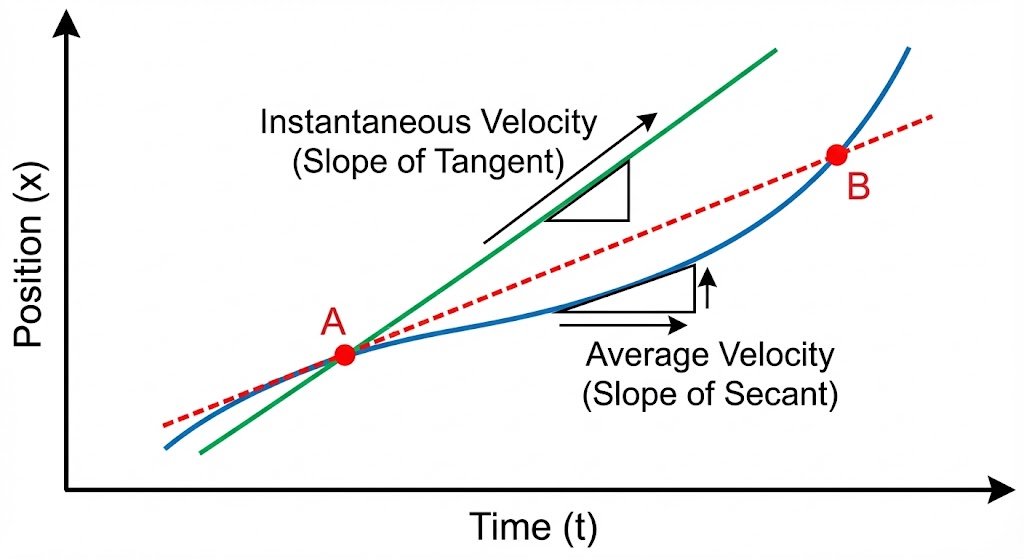
* **Graphical Meaning**: On a Position-Time ($x-t$) graph, average velocity is the **slope of the secant line** connecting the start and end points.
#### B. Instantaneous Velocity
* **Definition**: The velocity at a specific instant (limit as $\Delta t \to 0$).
* **Formula**: $$\vec{v} = \lim_{\Delta t \to 0} rac{\Delta \vec{x}}{\Delta t} = \frac{d\vec{x}}{dt}$$
* **Graphical Meaning**: On an $x-t$ graph, instantaneous velocity is the **slope of the tangent line** at that specific point.
3. Critical Trap: Average Speed $\neq$ Magnitude of Average Velocity
This is a common exam trick.
* **Average Speed** = **Total Distance** / Total Time
* **Magnitude of Avg. Velocity** = |**Total Displacement**| / Total Time
**Conclusion**: Unless the motion is **unidirectional and linear**, Average Speed is generally **greater than** the magnitude of Average Velocity. (e.g., A lap around a track has 0 velocity but high speed).
4. Composition of Motion (Boat Crossing River)
Velocity follows the **Parallelogram Rule** for vector addition. This is essential for 2D motion.
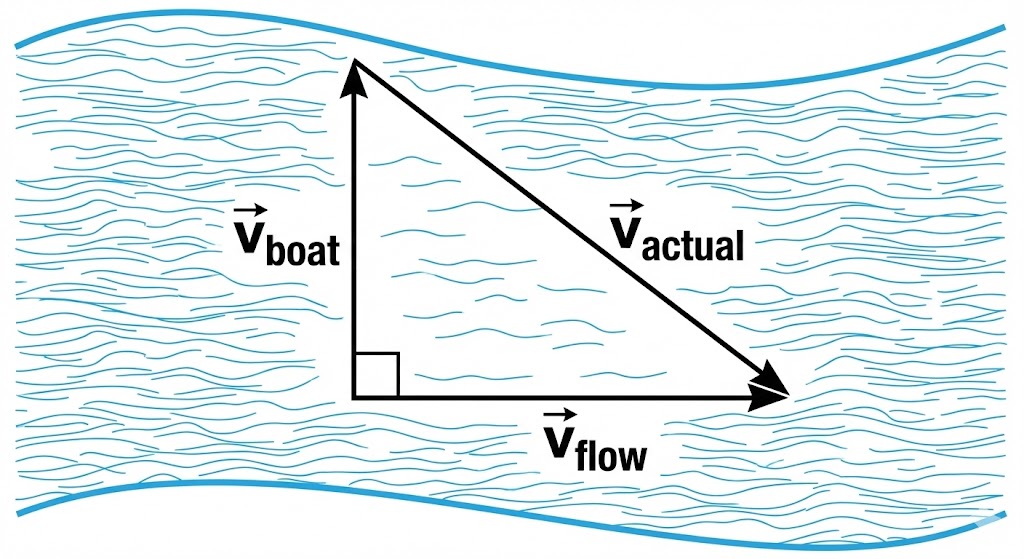
* **Model**: Boat velocity relative to water ($\vec{v}_{boat}$) and Water flow velocity ($\vec{v}_{flow}$).
* **Resultant Velocity**: $\vec{v}_{actual} = \vec{v}_{boat} + \vec{v}_{flow}$ (Vector Sum).
* **Independence Principle**: The time to cross the river depends **only** on the velocity component perpendicular to the bank. It is independent of the water flow speed.
$$ t = \frac{\text{Width } d}{v_{boat} \text{ (perpendicular component)}} $$
5. Typical Examples
**Example 1: Graphical Interpretation**
A particle moves along the x-axis. On its $x-t$ graph (parabola), at $t=2s$, the slope of the tangent line is $4$. The slope of the line connecting $t=0$ and $t=2s$ is $2$.
**Find**: (1) Instantaneous velocity at $t=2s$; (2) Average velocity over first 2 seconds.
**Solution**:
(1) Instantaneous velocity = Slope of tangent = $4 \, \text{m/s}$.
(2) Average velocity = Slope of secant = $2 \, \text{m/s}$.
**Example 2: Boat Crossing River**
$v_{boat} = 4 \, \text{m/s}$, $v_{water} = 3 \, \text{m/s}$, River Width = $120 \, \text{m}$.
(1) **Minimum Time**: Point boat perpendicular to bank.
$$ t_{min} = \frac{120}{4} = 30 \, \text{s} $$
(2) **Resultant Velocity**: $\vec{v} = \sqrt{4^2 + 3^2} = 5 \, \text{m/s}$ (directed downstream).