Modern Physics
CSCA Modern Physics study guide organized around the publicly available CSCA syllabus. Practice Physics questions on aicsca.com.
Before planning this topic, check the CSCA Exam Guide 2026 for exam dates, registration, fees, and subject requirements.
Syllabus Alignment
This study guide is organized around the publicly available CSCA syllabus for international undergraduate applicants.
Who It Is For
International students preparing for CSCA Math, Physics, Chemistry, or Chinese exams.
Related Practice
CSCA Practice · Go to questions
Past papers and worked video solutions · Timed mock exams · All subject video lessons
Practice by Topic
Jump from this tutorial to filtered practice questions for the same knowledge point.
Related formulas, concepts, and glossary terms
Physics Formula & Concept Reference
- Average Binding Energy (Binding Energy per Nucleon)
- Einstein's Mass-Energy Equivalence
- Nuclear Binding Energy Formula
- Relationship between Half-life and Decay Constant
- Average Binding Energy per Nucleon (Specific Binding Energy)
- Law of Radioactive Decay
- Hydrogen Atom Electron Orbital Angular Momentum Quantization Condition
- Photon Energy
Physics Exam Glossary
Tutorial Content
Modern Physics: The Revolution of the Microscopic World
1. What is Modern Physics?
**Modern Physics** refers to the theoretical framework developed in the early 20th century to explain experimental phenomena that Classical Physics (Newtonian mechanics, Electromagnetism) could not resolve. It fundamentally revolutionized humanity's understanding of time, space, matter, and energy.
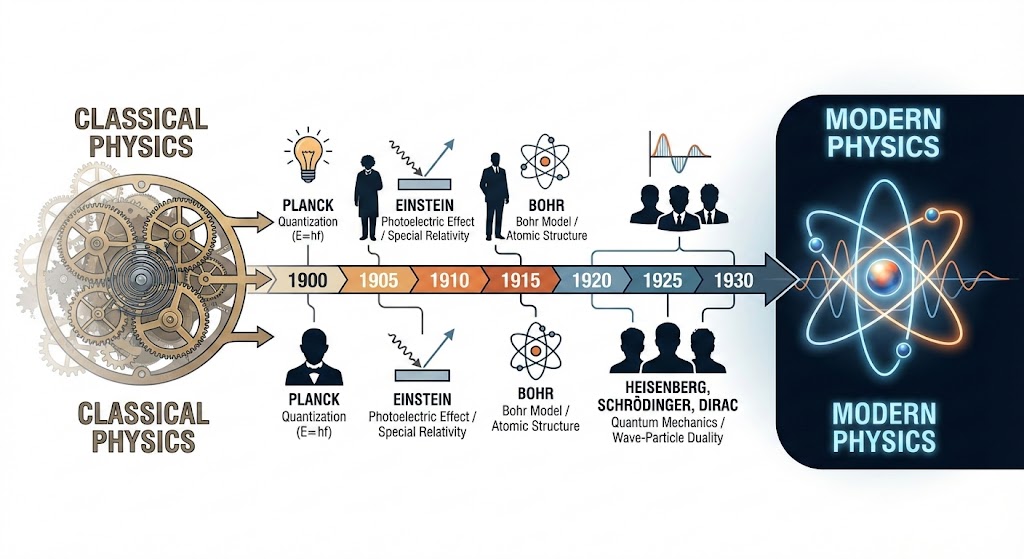 Its two main pillars are:
* **Quantum Mechanics**: Describes the behavior of microscopic particles (e.g., electrons, photons).
* **Relativity**: Describes physical laws at high speeds and in strong gravitational fields (Note: The CSCA exam focuses primarily on Quantum fundamentals, Atoms, and Nuclear Physics; Relativity is usually covered briefly).
---
2. Core Syllabus Framework
For the CSCA exam, the Modern Physics module consists of three progressive sections:
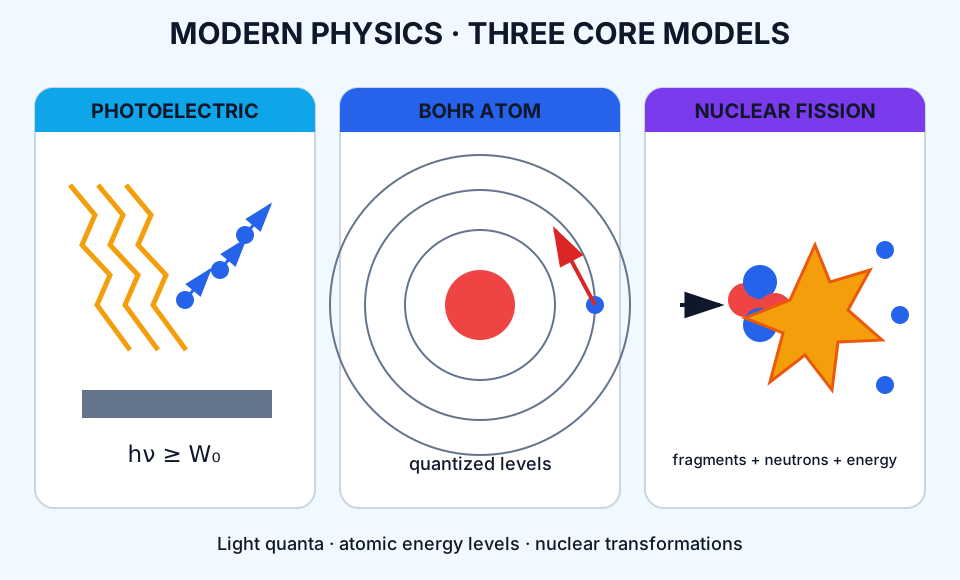 ### (1) Photoelectric Effect & Wave-Particle Duality
* **Core Question**: Is light a wave or a particle?
* **Key Concepts**: Planck's constant ($h$), Photon energy ($E=h\nu$), Work function ($W_0$).
* **Significance**: Confirmed the **particle nature** of light and launched the Quantum Era.
(2) Atomic Structure
* **Core Question**: What does the inside of an atom look like? How do electrons move?
* **Key Models**:
* Rutherford's Nuclear Model (Planetary Model).
* **Bohr Model** (Exam Focus): Introduced the concepts of **Energy Levels** and **Transitions**, successfully explaining the hydrogen spectrum.
(3) Nuclear Physics
* **Core Question**: What is the nucleus made of? Where does nuclear energy come from?
* **Key Concepts**:
* Decay ($\alpha, \beta, \gamma$ decay) and Half-life.
* **Mass-Energy Equivalence** ($E=mc^2$) and Mass Defect.
* Nuclear Reactions: Fission and Fusion.
---
3. Learning Objectives
By the end of this module, you should be able to:
1. **Understand "Quantization"**: Energy is not continuous but comes in discrete packets.
2. **Master Calculations**: Proficiently use the Photoelectric Equation ($E_k = h\nu - W_0$) and Bohr energy level formulas.
3. **Analyze Nuclear Energy**: Calculate energy released in nuclear reactions using mass defect.