Lorentz Force
CSCA Lorentz Force study guide organized around the publicly available CSCA syllabus. Practice Physics questions on aicsca.com.
Before planning this topic, check the CSCA Exam Guide 2026 for exam dates, registration, fees, and subject requirements.
Syllabus Alignment
This study guide is organized around the publicly available CSCA syllabus for international undergraduate applicants.
Who It Is For
International students preparing for CSCA Math, Physics, Chemistry, or Chinese exams.
Related Practice
CSCA Practice · Go to questions
Past papers and worked video solutions · Timed mock exams · All subject video lessons
Practice by Topic
Jump from this tutorial to filtered practice questions for the same knowledge point.
Related formulas, concepts, and glossary terms
Physics Formula & Concept Reference
- Magnitude of Lorentz Force
- Lorentz Force Formula
- Lorentz Force (including electric field)
- Lorentz Force Does No Work
- Cyclotron Period of a Charged Particle in a Uniform Magnetic Field
- Circular Motion of a Charged Particle in a Uniform Magnetic Field
- Lorentz Force (with Electric Field)
Physics Exam Glossary
Tutorial Content
Topic: Electromagnetism > Magnetic Field > Lorentz Force
1. Core Concept: Lorentz Force
**Lorentz Force** is the force exerted by a magnetic field on a **moving charge**. It is the microscopic origin of Ampere's force.
**CSCA Exam Focus**:
* **No Work Done**: The Lorentz force is always perpendicular to the velocity. It changes the **direction** of velocity but **NEVER changes the speed** (Kinetic energy remains constant).
* **Direction Logic**: Distinguishing between positive and negative charges is the most common pitfall.
---
2. Core Formulas
(1) Magnitude
$$F = |q| v B \sin\theta$$
* $F$: Lorentz Force (N).
* $q$: Charge (C), use **absolute value** for magnitude calculation.
* $v$: Velocity (m/s).
* $B$: Magnetic Flux Density (T).
* $\theta$: Angle between **Velocity $\vec{v}$** and **Field $\vec{B}$**.
**Special Cases**:
* $\vec{v} \perp \vec{B}$ ($\theta = 90^\circ$): $F = qvB$ (**Maximum**, leads to circular motion).
* $\vec{v} \parallel \vec{B}$ ($\theta = 0^\circ$): $F = 0$ (No force, linear motion).
(2) Direction: Left-Hand Rule
**Use Left Hand for Force**. Pay attention to the charge sign!
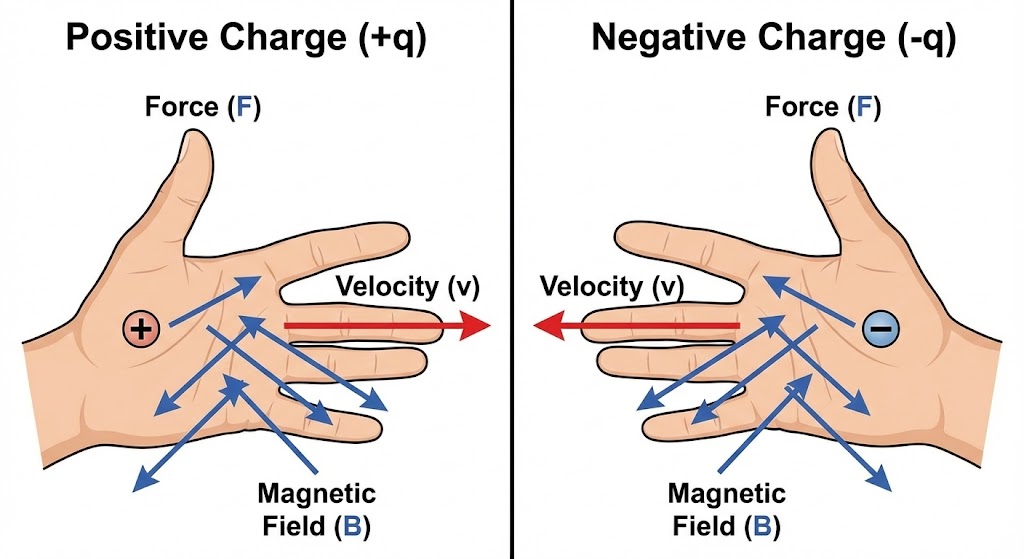
* **Step 1**: Open **Left Hand**, let B-field lines **pierce the palm**.
* **Step 2**: Point four fingers based on charge type:
* **Positive (+)**: Fingers point **WITH velocity** ($v$).
* **Negative (-)**: Fingers point **OPPOSITE to velocity** ($-v$).
* **Step 3**: **Thumb** points to **Lorentz Force** ($F$).
---
3. Motion of Charged Particles in Uniform Magnetic Field
This is the core model for calculation problems. Usually, gravity is ignored.
Model A: Uniform Circular Motion
When incident velocity $\vec{v} \perp \vec{B}$.
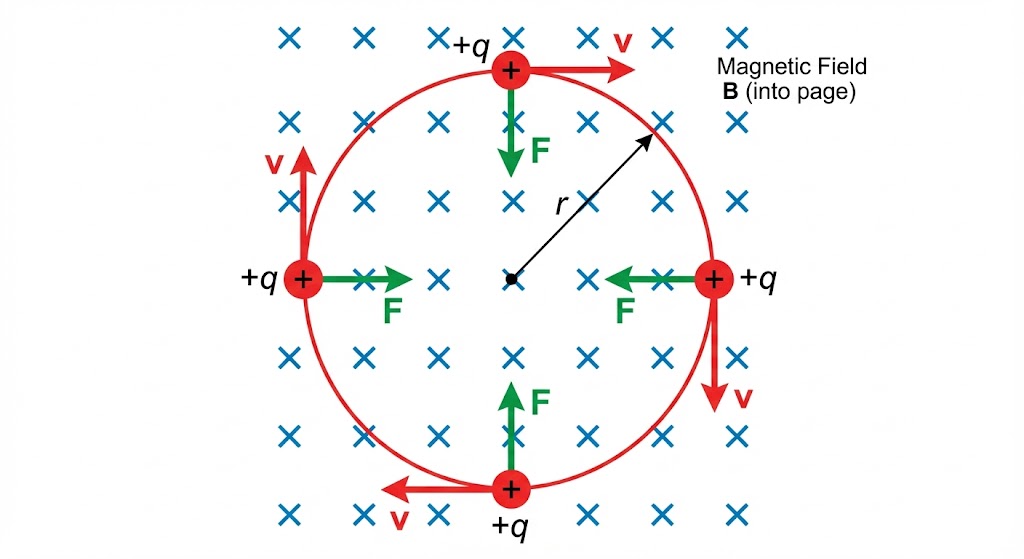
* **Dynamics Equation**: Lorentz force provides centripetal force.
$$qvB = m \frac{v^2}{r} = m \omega^2 r = m v \frac{2\pi}{T}$$
* **Two Key Derivations (Memorize)**:
1. **Radius**:
$$r = \frac{mv}{qB}$$
* Inference: Higher speed $v$ $\rightarrow$ Larger radius $r$.
2. **Period**:
$$T = \frac{2\pi r}{v} = \frac{2\pi m}{qB}$$
* Inference: **Period is INDEPENDENT of speed and radius**! It depends only on charge-to-mass ratio ($q/m$) and field ($B$).
* *Basis for the Cyclotron.*
Model B: Helical Motion
When incident velocity $\vec{v}$ is at an angle $\theta$ to $\vec{B}$.
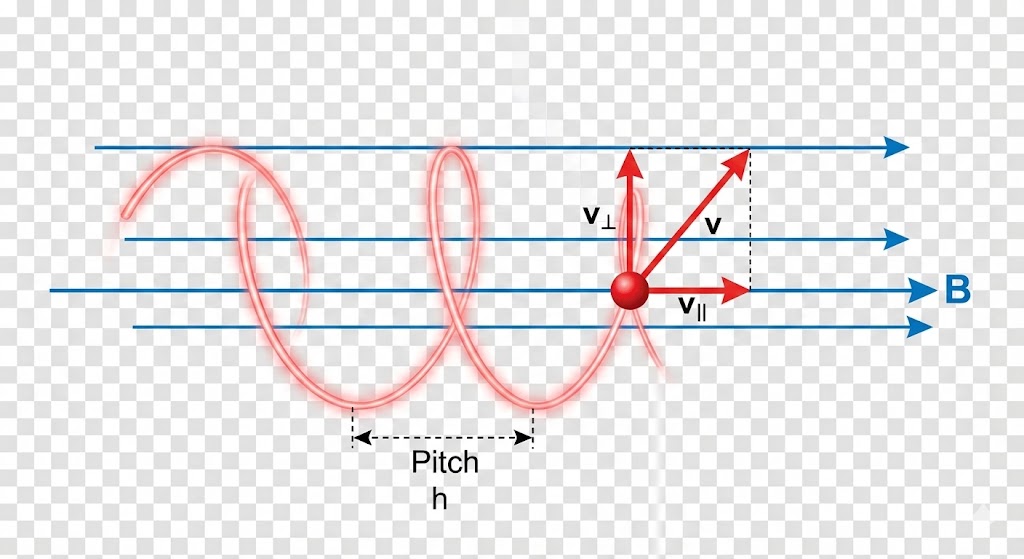
* **Decomposition**:
* $v_{\parallel} = v \cos\theta$: Parallel to B $\rightarrow$ **Uniform Linear Motion**.
* $v_{\perp} = v \sin\theta$: Perpendicular to B $\rightarrow$ **Uniform Circular Motion**.
* **Trajectory**: Helix (Spiral).
* **Pitch**: The axial distance covered in one period.
$$h = v_{\parallel} \cdot T = (v \cos\theta) \cdot \frac{2\pi m}{qB}$$
---
4. Typical Examples
**Example 1: The Negative Charge Trap**
**Problem**: A stream of electrons moves horizontally to the right into a uniform magnetic field pointing INTO the page. What is the direction of the Lorentz force?
**Solution**:
1. **Field**: In $\rightarrow$ Pierces left palm (Palm faces out).
2. **Fingers**: Electrons are **Negative**! Velocity is Right, so **fingers must point LEFT**.
3. **Thumb**: Points **Vertically Down**.
**Answer**: Downward.
**Example 2: Radius and Kinetic Energy**
**Problem**: A proton ($H^+$) and an alpha particle ($He^{2+}$, mass 4m, charge 2q) enter the same field perpendicularly with the **same Kinetic Energy**. Find ratio of radii.
**Solution**:
1. **Formula**: Need $r$ in terms of $E_k$.
From $E_k = \frac{1}{2}mv^2 \Rightarrow v = \sqrt{\frac{2E_k}{m}}$, substitute into $r = \frac{mv}{qB}$:
$$r = \frac{m \sqrt{2E_k/m}}{qB} = \frac{\sqrt{2mE_k}}{qB}$$
2. **Ratio**:
$B, E_k$ are same, so $r \propto \frac{\sqrt{m}}{q}$.
$$\frac{r_H}{r_{\alpha}} = \frac{\sqrt{1}/1}{\sqrt{4}/2} = \frac{1}{1} = 1:1$$
**Answer**: Ratio is 1:1.
**Example 3: Time of Motion**
**Problem**: A particle turns through a center angle of $60^\circ$ in the magnetic field. Find the time $t$.
**Solution**:
Use the Period $T$.
$$t = \frac{\theta}{360^\circ} \times T = \frac{60}{360} T = \frac{1}{6} T$$
Substitute $T = \frac{2\pi m}{qB}$ to solve.