Electrostatics
CSCA Electrostatics study guide organized around the publicly available CSCA syllabus. Practice Physics questions on aicsca.com.
Before planning this topic, check the CSCA Exam Guide 2026 for exam dates, registration, fees, and subject requirements.
Syllabus Alignment
This study guide is organized around the publicly available CSCA syllabus for international undergraduate applicants.
Who It Is For
International students preparing for CSCA Math, Physics, Chemistry, or Chinese exams.
Related Practice
CSCA Practice · Go to questions
Past papers and worked video solutions · Timed mock exams · All subject video lessons
Practice by Topic
Jump from this tutorial to filtered practice questions for the same knowledge point.
Related formulas, concepts, and glossary terms
Physics Formula & Concept Reference
- Electric Field Intensity of an Infinite Uniformly Charged Line
- Electric Field Intensity of a Uniformly Charged Infinite Plane
- Electric Field Intensity of an Infinite Uniformly Charged Plane
- Definition of Electric Field Intensity
- Electric Field Intensity of a Continuous Charge Distribution
- Electric Field Intensity of a Point Charge
- Electric Field Intensity of Continuous Charge Distribution (Integral Form)
- What are the applicable conditions for Coulomb's Law?
Physics Exam Glossary
Tutorial Content
Topic: Electromagnetism > Electrostatics
1. Introduction: Electrostatic Field
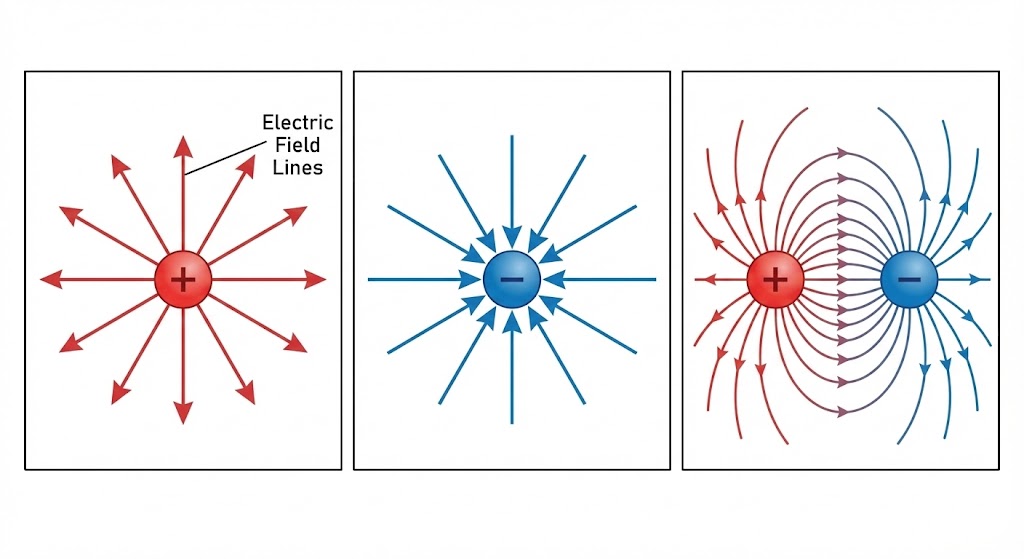
An **Electrostatic Field** is a field created by **stationary charges**. Although invisible, it is objectively real. For the CSCA exam, you must master its two core properties:
1. **Force Property**: Exerts force on charges placed within it (described by **Electric Field Strength**).
2. **Energy Property**: Work is done by the electric force when charges move (described by **Electric Potential**).
 ---
---
2. Comparison of Three Core Quantities
| Quantity | Symbol | Formula | Vector/Scalar | Physical Meaning | Note |
| :--- | :---: | :---: | :---: | :--- | :--- |
| **Electric Field Strength** | $\vec{E}$ | $E = \frac{F}{q}$ | **Vector** | Strength & direction of the field (Force nature) | Direction is that of force on a positive test charge |
| **Electric Potential** | $\varphi$ or $V$ | $V = \frac{W}{q}$ | **Scalar** | Energy state at a point (Energy nature) | Potential decreases along field lines |
| **Potential Difference** | $U$ | $U_{AB} = V_A - V_B$ | **Scalar** | Difference in potential (Voltage) | $W_{AB} = qU_{AB}$ |
**Note**: $E$ is independent of $F$ and $q$, determined only by the source; similarly, $V$ is independent of $W$ and $q$.
---
3. Core Law: Coulomb's Law
Applies to two **point charges** in a **vacuum**.
$$F = k \frac{|q_1 q_2|}{r^2}$$
* **Constant**: $k \approx 9.0 \times 10^9 \, N \cdot m^2 / C^2$
* **Direction**: Like charges repel, opposite charges attract (along the line connecting them).
* **Exam Tip**: Use absolute values of charges to calculate magnitude, and determine direction separately based on signs.
---
4. Key Method: Superposition Principle
This is the most critical topic for exams. When dealing with systems of multiple charges:
1. **Field Superposition (Vector Sum)**:
* **Rule**: Parallelogram rule or Orthogonal decomposition.
* **Step**: Calculate the $E$ vector generated by each charge independently, then combine them.
2. **Potential Superposition (Algebraic Sum)**:
* **Rule**: Direct numerical addition.
* **Step**: Calculate $V$ for each charge (keeping the +/- sign), then sum them up.
 ---
---
5. Typical Example
**Example: Vector Superposition of Electric Fields**
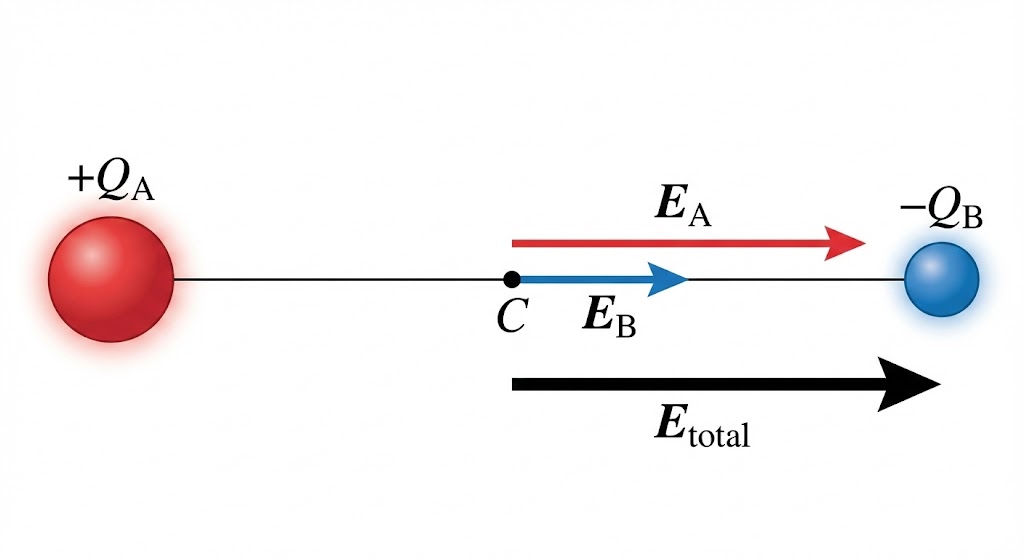
**Problem**: In a vacuum, two point charges $Q_A = +4.0 \times 10^{-8} C$ and $Q_B = -1.0 \times 10^{-8} C$ are fixed at points $A$ and $B$ on the $x$-axis, separated by $0.1m$. Find the electric field strength at the midpoint $C$.
**Solution Steps**:
1. **Model**: $C$ is the midpoint, so $r_{AC} = r_{BC} = 0.05 m$.
2. **Independent Calculation**:
* Field by $A$ at $C$: $E_A = k \frac{|Q_A|}{r^2} = 9.0\times10^9 \times \frac{4.0\times10^{-8}}{0.0025} = 1.44 \times 10^5 \, N/C$. Direction: **Right** (Away from positive).
* Field by $B$ at $C$: $E_B = k \frac{|Q_B|}{r^2} = 9.0\times10^9 \times \frac{1.0\times10^{-8}}{0.0025} = 3.6 \times 10^4 \, N/C$. Direction: **Right** (Towards negative).
3. **Vector Addition**:
* Since $E_A$ and $E_B$ are in the same direction, add them directly.
* $E_C = 1.44\times10^5 + 0.36\times10^5 = 1.80 \times 10^5 \, N/C$, direction is horizontal to the right.
---
6. CSCA Common Errors
* **Vector vs. Scalar Confusion**: $E$ fields cannot be added simply by numbers; you must draw diagrams. Potentials $V$ must be added with signs.
* **Scope of $U = Ed$**: Only applies to **Uniform Electric Fields**, where $d$ is the distance parallel to field lines.
* **Field Line Misconception**: Field lines are NOT the trajectory of charge motion. Dense lines mean stronger field.