Electromagnetism
CSCA Electromagnetism study guide organized around the publicly available CSCA syllabus. Practice Physics questions on aicsca.com.
Before planning this topic, check the CSCA Exam Guide 2026 for exam dates, registration, fees, and subject requirements.
Syllabus Alignment
This study guide is organized around the publicly available CSCA syllabus for international undergraduate applicants.
Who It Is For
International students preparing for CSCA Math, Physics, Chemistry, or Chinese exams.
Related Practice
CSCA Practice · Go to questions
Past papers and worked video solutions · Timed mock exams · All subject video lessons
Practice by Topic
Jump from this tutorial to filtered practice questions for the same knowledge point.
Related formulas, concepts, and glossary terms
Physics Formula & Concept Reference
- Electric Field Intensity of an Infinite Uniformly Charged Line
- Electric Field Intensity of a Uniformly Charged Infinite Plane
- Electric Field Intensity of an Infinite Uniformly Charged Plane
- Definition of Electric Field Intensity
- Electric Field Intensity of a Continuous Charge Distribution
- Electric Field Intensity of a Point Charge
- Electric Field Intensity of Continuous Charge Distribution (Integral Form)
- Force on a Current Element in a Magnetic Field
Physics Exam Glossary
Tutorial Content
Electromagnetism: Module Framework and Objectives
1. Module Introduction
Electromagnetism is a core branch of physics that studies electric charges, electric fields, magnetic fields, and the laws governing their interactions. For the CSCA exam, this is a mandatory module with a significant weight in scoring. It is not only the foundation for understanding modern electrical engineering but also a stepping stone to modern physics (such as relativity and quantum mechanics).
In this module, we divide electromagnetism into four logically connected sections: **Electrostatics**, **Steady Current (DC Circuits)**, **Magnetism**, and **Electromagnetic Induction**.
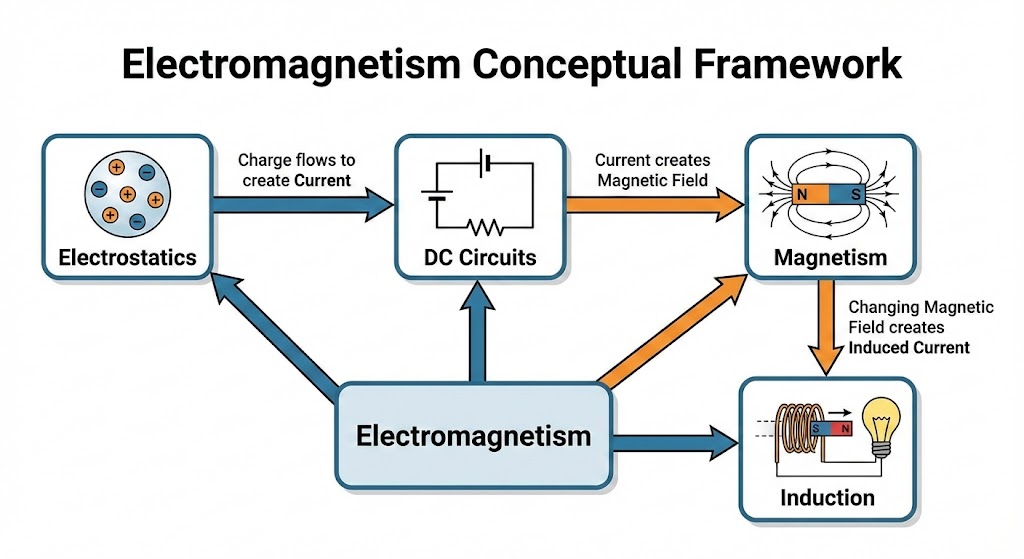
2. Detailed Knowledge Framework
(1) Electrostatics
This is the cornerstone of electromagnetism, studying the fields produced by **stationary** charges and their properties. Exams often focus on force analysis and energy analysis in this section.
* **Core Concepts**: Point charge, Electric Field Strength $E$, Electric Potential $\varphi$, Electric Potential Energy.
* **Key Laws**:
* **Coulomb's Law**: Quantitatively describes the interaction force between charges.
* **Superposition Principle**: Used to calculate the electric field distribution of multi-charge systems.
(2) Steady Current (DC Circuits)
Studies the directional movement of charges driven by a constant electric field. The focus here is on circuit calculation and analysis.
* **Core Concepts**: Current $I$, Voltage $U$, Resistance $R$, Electromotive Force (EMF) $E$.
* **Key Laws**:
* **Ohm's Law**: Includes Ohm's law for partial circuits and **closed circuits**.
* **Series and Parallel Rules**: The basis for circuit simplification.
* **Kirchhoff's Laws** (Advanced topic): Used for solving complex circuit networks.
(3) Magnetism
Studies the fields produced by **moving** charges (currents) and the effect of magnetic fields on matter.
* **Core Concepts**: Magnetic Flux Density $B$, Magnetic Flux $\Phi$.
* **Key Laws**:
* **Ampere's Force**: The force exerted by a magnetic field on a current-carrying wire (Left-Hand Rule).
* **Lorentz Force**: The force exerted by a magnetic field on a moving charge (Charged particle motion in a magnetic field is a high-frequency exam topic).
(4) Electromagnetic Induction
This is the bridge between electricity and magnetism, studying how a **changing** magnetic field generates an electric field. Questions in this section are usually highly comprehensive.
* **Core Concepts**: Induced EMF, Induced Current.
* **Key Laws**:
* **Faraday's Law of Induction**: Calculates the magnitude of induced EMF ($E = n \frac{\Delta \Phi}{\Delta t}$).
* **Lenz's Law**: Determines the direction of the induced current.
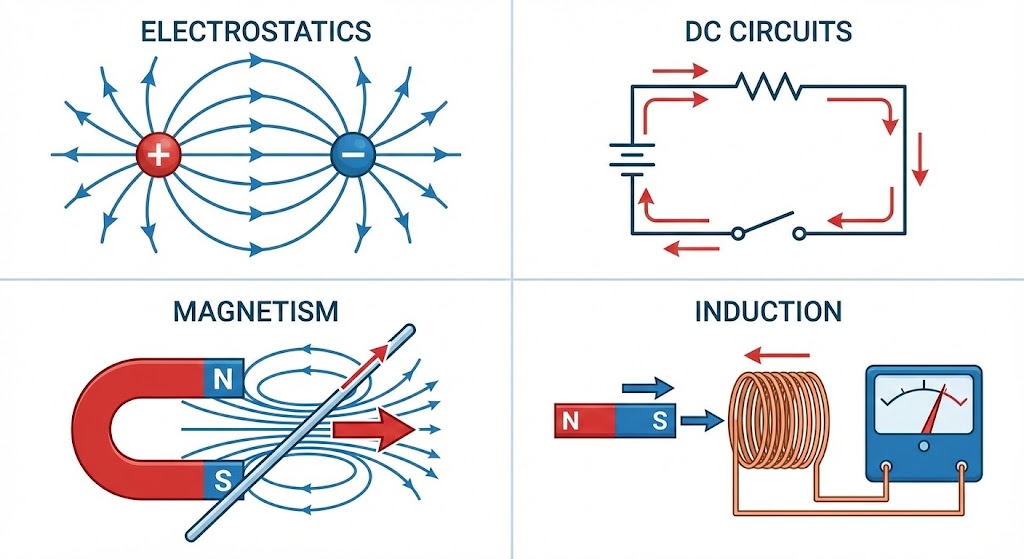
3. Logical Connections
These four parts are not isolated but progressively built upon each other:
1. **Electrostatics** establishes the concept and model of the "Field".
2. The flow of charge forms **Current**, which involves not only circuit calculations but is also the source of magnetic fields.
3. **Magnetic Fields** interact with currents, and changing magnetic fields can eventually generate electric fields (Induced EMF) through **Electromagnetic Induction**.
4. Learning Objectives
Upon completing this module, you should achieve the following:
* **Concept Differentiation**: Clearly distinguish between confusing concepts such as Electric Force vs. Lorentz Force, and Electric Potential vs. Electromotive Force.
* **Quantitative Calculation**: Proficiently apply Coulomb's Law, Ohm's Law, and Faraday's Law for accurate calculations.
* **Model Handling**: Be able to handle classic physics models such as "Motion of charged particles in electromagnetic fields" and the "Rail/Rod on Conductors model".
* **Comprehensive Application**: Understand the principles of electromagnetism in devices like cyclotrons, transformers, and generators.