Geometrical Optics
CSCA Geometrical Optics study guide organized around the publicly available CSCA syllabus. Practice Physics questions on aicsca.com.
Before planning this topic, check the CSCA Exam Guide 2026 for exam dates, registration, fees, and subject requirements.
Syllabus Alignment
This study guide is organized around the publicly available CSCA syllabus for international undergraduate applicants.
Who It Is For
International students preparing for CSCA Math, Physics, Chemistry, or Chinese exams.
Related Practice
CSCA Practice · Go to questions
Past papers and worked video solutions · Timed mock exams · All subject video lessons
Practice by Topic
Jump from this tutorial to filtered practice questions for the same knowledge point.
Related formulas, concepts, and glossary terms
Physics Formula & Concept Reference
- Relationship between Refractive Index and Speed of Light
- Critical Angle Formula (Condition for Total Internal Reflection)
- Law of Refraction (Snell's Law)
- Critical Angle for Total Internal Reflection
- Definition of Refractive Index
- Vector Form of Reflection Law
- Law of Reflection
Physics Exam Glossary
Tutorial Content
Topic: Optics > Geometrical Optics
Geometrical Optics
1. Conceptual Definition
Geometrical optics abstracts light as **"Light Rays"**, ignoring wave details to focus on the propagation path of light. Its core assumptions include:
* **Rectilinear Propagation**: Light travels in straight lines in a homogeneous medium.
* **Independence**: Light rays do not interfere with each other when they cross.
* **Reversibility**: The path of light is reversible (if light travels from A to B, it can travel from B back to A along the same path).
2. Core Laws
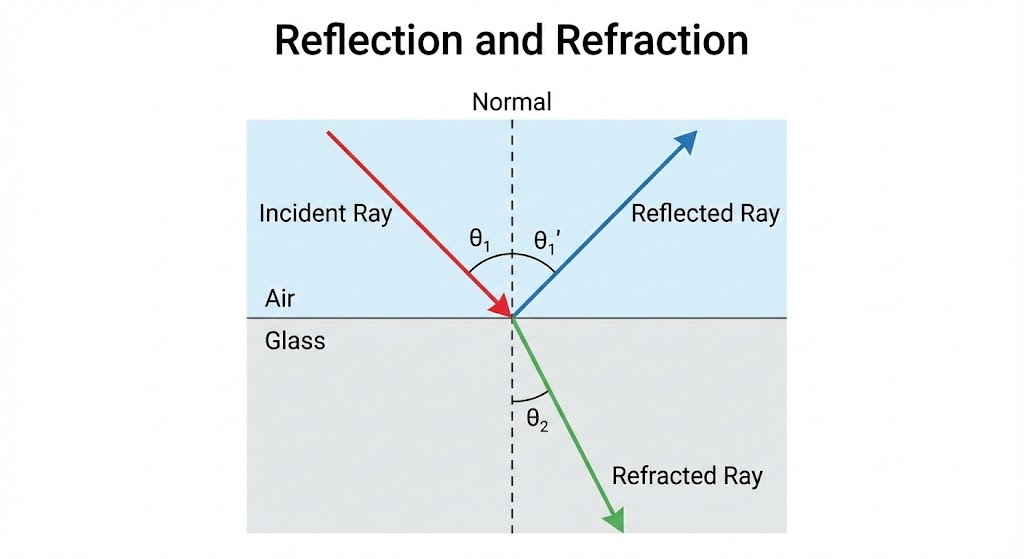
#### A. Law of Reflection
The phenomenon where light returns to the original medium upon hitting an interface.
* **Coplanar**: The incident ray, reflected ray, and normal lie in the same plane.
* **Equal Angles**: The angle of reflection equals the angle of incidence ($\theta_r = \theta_i$).
#### B. Law of Refraction (Snell's Law)
The change in direction of light when passing obliquely from one medium to another.
* **Formula**: $$n_1 \sin\theta_1 = n_2 \sin\theta_2$$
* $n_1, n_2$: Absolute refractive indices of the first and second media.
* $\theta_1, \theta_2$: Angle of incidence and angle of refraction (**angles relative to the normal**).
* **Refractive Index**: $$n = \frac{c}{v}$$ (where $c$ is speed of light in vacuum, $v$ is speed in the medium).
#### C. Total Internal Reflection (TIR)
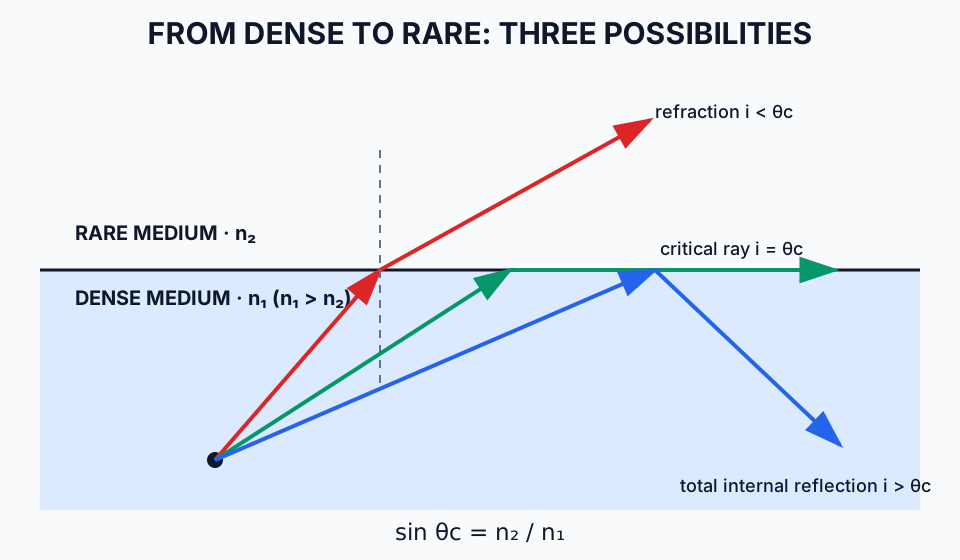
Occurs when light travels from an **optically denser medium** (higher $n$) to an **optically rarer medium** (lower $n$), and the angle of incidence $\theta_i$ exceeds the **Critical Angle $\theta_c$**. All light is reflected back.
* **Critical Angle Formula**: $$\sin\theta_c = \frac{n_{small}}{n_{large}}$$
3. Problem Solving Strategy
1. **Draw**: Always sketch the ray diagram, labeling the interface and the **Normal**.
2. **Identify Angles**: Determine angles of incidence and refraction, ensuring they are measured **relative to the normal**, not the surface.
3. **Calculate**: Apply Snell's Law or geometric relationships.
4. Typical Examples
**Example 1: Law of Reflection (Rotating Mirror)**
A light ray strikes a plane mirror perpendicularly. If the incident ray is fixed and the mirror rotates by an angle $\alpha$, by how much does the reflected ray rotate?
* **Analysis**: The normal rotates by $\alpha$, making the new angle of incidence $\alpha$. By the law of reflection, the angle of reflection is also $\alpha$. The total angle between incident and reflected rays becomes $2\alpha$. Thus, the reflected ray rotates by **$2\alpha$**.
**Example 2: Refraction and TIR**
Light travels from glass ($n=1.5$) to air ($n \approx 1$).
* (1) If the angle of incidence is $30^\circ$, find the angle of refraction.
* Solution: $1.5 \times \sin 30^\circ = 1.0 \times \sin \theta_2 \Rightarrow \sin \theta_2 = 0.75 \Rightarrow \theta_2 \approx 48.6^\circ$.
* (2) Find the critical angle for total internal reflection.
* Solution: $\sin \theta_c = 1.0 / 1.5 = 2/3 \Rightarrow \theta_c \approx 41.8^\circ$.