Photoelectric Effect
Understand the photoelectric effect, work function, threshold frequency, and stopping potential, with graph explanations and a worked frequency-change example.
Before planning this topic, check the CSCA Exam Guide 2026 for exam dates, registration, fees, and subject requirements.
Syllabus Alignment
This study guide is organized around the publicly available CSCA syllabus for international undergraduate applicants.
Who It Is For
International students preparing for CSCA Math, Physics, Chemistry, or Chinese exams.
Related Practice
CSCA Practice · Go to questions
Past papers and worked video solutions · Timed mock exams · All subject video lessons
Practice by Topic
Jump from this tutorial to filtered practice questions for the same knowledge point.
Related formulas, concepts, and glossary terms
Physics Formula & Concept Reference
- Photon Energy
- Maximum Initial Kinetic Energy of Photoelectrons
- Stopping Voltage
- Cut-off Frequency (Threshold Frequency)
- Relationship between Stopping Voltage and Maximum Initial Kinetic Energy
- Photoelectric Effect Equation (Einstein's Equation)
Physics Exam Glossary
Tutorial Content
Photoelectric Effect
The photoelectric effect occurs when light transfers enough energy to electrons in a material for them to escape. The emitted electrons are called photoelectrons. If they are collected in a circuit, they produce a photocurrent.
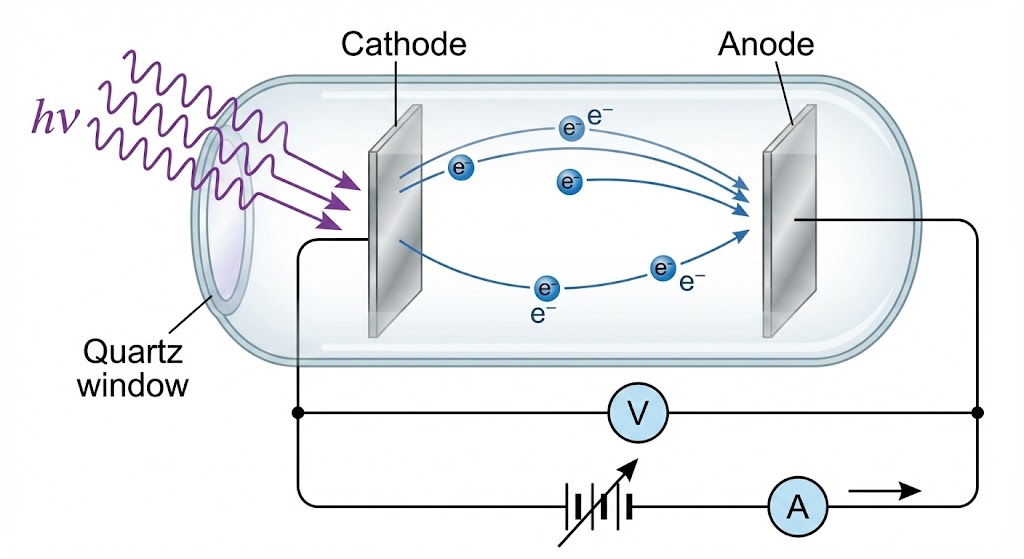
In the diagram, the cathode is the illuminated emitting surface; the anode collects electrons. The voltmeter measures the applied potential difference, and the ammeter measures the photocurrent.
1. Why frequency matters
Increasing the intensity of light does not, by itself, guarantee electron emission. In the usual single-photon model, one photon transfers energy to one electron. That energy must be sufficient to overcome the material's work function, .
The work function is the minimum energy needed to remove an electron from the surface. It depends on the material and its surface condition. The threshold frequency is
Below this frequency, the model predicts no emission, even if the light is made brighter. At the threshold, the maximum kinetic energy is zero. Above it, the excess photon energy can become kinetic energy.
2. Einstein's photoelectric equation
- is Planck's constant.
- and are the frequency and wavelength of the incident light.
- is the speed of light.
- is the greatest kinetic energy of an emitted electron, not the energy of every emitted electron.
In the non-relativistic model, . If , a negative value from the equation means that emission is not possible under these assumptions; it is not a negative electron kinetic energy.
3. Reading the graphs
Maximum kinetic energy against frequency
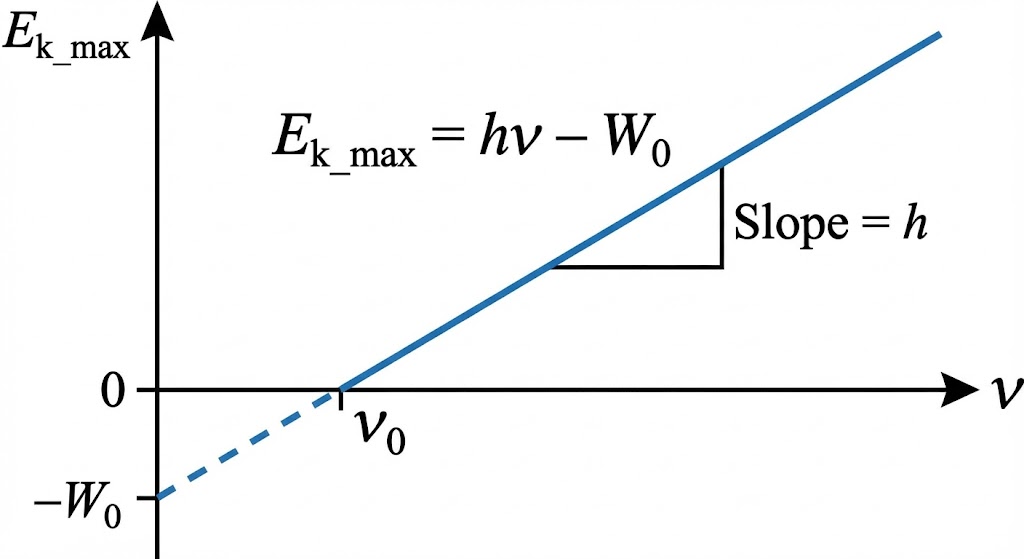
The slope is when the energy and frequency units are chosen consistently. The horizontal intercept is . Extending the straight line back to the vertical axis gives .
The dashed section below zero is only an extrapolation. It does not represent emitted electrons with negative kinetic energy.
Photocurrent against applied voltage
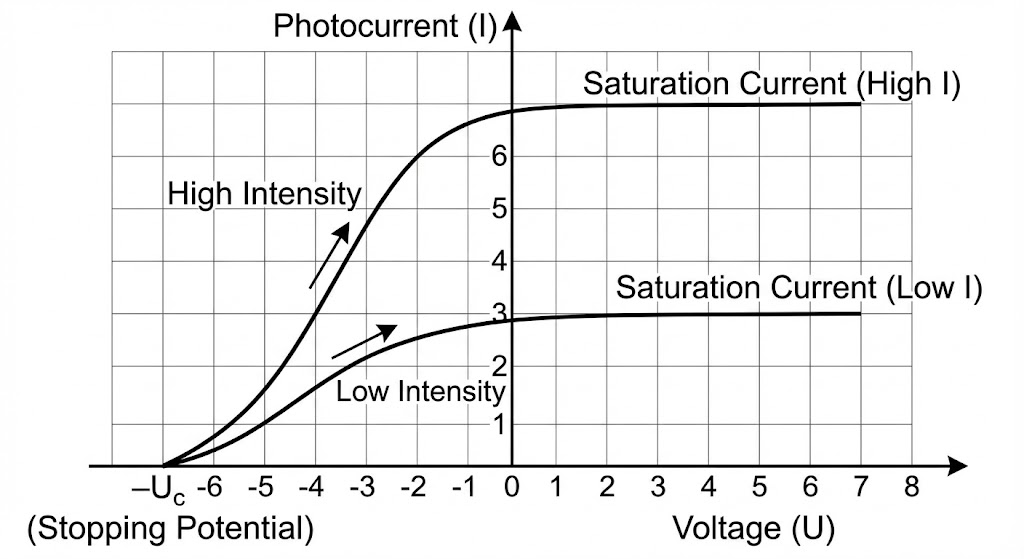
At a sufficiently positive collecting voltage, essentially all emitted electrons reach the collector and the current reaches its saturation value.
A reverse voltage opposes the electrons' motion. Let denote the positive magnitude of the stopping potential and the positive elementary charge. Then
On the signed voltage axis shown above, the intercept is . Do not insert that negative coordinate into an equation that uses the positive magnitude.
For the same metal at a fixed frequency above threshold, increasing intensity increases the photon arrival rate and usually raises the saturation current. It does not increase the energy per photon, the maximum kinetic energy, or the stopping potential in this model. Changing the frequency or the work function can change the stopping potential.
4. Keep energy units consistent
Useful approximate values are
For light with wavelength , the photon energy is approximately . Subtract the work function in the same energy unit before finding the maximum kinetic energy. Use the constants and rounding instructions supplied in the question.
5. Worked example: doubling the frequency
Light of frequency produces a stopping-potential magnitude from a metal with work function . Assume the same metal and surface conditions when the frequency doubles.
Initially,
At frequency ,
Therefore,
Since , the new stopping-potential magnitude is more than twice the original. Doubling the frequency doubles the photon energy, but the work function is subtracted only once in each emission event.
Further reading
Content reviewed: 9 September 2026.