Optics
CSCA Optics study guide organized around the publicly available CSCA syllabus. Practice Physics questions on aicsca.com.
Before planning this topic, check the CSCA Exam Guide 2026 for exam dates, registration, fees, and subject requirements.
Syllabus Alignment
This study guide is organized around the publicly available CSCA syllabus for international undergraduate applicants.
Who It Is For
International students preparing for CSCA Math, Physics, Chemistry, or Chinese exams.
Related Practice
CSCA Practice · Go to questions
Past papers and worked video solutions · Timed mock exams · All subject video lessons
Practice by Topic
Jump from this tutorial to filtered practice questions for the same knowledge point.
Related formulas, concepts, and glossary terms
Physics Formula & Concept Reference
- Relationship between Refractive Index and Speed of Light
- Critical Angle Formula (Condition for Total Internal Reflection)
- Law of Refraction (Snell's Law)
- Critical Angle for Total Internal Reflection
- Definition of Refractive Index
- Vector Form of Reflection Law
- Law of Reflection
- Bright Fringe Condition for Young's Double-Slit Interference
Physics Exam Glossary
Tutorial Content
Optics
Module Framework and Learning Objectives
Optics is the branch of physics involving the generation, propagation, and detection of light, as well as its interaction with matter. In the CSCA exam, Optics is a relatively independent module but one where it is easy to score high if mastered. We need to build our knowledge system from two dimensions: "Geometrical" and "Physical."
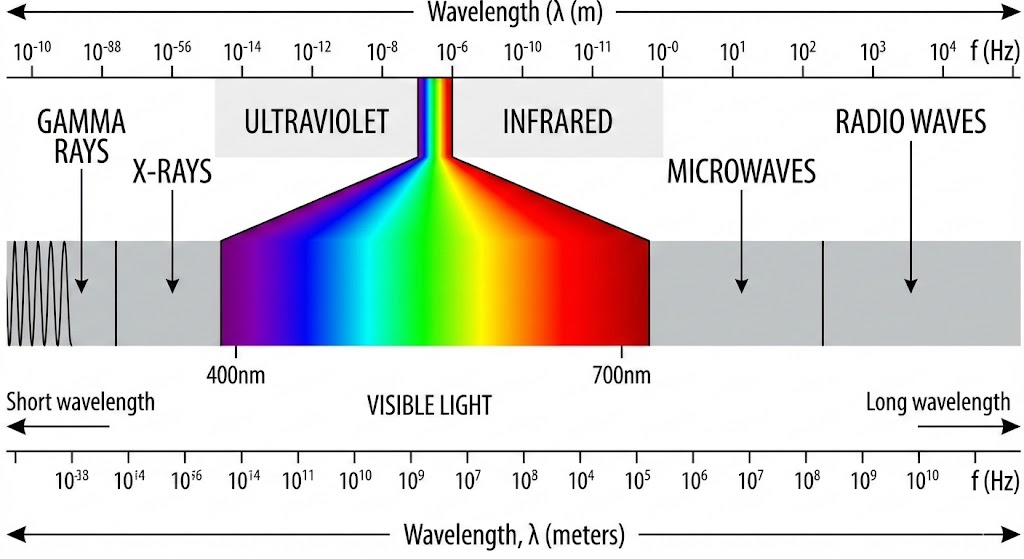
1. Core Knowledge System
This module is divided into two main areas of study:
* **Geometrical Optics**:
* **Core Model**: Ignores the wave nature of light and abstracts light as **"Light Rays."**
* **Key Principles**: Rectilinear propagation, Law of Reflection, Law of Refraction (Snell's Law $n_1 \sin \theta_1 = n_2 \sin \theta_2$), and Total Internal Reflection.
* **Applications**: Plane mirror imaging, lens imaging (convex and concave lenses), optical instruments (microscopes, telescopes), and vision correction.
* **Physical Optics**:
* **Core Model**: Based on the **"Wave Nature"** of light, treating light as an electromagnetic wave.
* **Key Principles**: Huygens' Principle, Principle of Superposition.
* **Typical Phenomena**: Interference (Young's double-slit, thin-film), Diffraction (single-slit), and Polarization. This part involves the relationship between wavelength $\lambda$, frequency $f$, and wave speed $v$ ($v = f\lambda$).
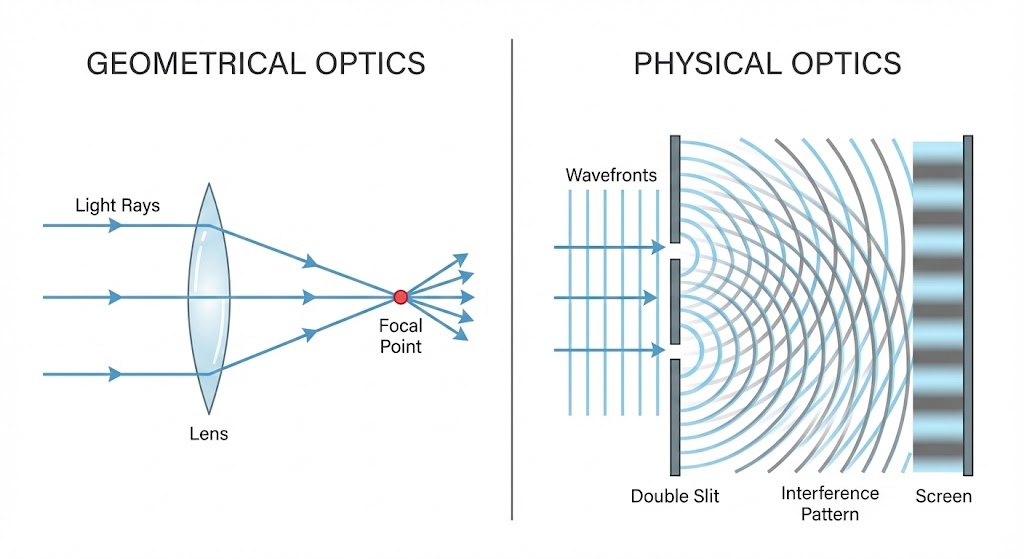
**Note**: Although light exhibits **Wave-Particle Duality**, the "Particle Nature of Light" (e.g., Photoelectric Effect) is usually categorized under the "Atomic Physics" module. However, maintaining this global perspective is crucial when studying optics.
2. Learning Objectives
1. **Distinguish Model Applicability**: Understand when to apply geometrical optics (macroscopic scale $\gg$ wavelength) and when to consider physical optics (obstacle size $\approx$ wavelength).
2. **Master Quantitative Calculations**:
* Proficiently use the Thin Lens Equation $\frac{1}{u} + \frac{1}{v} = \frac{1}{f}$ and the Magnification formula.
* Calculate the fringe spacing in double-slit interference $\Delta x = \frac{L\lambda}{d}$.
3. **Drawing Skills**: Accurately draw **Ray Diagrams**. This is the soul of solving geometrical optics problems.
4. **Explain Natural Phenomena**: Be able to use physical language to explain phenomena such as rainbows (dispersion), soap bubble colors (thin-film interference), and optical fiber transmission (total internal reflection).
3. Exam Preparation Advice
* **Focus on Diagramming**: In the CSCA exam, an accurate ray diagram often helps you quickly find geometrical relationships. Practice drawing diagrams by hand.
* **Unit Conversion**: In physical optics calculations, wavelength is usually in nanometers (nm), while geometrical dimensions are in meters (m) or centimeters (cm). **Pay strict attention to orders of magnitude.**
* **Connect with the Spectrum**: Memorize the approximate wavelength range of visible light (400nm - 700nm) and the color order, as this is very helpful for qualitative analysis questions.