Diffraction
CSCA Diffraction study guide organized around the publicly available CSCA syllabus. Practice Physics questions on aicsca.com.
Before planning this topic, check the CSCA Exam Guide 2026 for exam dates, registration, fees, and subject requirements.
Syllabus Alignment
This study guide is organized around the publicly available CSCA syllabus for international undergraduate applicants.
Who It Is For
International students preparing for CSCA Math, Physics, Chemistry, or Chinese exams.
Related Practice
CSCA Practice · Go to questions
Past papers and worked video solutions · Timed mock exams · All subject video lessons
Practice by Topic
Jump from this tutorial to filtered practice questions for the same knowledge point.
Related formulas, concepts, and glossary terms
Physics Formula & Concept Reference
- Angular Width of the Central Bright Fringe (Principal Maximum) in Single-Slit Fraunhofer Diffraction
- Dark Fringe Condition for Single-Slit Fraunhofer Diffraction
- Missing Order Condition in Grating Diffraction
- Minimum Resolvable Angle for Optical Instruments (Rayleigh Criterion)
- Half-Angular Width of Airy Disk in Circular Aperture Fraunhofer Diffraction
- Principal Maximum Condition for Grating Diffraction (Multiple-Slit Interference) - Grating Equation
- Angular Width of the Central Bright Fringe in Single-Slit Fraunhofer Diffraction
Physics Exam Glossary
Tutorial Content
Topic: Optics > Physical Optics > Diffraction
Diffraction
1. Conceptual Definition
Diffraction is the phenomenon where light bends around the edges of an **obstacle** or passes through a small **aperture**, entering the geometric shadow. It is direct evidence of the **Wave Nature** of light.
**Key Exam Point: Conditions for Diffraction**
* Diffraction is most pronounced when the size of the aperture/obstacle $a$ is **comparable to** or **smaller than** the wavelength $\lambda$ ($a \approx \lambda$).
* When $a \gg \lambda$, diffraction is negligible, and light travels in straight lines (Geometrical Optics).
2. Core Models & Formulas
#### A. Single Slit Fraunhofer Diffraction
Parallel light hits a single slit normally, creating a pattern on a screen.
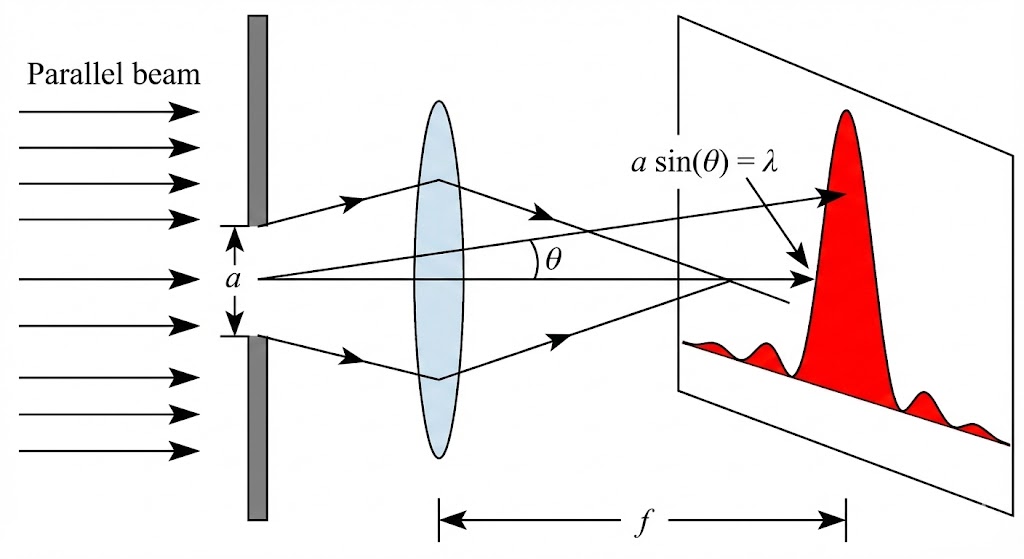 * **Pattern Characteristics**:
* **Central Maximum**: Located at the center, widest (approx. 2x width of others), and brightest.
* **Secondary Maxima**: Located on sides, intensity decreases rapidly.
* **Condition for Minima (Dark Fringes) —— ⚠️ Memorize**
Using the "Half-Period Zone" method, minima occur when the path difference between edges is an integer multiple of wavelength:
$$ a \sin\theta = k\lambda \quad (k = \pm 1, \pm 2, \pm 3...) $$
* **Note**: Here $k\lambda$ corresponds to **DARK** fringes, which is the opposite of double-slit interference (where $k\lambda$ is Bright)!
* **Width of Central Maximum**:
$$ \Delta x \approx \frac{2f\lambda}{a} $$
($f$ is focal length, $a$ is slit width). Narrower slit ($a$ decreases) $\to$ Wider pattern.
#### B. Circular Aperture & Rayleigh Criterion
Light passing through a circular hole forms an "Airy Disc".
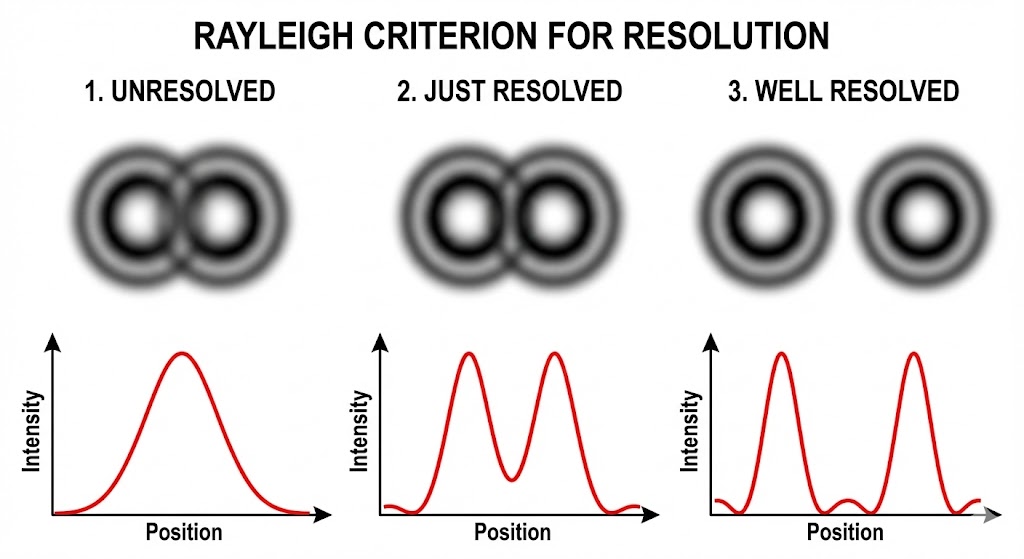 * **Resolution Limit**: The resolving power of optical instruments (telescopes, microscopes) is limited by diffraction.
* **Rayleigh Criterion**: Two point sources are considered **just resolved** when the center of the diffraction pattern of one lies exactly on the first dark ring of the other.
* **Minimum Angle of Resolution**:
$$ \theta_{min} = 1.22 \frac{\lambda}{D} $$
($D$ is aperture diameter). Smaller $\theta_{min}$ means higher resolving power.
#### C. Diffraction Grating
Consists of many equally spaced, identical slits.
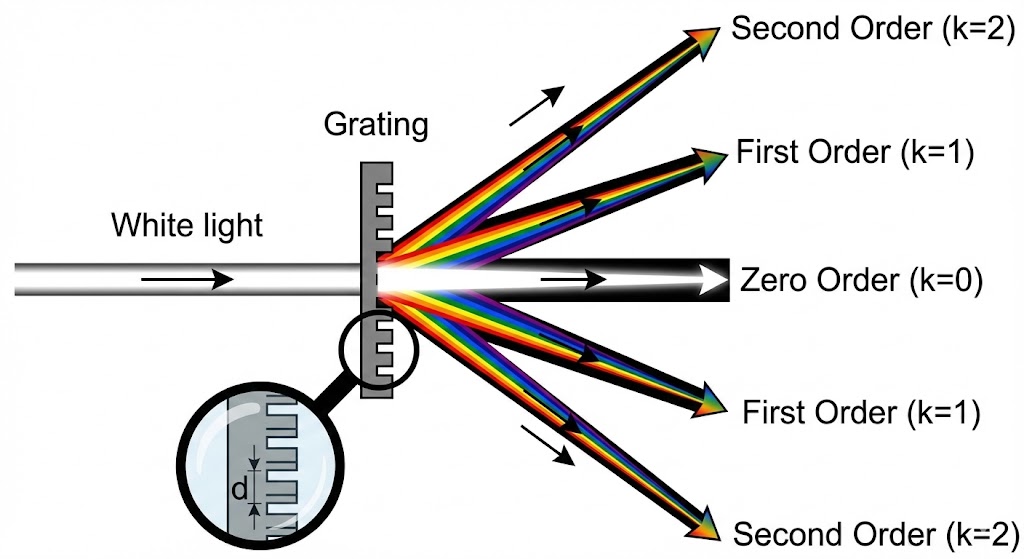 * **Features**: Compared to double-slit, grating fringes are **sharper, brighter, and more widely spaced**.
* **Grating Equation (Maxima Condition)**:
$$ d \sin\theta = k\lambda \quad (k = 0, \pm 1, \pm 2...) $$
($d$ is the grating constant, i.e., spacing between slits).
3. Comparison: Double-Slit vs. Single-Slit
| Feature | Double-Slit Interference | Single-Slit Diffraction |
| :--- | :--- | :--- |
| **Cause** | Superposition of 2 beams | Superposition of infinite wavelets from 1 wavefront |
| **Fringe Width** | Uniform width | Central max is widest |
| **Intensity** | Relatively uniform | Central max is brightest, decays fast |
| **Formula ($k\lambda$)** | $d\sin\theta = k\lambda$ (**Bright**) | $a\sin\theta = k\lambda$ (**Dark**) |
**Advanced Note**: Real double-slit patterns are **modulated by the single-slit diffraction envelope**. If an interference maximum coincides with a diffraction minimum, that interference fringe disappears. This is called a **Missing Order**.
4. Typical Examples
**Example 1: Single Slit Calculation**
Parallel light ($\lambda = 500 nm$) hits a slit ($a = 0.5 mm$). Screen is at focal plane of lens ($f = 1 m$). Find the width of the central bright fringe.
* **Solution**:
Central width = distance between first dark fringes ($k=\pm 1$).
Angle of 1st dark fringe: $\sin\theta \approx \theta = \frac{\lambda}{a}$.
Distance on screen: $x_1 = f \cdot \tan\theta \approx f \cdot \frac{\lambda}{a}$.
Width $\Delta x = 2x_1 = \frac{2f\lambda}{a}$.
$$ \Delta x = \frac{2 \times 1.0 \times 500 \times 10^{-9}}{0.5 \times 10^{-3}} = 2 \times 10^{-3} m = 2 mm $$
**Example 2: Resolving Power**
Hubble Telescope ($D=2.4m$) observes a star ($\lambda=550nm$). Find the minimum angular resolution.
* **Solution**:
$$ \theta_{min} = 1.22 \frac{\lambda}{D} = 1.22 \times \frac{5.5 \times 10^{-7}}{2.4} \approx 2.8 \times 10^{-7} rad $$