Electric Potential
CSCA Electric Potential study guide organized around the publicly available CSCA syllabus. Practice Physics questions on aicsca.com.
Before planning this topic, check the CSCA Exam Guide 2026 for exam dates, registration, fees, and subject requirements.
Syllabus Alignment
This study guide is organized around the publicly available CSCA syllabus for international undergraduate applicants.
Who It Is For
International students preparing for CSCA Math, Physics, Chemistry, or Chinese exams.
Related Practice
CSCA Practice · Go to questions
Past papers and worked video solutions · Timed mock exams · All subject video lessons
Practice by Topic
Jump from this tutorial to filtered practice questions for the same knowledge point.
Related formulas, concepts, and glossary terms
Physics Formula & Concept Reference
- Electric Potential of a System of Point Charges (Superposition Principle)
- Electric Potential of a Point Charge
- Definition of Electric Potential Difference
- Superposition Principle for Electric Potential
- Electric Potential of a Continuous Charge Distribution
- Definition of Electric Potential Difference (Voltage)
- Relationship between Electric Potential and Electric Field Strength
- Electric Potential Energy of a Charge in an Electrostatic Field
Physics Exam Glossary
Tutorial Content
Topic: Electromagnetism > Electrostatics > Electric Potential
1. Core Concept: Electric Potential ($V$)
**Electric Potential** is a scalar quantity describing the **energy attribute** of an electric field.
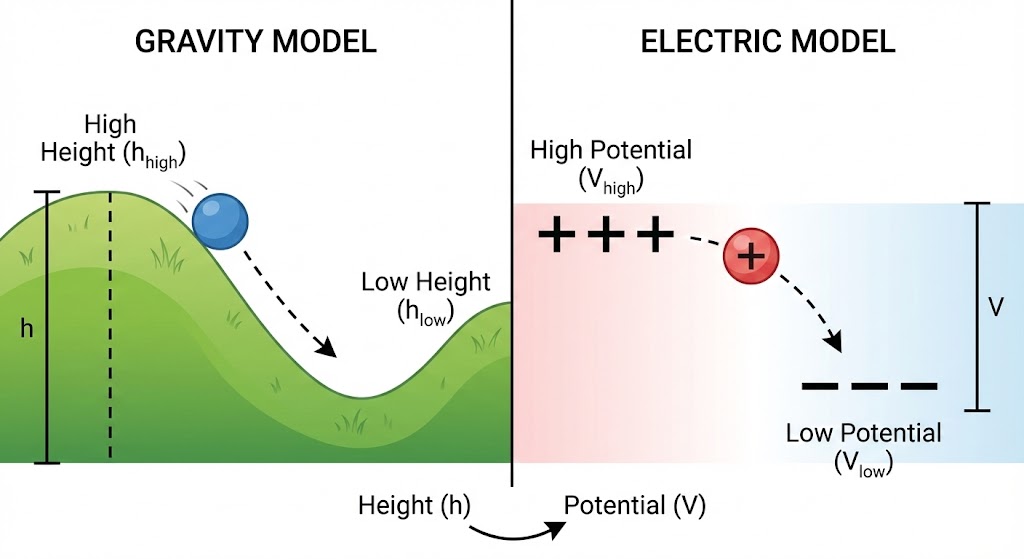
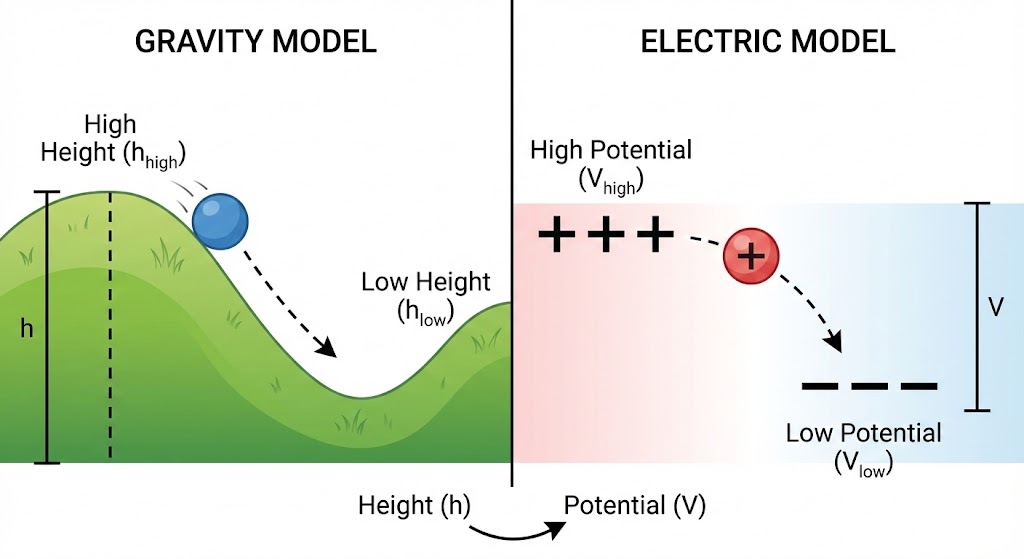
To understand it intuitively, use the **Gravity Analogy**:
* **Electric Potential** $\approx$ **Height** ($h$)
* **Electric Field Lines** $\approx$ **Slope Direction**
* **Positive Charge** creates a "**Hill**" (High Potential).
* **Negative Charge** creates a "**Valley**" (Low Potential).
**Definition**:
The work done by the electric force in moving a unit positive charge from a point to the **Zero Potential Reference** (usually infinity).
* **Formula**: $V = \frac{E_p}{q} = \frac{W}{q}$
* **Unit**: Volt ($V$), $1V = 1 J/C$.
* **Scalar**: It has magnitude and sign (+/-), but NO direction.
---
2. Core Formulas
(1) Potential of a Point Charge
For a stationary point charge in a vacuum ($V_{\infty}=0$).
$$V = k \frac{Q}{r}$$
**CSCA Exam Warning**:
Unlike Coulomb's Force calculation, you **MUST include the sign (+/-)** of the charge $Q$ in this formula!
* Potential around a positive charge is **positive**.
* Potential around a negative charge is **negative**.
(2) Superposition Principle
The total potential is the **Algebraic Sum** of potentials produced by individual charges.
$$V_{total} = V_1 + V_2 + ...$$
(Simple addition of numbers, no vector decomposition needed).
---
3. Potential Difference & Work
**Potential Difference (Voltage)**:
$$U_{AB} = V_A - V_B$$
**Work Done by Electric Force**:
$$W_{AB} = q U_{AB} = q(V_A - V_B)$$
* **Key Rules**:
* **Along the electric field line, Potential decreases.**
* Positive charges naturally move from High $V$ $\to$ Low $V$.
* Negative charges naturally move from Low $V$ $\to$ High $V$.
---
4. Equipotential Surfaces
Surfaces where the potential is equal everywhere. Similar to "Contour Lines" on a map.
**Four Properties**:
1. **Perpendicular**: Always perpendicular to Electric Field lines.
2. **Zero Work**: Moving a charge along an equipotential surface requires zero work.
3. **Direction**: Field lines point from Higher Potential surfaces to Lower ones.
4. **Density**: Dense equipotential lines indicate a stronger Electric Field ($E$).
---
5. Typical Examples
**Example 1: Calculation (Watch the Sign)**
**Problem**: A point charge $Q = -3.0 \times 10^{-9} C$. Find $V$ at $r = 0.1 m$.
**Solution**:
Substitute with sign:
$$V = k \frac{Q}{r} = 9.0 \times 10^9 \times \frac{-3.0 \times 10^{-9}}{0.1} = -270 \, V$$
**Example 2: Superposition (Dipole)**
**Problem**: At the midpoint between $+Q$ and $-Q$, what are the Potential and Field Strength?
**Solution**:
* **Potential**: $V_{mid} = V_+ + V_- = k\frac{Q}{r} + k\frac{-Q}{r} = 0$. (Scalar sum is zero).
* **Field**: Directions are the same, so they add up. $E_{mid} \neq 0$.
**Example 3: Work Calculation**
**Problem**: Move an electron ($q = -1.6\times 10^{-19}C$) from $A$ ($10V$) to $B$ ($6V$). Calculate work.
**Solution**:
$$W_{AB} = q(V_A - V_B) = (-1.6\times 10^{-19}) \times (4) = -6.4 \times 10^{-19} \, J$$