Ohm's Law
CSCA Ohm's Law study guide organized around the publicly available CSCA syllabus. Practice Physics questions on aicsca.com.
Before planning this topic, check the CSCA Exam Guide 2026 for exam dates, registration, fees, and subject requirements.
Syllabus Alignment
This study guide is organized around the publicly available CSCA syllabus for international undergraduate applicants.
Who It Is For
International students preparing for CSCA Math, Physics, Chemistry, or Chinese exams.
Related Practice
CSCA Practice · Go to questions
Past papers and worked video solutions · Timed mock exams · All subject video lessons
Practice by Topic
Jump from this tutorial to filtered practice questions for the same knowledge point.
Related formulas, concepts, and glossary terms
Physics Formula & Concept Reference
- What is the formula of Ohm's Law?
- Ohm's Law (for a complete circuit)
- Definition of Resistance
- Ohm's Law (for part of a circuit)
- What are the formulas for resistors in series and parallel?
- How to express electrical power using resistance, current, and voltage?
- Determinant Formula for Resistance (Resistivity Law)
Physics Exam Glossary
Tutorial Content
Topic: Electromagnetism > DC Circuits > Ohm's Law
1. Core Law: Ohm's Law
Ohm's Law is the cornerstone of circuit analysis. It reveals the quantitative relationship between voltage, current, and resistance in **pure resistive elements**.
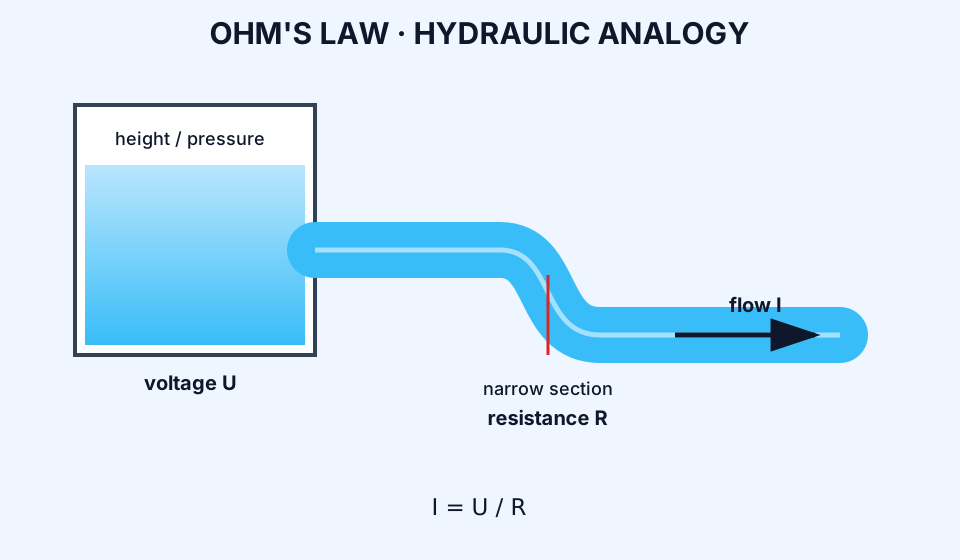
* **Formula**: $$I = \frac{U}{R}$$
* **Physical Meaning**: The current $I$ flowing through a conductor is directly proportional to the voltage $U$ across it and inversely proportional to its resistance $R$.
* **Scope of Application**: **Pure Resistive Circuits** (e.g., metal wires, resistors, electrolytes).
* *Note: It does not fully apply to non-linear components (like diodes, gaseous conductors) or active circuits containing EMF (like running motors).*
---
2. The "Two Faces" of Resistance
In the CSCA exam, distinguishing between the **Definition Formula** and the **Determination Formula** is a frequent testing point.
| Type | Formula | Significance | Notes |
| :--- | :---: | :--- | :--- |
| **Definition** | $$R = \frac{U}{I}$$ | Provides a method to **measure** resistance. | **$R$ is independent of $U$ and $I$**. For a fixed resistor, $R$ exists even if $U=0$. |
| **Determination** | $$R = \rho \frac{L}{S}$$ | Reveals factors that **determine** resistance. | $\rho$: Resistivity (Material/Temp)<br>$L$: Length<br>$S$: Cross-sectional Area |
**Common Mistake Warning**:
Many students think "$R$ is proportional to $U$ and inversely proportional to $I$". This is **WRONG**! Resistance is an intrinsic property determined by material and geometry (Determination Formula), not by voltage or current (Definition Formula).
---
3. Volt-Ampere Characteristic Curve ($I-U$ Graph)
Analyzing component properties via graphs is crucial for physics competitions and exams.
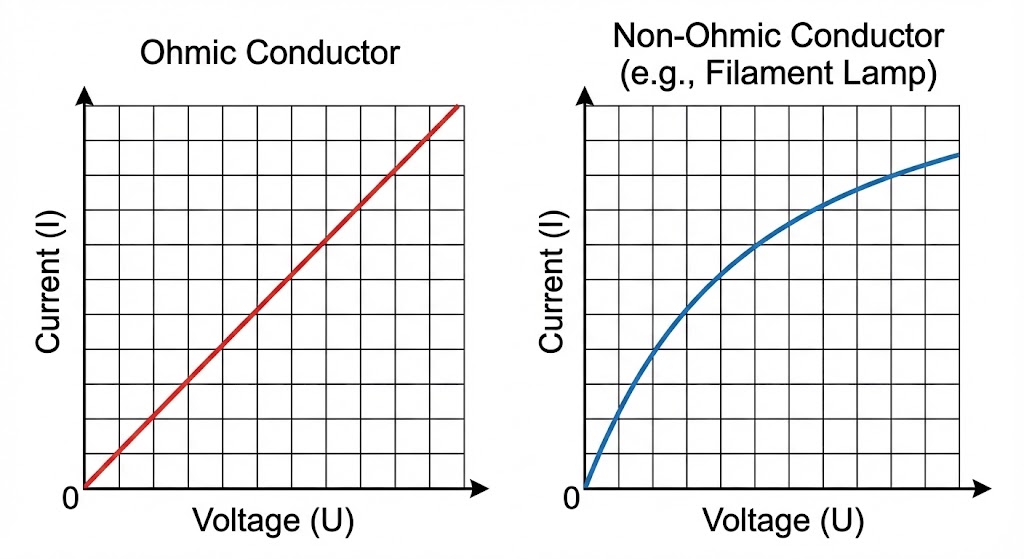
* **Linear Element (Ohmic)**: The graph is a straight line passing through the origin. Slope $k = \frac{I}{U} = \frac{1}{R}$. Larger slope means smaller resistance.
* **Non-linear Element (Non-Ohmic)**: The graph is a curve (e.g., light bulb filament, diode). Resistance changes with voltage/current. In this case, $R = U/I$ calculates the resistance at that specific operating point.
---
4. Key to Problem Solving: Consistency Principle
When applying $I = U/R$, you must ensure that **$I$, $U$, and $R$ belong to the SAME object** (the same conductor or the same component).
Typical Example Analysis
**Example: Mixed Circuit Calculation**
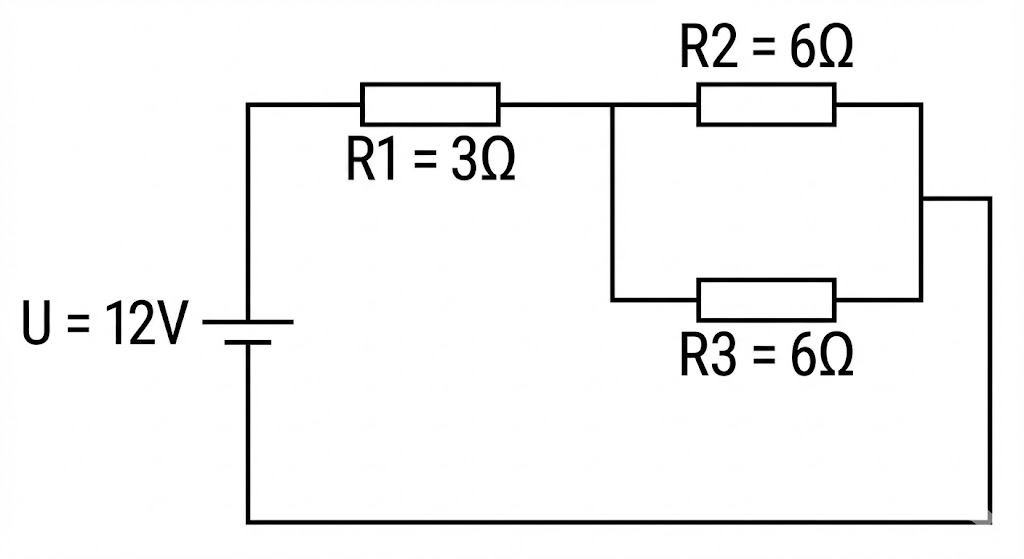
**Problem**: In the circuit shown, the source voltage is $U = 12V$. Resistors are $R_1 = 3\Omega$, $R_2 = 6\Omega$, and $R_3 = 6\Omega$. $R_2$ and $R_3$ are connected in parallel, and this combination is connected in series with $R_1$. Find: (1) Total resistance; (2) Current through $R_1$; (3) Voltage across $R_2$.
**Solution Steps**:
1. **Analyze Structure**: $R_2 // R_3$ (Parallel), then $+ R_1$ (Series).
2. **Total Resistance**:
* Parallel part: $\frac{1}{R_{23}} = \frac{1}{R_2} + \frac{1}{R_3} = \frac{1}{6} + \frac{1}{6} \Rightarrow R_{23} = 3\Omega$
* Total: $R_{tot} = R_1 + R_{23} = 3 + 3 = 6\Omega$
3. **Total Current ($I_1$)**:
* Ohm's Law (Whole circuit): $I_{tot} = \frac{U}{R_{tot}} = \frac{12V}{6\Omega} = 2A$
* Current is the same in series, so current through $R_1$ is $I_1 = 2A$.
4. **Voltage across $R_2$ ($U_2$)**:
* **Method 1 (Ohm's Law on Part)**: Calculate voltage across the parallel block. $U_{23} = I_{tot} \times R_{23} = 2A \times 3\Omega = 6V$. Since parallel voltages are equal, $U_2 = 6V$.
* **Method 2 (Potential Difference)**: Voltage drop on $R_1$ is $U_1 = I_1 R_1 = 6V$. Remaining voltage for the parallel part is $U_2 = U - U_1 = 6V$.
**Answer**: (1) $6\Omega$; (2) $2A$; (3) $6V$.