Work, Energy, and Conservation of Mechanical Energy
Apply the work–energy theorem and conservation of mechanical energy. Worked block and pendulum examples explain force signs, friction, and potential energy.
Before planning this topic, check the CSCA Exam Guide 2026 for exam dates, registration, fees, and subject requirements.
Syllabus Alignment
This study guide is organized around the publicly available CSCA syllabus for international undergraduate applicants.
Who It Is For
International students preparing for CSCA Math, Physics, Chemistry, or Chinese exams.
Related Practice
CSCA Practice · Go to questions
Past papers and worked video solutions · Timed mock exams · All subject video lessons
Practice by Topic
Jump from this tutorial to filtered practice questions for the same knowledge point.
Related formulas, concepts, and glossary terms
Physics Formula & Concept Reference
- Gravitational Potential Energy
- Gravitational Potential Energy Formula
- Formula for Work Done by a Constant Force
- Elastic Potential Energy Formula (Spring)
- Law of Conservation of Mechanical Energy
- Power (Average Power)
- Elastic Potential Energy (Spring)
- Work-Energy Theorem
Physics Exam Glossary
Tutorial Content
Work, Energy, and Conservation of Mechanical Energy
Work connects forces with changes in energy. If a question asks for a speed after an object moves through a distance, an energy equation may avoid the need to calculate the motion at every instant. Start by identifying the object or system, the initial and final states, and the forces that do work.
The equations below use classical mechanics. For the kinetic-energy calculations, treat the moving object as a constant-mass particle or as a body in translation without rotation. Use one consistent inertial reference frame.
1. Work done by a force
For a constant force acting through a displacement ,
where is the angle between the force and the displacement. Work is a scalar, measured in joules: .
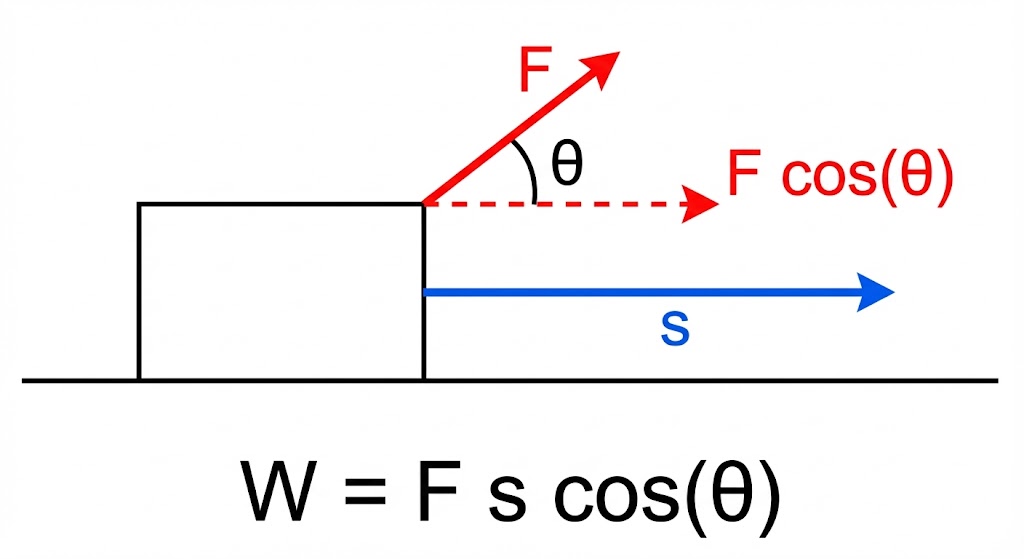
- If , the force does positive work.
- If , it does no work over that displacement.
- If , it does negative work.
For a varying force or a curved path, add the work over small displacements. In calculus notation,
The sign of the work done by one force does not, by itself, tell you whether the object speeds up. That depends on the net work done by all forces.
A force perpendicular to the velocity at every instant does no work. For example, the magnetic part of the Lorentz force on a moving point charge is perpendicular to its velocity. An electric force need not be perpendicular and can do work. Likewise, a normal force is not automatically a zero-work force; a moving surface can transfer energy to an object.
2. The work–energy theorem
The translational kinetic energy of a mass moving at speed is
The work–energy theorem relates the net work to its change in kinetic energy:
Include every force that does work. Positive net work increases the speed; negative net work decreases it. Zero net work means that the initial and final speeds are equal, although the direction of motion may change.
Work describes energy transferred during a process. Kinetic energy describes a state. If an object also rotates or deforms, the energy accounting must include those effects rather than treating as its entire energy.
Example 1: A block with friction
A block starts from rest on a horizontal surface. A constant horizontal force of pulls it through , while a constant friction force of opposes the motion. Find its final speed.
Gravity and the normal force are perpendicular to the displacement, so neither does work in this situation. The net work is
Therefore,
Using only the work done by the pulling force would overlook the energy transferred by friction.
3. Potential energy
Potential energy is associated with interactions within a system. For an object and Earth near the surface, where can be treated as constant,
Choose a reference height for and use it throughout the problem. The reference is arbitrary; the change in potential energy is what matters.
For an ideal spring obeying Hooke's law,
where is the extension or compression measured from the spring's natural length, and is the spring constant. This expression applies within the spring's Hooke's-law range.
For these conservative forces, work and potential-energy change satisfy
Gravity does positive work during a fall because gravitational potential energy decreases.
4. When is mechanical energy conserved?
Define mechanical energy as the kinetic energy plus the potential energies included in the model:
For the particle model used here, separating the conservative forces from the other forces gives
Here, is the work done by forces whose effects have not already been represented by . If that work is zero over the chosen interval,
Conservation of mechanical energy does not mean that kinetic and potential energy are individually constant. They can change by equal and opposite amounts. Friction often reduces mechanical energy while increasing internal energy; it does not destroy energy.
| Question | Useful relation | What to check |
|---|---|---|
| How does the net work change the speed? | Include the work done by all forces. | |
| How do gravity or a spring exchange kinetic and potential energy? | Check that the other forces do no net work. | |
| Does an applied force or friction transfer mechanical energy? | Do not count a conservative force both as work and as a potential-energy change. |
Example 2: A pendulum released from rest
A pendulum has a point-mass bob on a light, inextensible string of length , attached to a fixed pivot. It is released from rest with the string at to the downward vertical. Neglect air resistance. Find the speed at the lowest point.
Take the lowest point as the zero of gravitational potential energy. The release height is
The string tension is perpendicular to the bob's motion and does no work. Mechanical energy is therefore conserved:
The mass cancels. This calculation uses the exact height difference, so it does not require the small-angle approximation used for a pendulum's period.
Further reading
Content reviewed: 9 September 2026.