Kinetic Theory of Molecules
CSCA Kinetic Theory of Molecules study guide organized around the publicly available CSCA syllabus. Practice Physics questions on aicsca.com.
Before planning this topic, check the CSCA Exam Guide 2026 for exam dates, registration, fees, and subject requirements.
Syllabus Alignment
This study guide is organized around the publicly available CSCA syllabus for international undergraduate applicants.
Who It Is For
International students preparing for CSCA Math, Physics, Chemistry, or Chinese exams.
Related Practice
CSCA Practice · Go to questions
Past papers and worked video solutions · Timed mock exams · All subject video lessons
Practice by Topic
Jump from this tutorial to filtered practice questions for the same knowledge point.
Related formulas, concepts, and glossary terms
Physics Formula & Concept Reference
- Dalton's Law of Partial Pressures
- Pressure Formula (Kinetic Theory)
- Root-Mean-Square Speed Formula
- Relationship Between Temperature and Average Translational Kinetic Energy
- Pressure Formula (Microscopic Interpretation)
- Relationship between Average Translational Kinetic Energy and Temperature
Physics Exam Glossary
Tutorial Content
Kinetic Theory of Molecules
1. Concepts and Core Ideas
The Kinetic Theory is the foundation of thermal physics, explaining macroscopic phenomena via microscopic structure. It is based on three postulates:
1. **Matter is composed of particles**:
* Diameter $\approx 10^{-10} \, \text{m}$.
* **Avogadro constant ($N_A$)**: $6.02 \times 10^{23} \, \text{mol}^{-1}$.
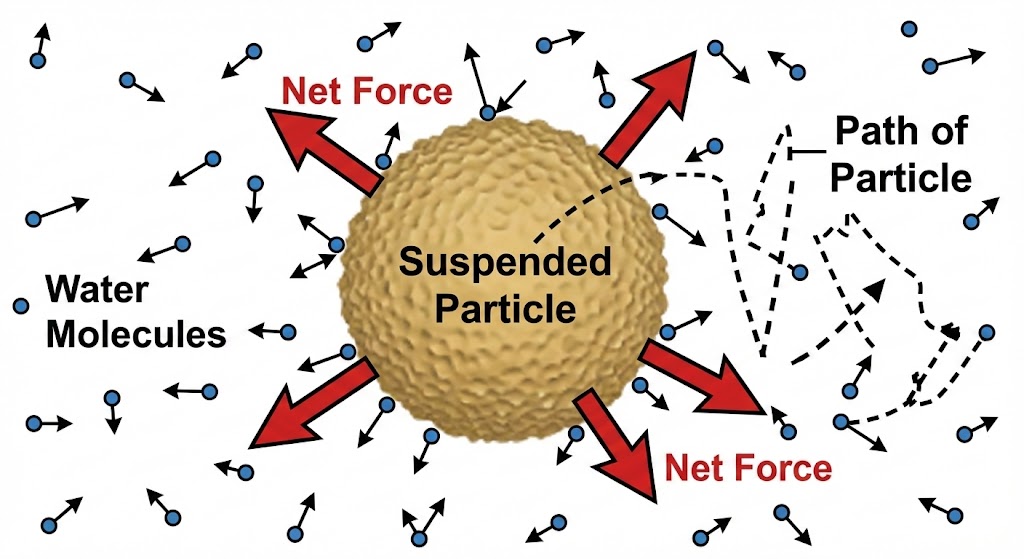
2. **Particles are in constant random motion**:
* **Evidence**: Diffusion and Brownian Motion.
* **Brownian Motion Focus**: It is the random movement of **suspended solid particles** (e.g., pollen), NOT the fluid molecules themselves. However, it **reflects** the chaotic motion of the invisible fluid molecules colliding with the particle.
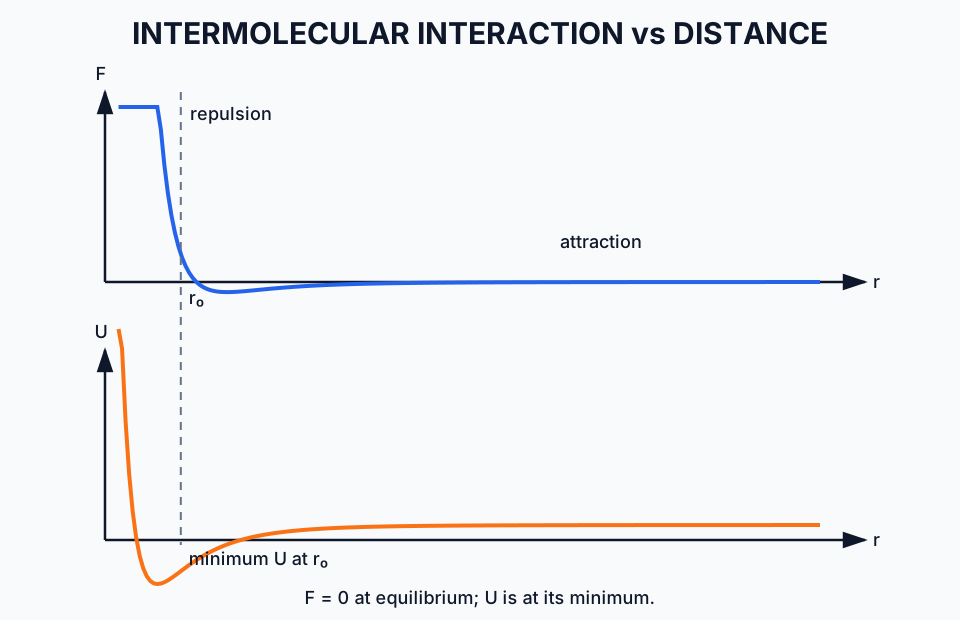
3. **Intermolecular Forces exist**:
* Both attractive and repulsive forces exist. Depending on distance $r$:
* $r < r_0$: Repulsion dominates.
* $r = r_0$: Forces are balanced ($F_{net}=0$). Equilibrium position.
* $r > r_0$: Attraction dominates.
* $r > 10r_0$: Force is negligible.
2. Statistical Law: Maxwell Speed Distribution
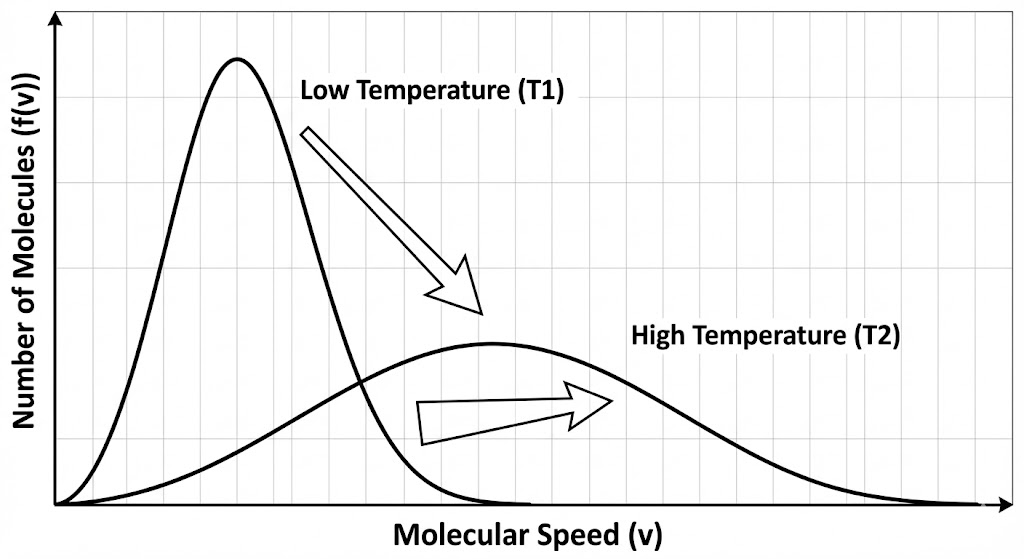
While individual molecular speed is random, the distribution follows a statistical pattern.
* **Pattern**: Most molecules have speeds near the average ("bell-shaped" but asymmetrical).
* **Effect of Temperature**: As $T$ increases, the peak shifts to the **right** (higher speed) and the curve becomes **flatter/wider**. This indicates a higher average kinetic energy.
3. Core Formulas (CSCA Focus)
* **Pressure Formula** (Conceptual understanding):
$$ p = \frac{2}{3} n \bar{\varepsilon_k} $$
Where $n = N/V$ is number density.
* **Microscopic Meaning of Temperature** (Crucial):
Temperature is a measure of the **average translational kinetic energy** of molecules.
$$ \bar{\varepsilon_k} = \frac{1}{2} m \overline{v^2} = \frac{3}{2} k T $$
* $k$: Boltzmann constant ($1.38 \times 10^{-23} \, \text{J/K}$).
* **Note**: Higher $T$ means higher average energy. $T$ is a statistical concept, meaningless for a single molecule.
* **RMS Speed ($v_{\text{rms}}$)**:
$$ v_{\text{rms}} = \sqrt{\frac{3RT}{M}} $$
* $M$: Molar mass (kg/mol).
* **Insight**: At the same $T$, lighter gas molecules (lower $M$) move faster.
4. Typical Examples
**Example 1: Calculation**
Oxygen ($O_2$) has molar mass $M = 32 \, \text{g/mol}$ at $27^{\circ}\text{C}$.
Find: (1) Average translational kinetic energy; (2) RMS speed.
**Solution**:
1. **Convert Units**: $T = 300 \, \text{K}$, $M = 0.032 \, \text{kg/mol}$.
2. **Avg Kinetic Energy**:
$$ \bar{\varepsilon_k} = \frac{3}{2} k T \approx 6.21 \times 10^{-21} \, \text{J} $$
3. **RMS Speed**:
$$ v_{\text{rms}} = \sqrt{\frac{3RT}{M}} = \sqrt{\frac{3 \times 8.31 \times 300}{0.032}} \approx 483 \, \text{m/s} $$
**Example 2: Conceptual Check**
Regarding Brownian motion, which statement is true?
A. It is the thermal motion of fluid molecules.
B. The larger the suspended particle, the more obvious the motion.
C. The higher the temperature, the more intense the motion.
**Solution**: **C**.
* A is False: It is the motion of the *suspended particle*, caused by fluid molecules.
* B is False: Larger particles have more inertia and average out the collisions, making motion *less* obvious.
* C is True: Higher $T$ means more energetic molecular collisions.