Acceleration
CSCA Acceleration study guide organized around the publicly available CSCA syllabus. Practice Physics questions on aicsca.com.
Before planning this topic, check the CSCA Exam Guide 2026 for exam dates, registration, fees, and subject requirements.
Syllabus Alignment
This study guide is organized around the publicly available CSCA syllabus for international undergraduate applicants.
Who It Is For
International students preparing for CSCA Math, Physics, Chemistry, or Chinese exams.
Related Practice
CSCA Practice · Go to questions
Past papers and worked video solutions · Timed mock exams · All subject video lessons
Practice by Topic
Jump from this tutorial to filtered practice questions for the same knowledge point.
Related formulas, concepts, and glossary terms
Physics Formula & Concept Reference
- Definition of Instantaneous Acceleration
- Relationship Between Acceleration and Displacement (Uniformly Accelerated Rectilinear Motion)
- Velocity-Displacement Relation for Uniformly Accelerated Rectilinear Motion
- Displacement Formula for Uniformly Accelerated Rectilinear Motion (Involving Acceleration)
- Definition of Average Acceleration
- Acceleration Formula for Uniformly Accelerated Rectilinear Motion
Physics Exam Glossary
Tutorial Content
Acceleration
1. Core Definition
Acceleration is not just about "going faster"; it measures **how fast the velocity changes** and **in what direction**.
* **Definition**: The rate of change of velocity.
* **Formula**: $$\vec{a} = \frac{\Delta \vec{v}}{\Delta t} = \frac{\vec{v}_f - \vec{v}_i}{\Delta t}$$
* **Vector Nature**: The direction of $\vec{a}$ is determined solely by the direction of **change in velocity ($\Delta \vec{v}$)**, not necessarily the direction of velocity $\vec{v}$ itself.
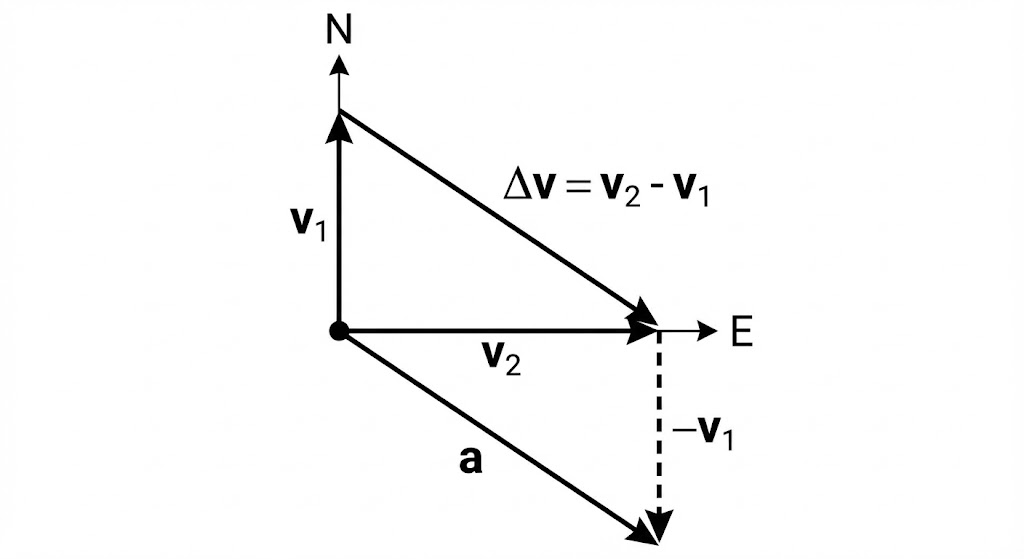
2. Core Difficulty: Speeding Up or Slowing Down?
This is the most frequent testing point in CSCA. **Remember: $a < 0$ does NOT mean slowing down!**
The only criterion for "Speeding Up" or "Slowing Down" is the **relationship between the directions of $\vec{a}$ and $\vec{v}$**.
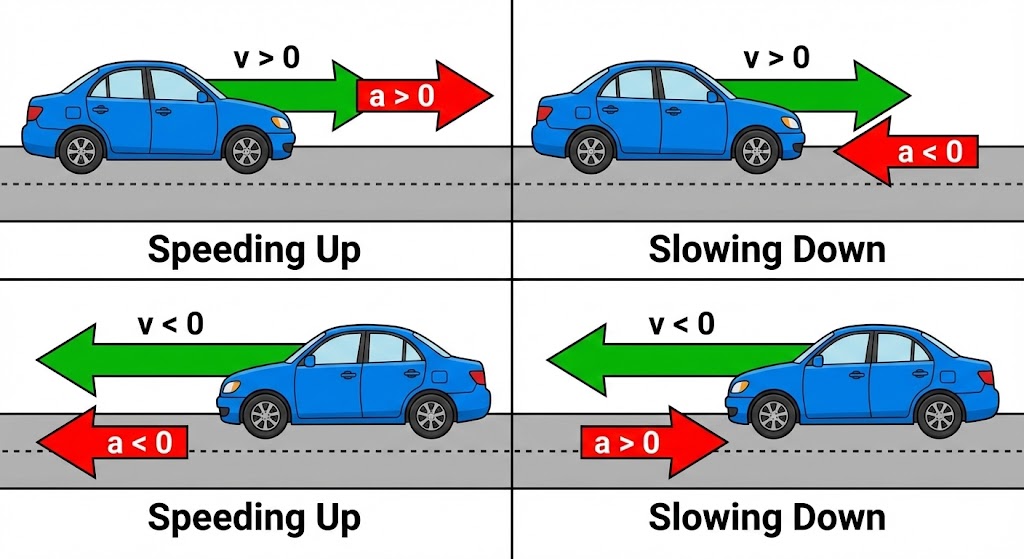
| Sign of $v$ (Direction of Motion) | Sign of $a$ (Direction of Force) | Relationship | Motion State (Speed Change) |
| :---: | :---: | :---: | :--- |
| $+$ (Right) | $+$ (Right) | **Same** | **Speeding Up** |
| $+$ (Right) | $-$ (Left) | **Opposite** | **Slowing Down** |
| $-$ (Left) | $-$ (Left) | **Same** | **Speeding Up** |
| $-$ (Left) | $+$ (Right) | **Opposite** | **Slowing Down** |
**Summary**: Same signs = Speed up; Opposite signs = Slow down.
3. Graphical Analysis ($v-t$ Graph)
In a Velocity-Time graph, acceleration is represented by geometric features.
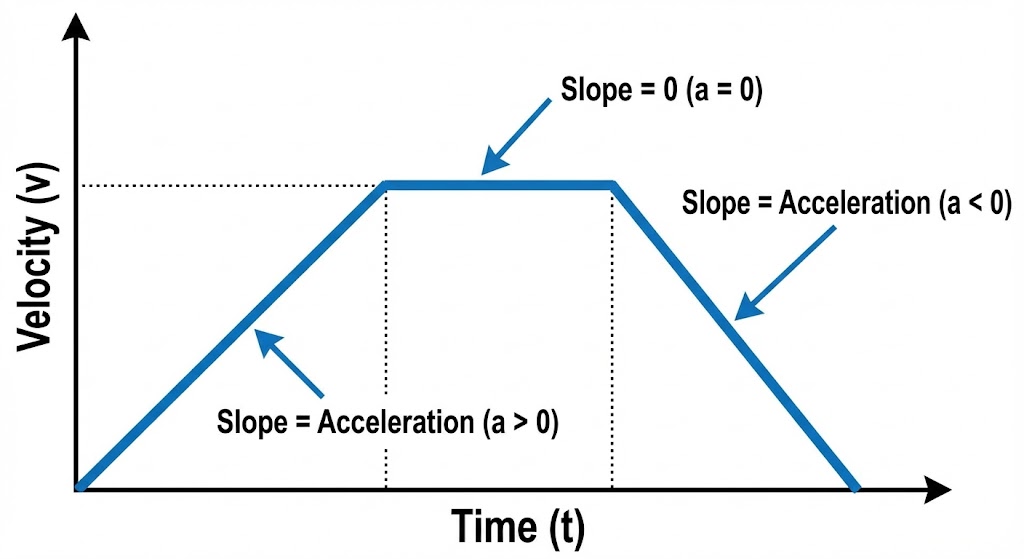
* **Slope**: The slope of the tangent line in a $v-t$ graph represents **Instantaneous Acceleration**.
* Positive Constant Slope $\to$ Uniform Acceleration.
* Zero Slope $\to$ Constant Velocity.
* Changing Slope $\to$ Variable Acceleration.
* **Area**: The area under an Acceleration-Time ($a-t$) graph represents the **Change in Velocity ($\Delta v$)**.
4. Typical Examples
**Example 1: Does Negative Acceleration Mean Slowing Down?**
**Question**: An object moves West, and its acceleration is also directed West. Is its speed increasing or decreasing?
**Analysis**:
1. Define East as Positive (+), West as Negative (-).
2. Moves West $\to v < 0$.
3. Acceleration West $\to a < 0$.
4. $a$ and $v$ have the **same sign**, so the object is **Speeding Up**.
**Example 2: The Braking Problem**
**Question**: A car travels at $20\text{m/s}$ and brakes with an acceleration magnitude of $5\text{m/s}^2$. Find the displacement during the **last** $2\text{s}$ before it stops.
**Trick**: Don't calculate the first 2 seconds of braking. The question asks for the "last" 2 seconds.
**Technique**:
* **Reverse Thinking**: Treat the braking process (decelerating to 0) in reverse as accelerating from 0.
* $x = \frac{1}{2}at^2 = \frac{1}{2}(5)(2)^2 = 10\text{m}$.
* This utilizes symmetry and avoids calculating exactly when the final 2s interval starts.