SHM & Mechanical Waves
CSCA SHM & Mechanical Waves study guide organized around the publicly available CSCA syllabus. Practice Physics questions on aicsca.com.
Before planning this topic, check the CSCA Exam Guide 2026 for exam dates, registration, fees, and subject requirements.
Syllabus Alignment
This study guide is organized around the publicly available CSCA syllabus for international undergraduate applicants.
Who It Is For
International students preparing for CSCA Math, Physics, Chemistry, or Chinese exams.
Related Practice
CSCA Practice · Go to questions
Past papers and worked video solutions · Timed mock exams · All subject video lessons
Practice by Topic
Jump from this tutorial to filtered practice questions for the same knowledge point.
Related formulas, concepts, and glossary terms
Physics Formula & Concept Reference
- Period of a Mass-Spring System
- Wave Equation for a Plane Simple Harmonic Wave
- Relationship between Wavelength, Wave Speed, and Frequency
- Conditions for Constructive and Destructive Interference of Waves
- Simple Harmonic Motion Displacement Equation
- Plane Simple Harmonic Wave Equation
- Period Formula for a Spring Oscillator
- Relationship between Wave Speed, Wavelength, and Frequency
Physics Exam Glossary
Tutorial Content
SHM & Mechanical Waves
1. Simple Harmonic Motion (SHM)
#### A. Definition & Features
The most basic periodic motion, defined by a **Restoring Force**.
* **Dynamics**: $F = -kx$ (Force proportional to displacement, opposite direction).
* **Kinematics**: $a = -\omega^2 x$.
#### B. Key Quantities
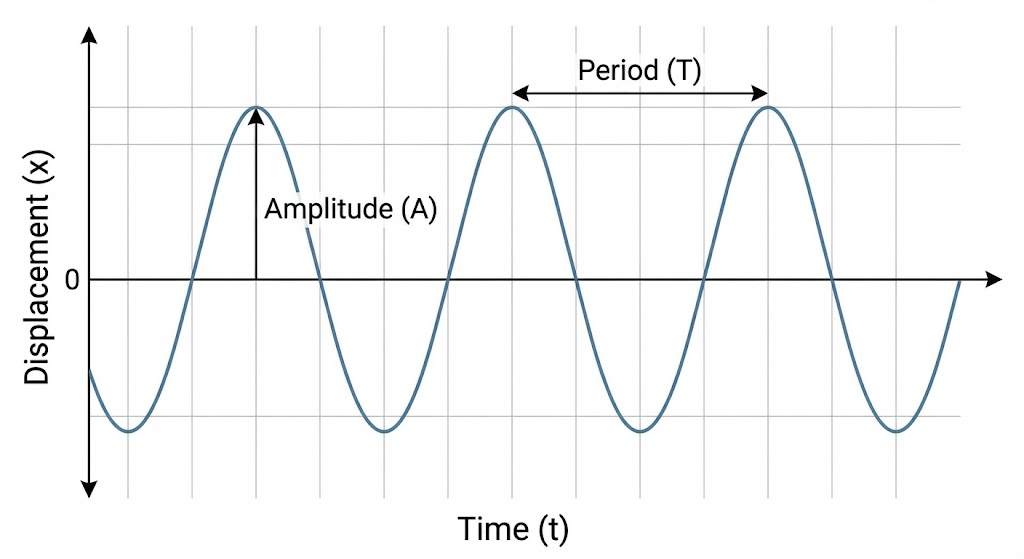
* **Amplitude ($A$)**: Max displacement from equilibrium.
* **Period ($T$)**: Time for one complete cycle.
* Spring: $T = 2\pi \sqrt{\frac{m}{k}}$
* Pendulum (small angle): $T = 2\pi \sqrt{\frac{L}{g}}$
* **Frequency ($f$)**: $f = 1/T$.
* **Angular Frequency ($\omega$)**: $\omega = 2\pi f = \frac{2\pi}{T}$.
#### C. Vibration Graph ($x-t$ Graph)
Describes the history of **ONE particle**.
* X-axis: Time $t$.
* Y-axis: Displacement $x$.
* Slope: Velocity $v$.
2. Mechanical Waves
#### A. Core Formula
Wave Speed depends on **Medium**; Frequency depends on **Source**.
$$v = \lambda f = \frac{\lambda}{T}$$
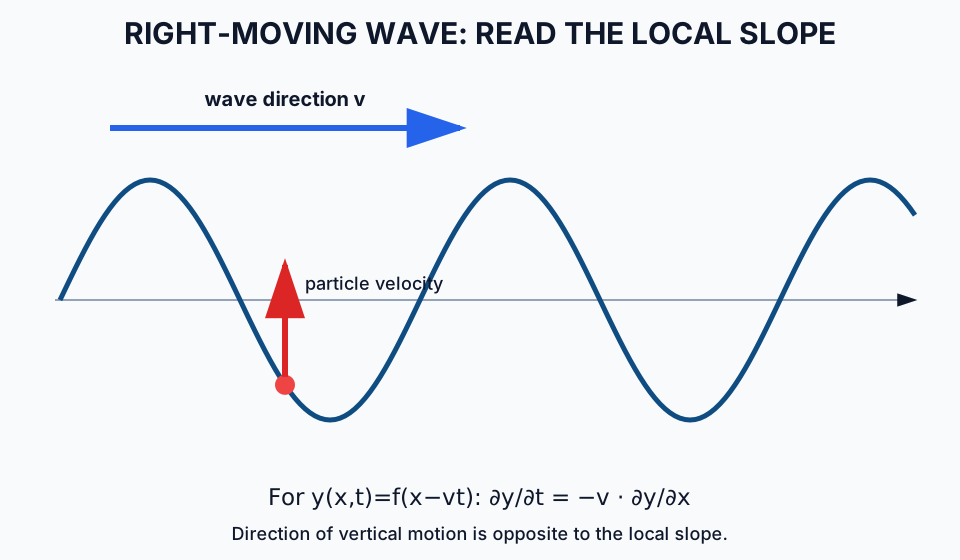
#### B. Wave Graph ($y-x$ Graph)
Describes the position of **ALL particles** at **ONE instant**.
* X-axis: Position $x$.
* Y-axis: Displacement $y$.
* **"Same-Side Rule"**: A trick to find direction. On the wave curve, the direction of wave propagation and the direction of particle vibration are on the **same side** of the curve line.
3. Vibration Graph vs. Wave Graph
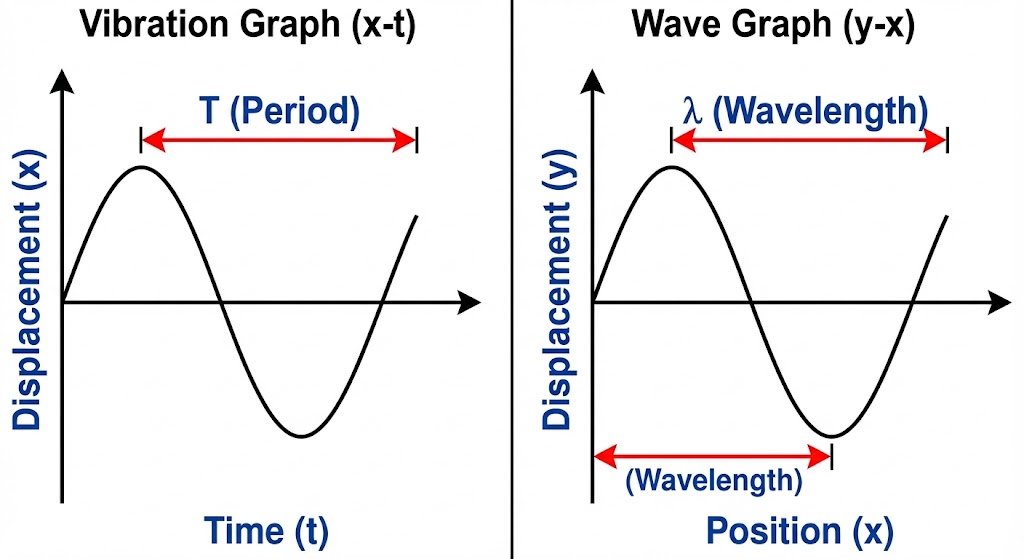
Most common confusion point!
| Feature | Vibration Graph ($x-t$) | Wave Graph ($y-x$) |
| :--- | :--- | :--- |
| **Subject** | **ONE particle** | **ALL particles** (The medium) |
| **X-Axis** | Time ($t$) | Position ($x$) |
| **Analogy** | A person's "Diary" | A group "Photo" |
| **Read Directly** | Period $T$, Amplitude $A$ | Wavelength $\lambda$, Amplitude $A$ |
4. Typical Examples
**Example 1: Same-Side Rule**
**Problem**: A wave moves RIGHT. Find the vibration direction of particle P at $x=2\text{m}$.
**Solution**:
1. Locate P.
2. Since wave moves RIGHT, imagine the waveform shifting slightly to the right.
3. Or use Same-Side Rule: If P is on an "uphill" slope and wave moves Right, P must move **Down**.
**Example 2: Wave Speed Calculation**
**Problem**: In air, $\lambda_1 = 2\text{m}, v_1 = 340\text{m/s}$. Enters water, $\lambda_2 = 8\text{m}$. Find speed in water.
**Solution**:
Source unchanged $\to$ **Frequency $f$ is constant**.
$f = \frac{v_1}{\lambda_1} = \frac{340}{2} = 170\text{Hz}$.
$v_2 = \lambda_2 f = 8 \times 170 = 1360\text{m/s}$.
**Example 3: Speed from Graphs**
**Problem**: From $x-t$ graph, $T=0.2\text{s}$. From $y-x$ graph, $\lambda=4\text{m}$. Find wave speed.
**Solution**:
$v = \frac{\lambda}{T} = \frac{4}{0.2} = 20\text{m/s}$.