Circular Motion & Gravitation
CSCA Circular Motion & Gravitation study guide organized around the publicly available CSCA syllabus. Practice Physics questions on aicsca.com.
Before planning this topic, check the CSCA Exam Guide 2026 for exam dates, registration, fees, and subject requirements.
Syllabus Alignment
This study guide is organized around the publicly available CSCA syllabus for international undergraduate applicants.
Who It Is For
International students preparing for CSCA Math, Physics, Chemistry, or Chinese exams.
Related Practice
CSCA Practice · Go to questions
Past papers and worked video solutions · Timed mock exams · All subject video lessons
Practice by Topic
Jump from this tutorial to filtered practice questions for the same knowledge point.
Related formulas, concepts, and glossary terms
Physics Formula & Concept Reference
- Angular Velocity Formula for Uniform Circular Motion
- Linear Velocity Formula for Uniform Circular Motion
- Basic Equation for Celestial Body in Uniform Circular Motion (Gravity as Centripetal Force)
- Centripetal Acceleration Formula for Uniform Circular Motion
- Kepler's Third Law (Law of Periods)
- Universal Gravitation Provides Centripetal Force for Celestial Bodies in Uniform Circular Motion
- Centripetal Force Formula for Uniform Circular Motion
Physics Exam Glossary
Tutorial Content
Circular Motion & Gravitation
1. Kinematics of Circular Motion
Quantities describing circular motion:
* **Linear Velocity ($v$)**: How fast it moves along the path. Tangential direction.
* Formula: $v = \frac{\Delta s}{\Delta t} = \frac{2\pi r}{T}$
* **Angular Velocity ($\omega$)**: How fast the angle changes.
* Formula: $\omega = \frac{\Delta \theta}{\Delta t} = \frac{2\pi}{T} = 2\pi f$
* **Relation**: $$v = \omega r$$
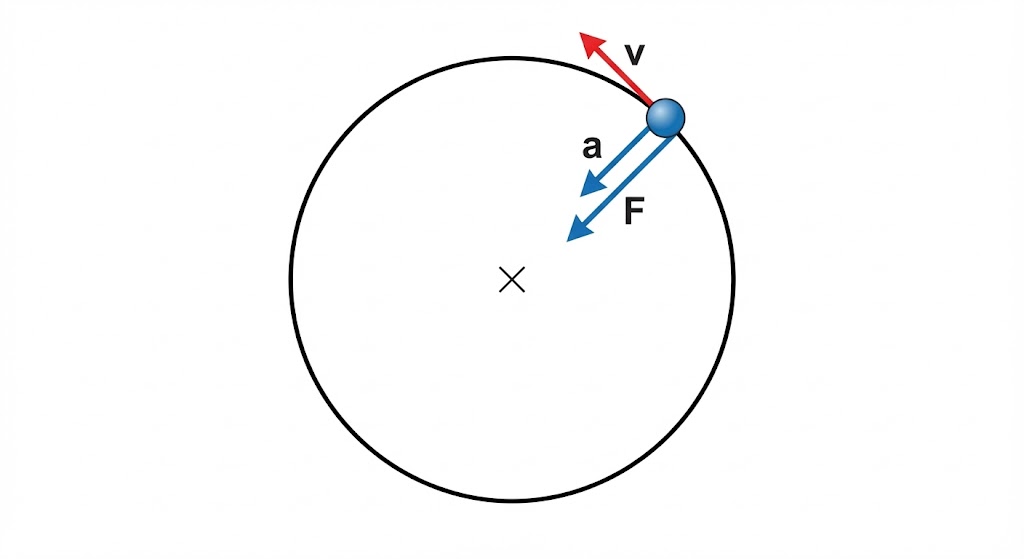
* **Centripetal Acceleration ($a_n$)**: Changes direction only.
* Formula: $$a_n = \frac{v^2}{r} = \omega^2 r = \frac{4\pi^2}{T^2}r$$
* Direction: **Always points to the center**.
2. Dynamics of Circular Motion
#### Centripetal Force ($F_n$)
* **Definition**: The force causing centripetal acceleration.
* **Nature**: It is an **Effect Force**, not a new type of force! It is provided by the **net force** or **component** of gravity, tension, friction, etc.
* **Formula**:
$$F_n = m a_n = m \frac{v^2}{r} = m \omega^2 r$$
#### Classic Model: Conical Pendulum
A standard CSCA model for force analysis.
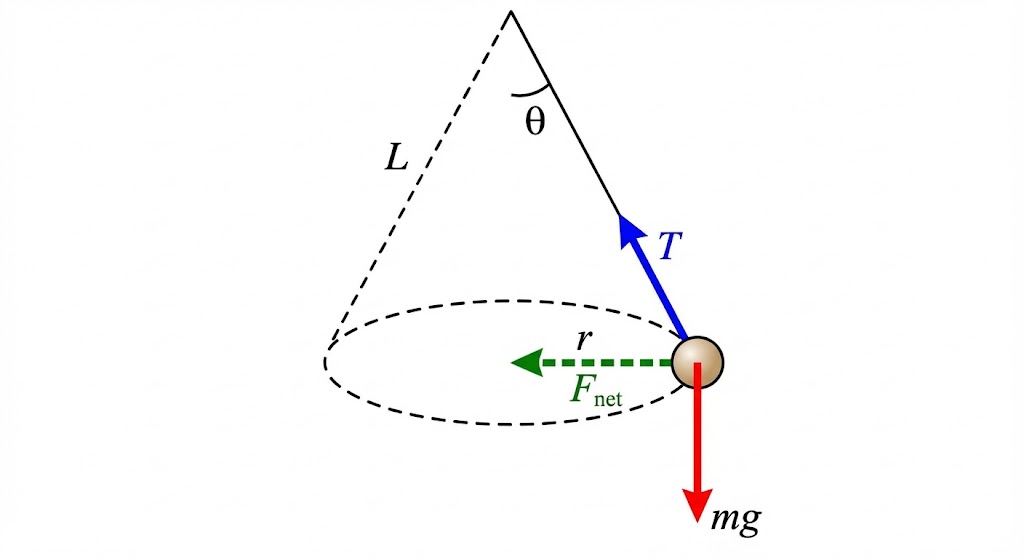
* **FBD**: Gravity $mg$ (down), Tension $T$ (along string).
* **Net Force**: Horizontal, pointing to the center.
* **Equations**:
* Vertical: $T \cos\theta = mg$
* Horizontal: $T \sin\theta = m \frac{v^2}{r} = m \omega^2 r$
* Geometry: $r = L \sin\theta$
3. Gravitation & Spaceflight
#### A. Law of Universal Gravitation
$$F = G \frac{m_1 m_2}{r^2}$$
#### B. Core Equation for Satellites
**"Gravitational Force provides Centripetal Force"** is the key.
$$G \frac{Mm}{r^2} = m \frac{v^2}{r} = m \omega^2 r = m \frac{4\pi^2}{T^2}r$$
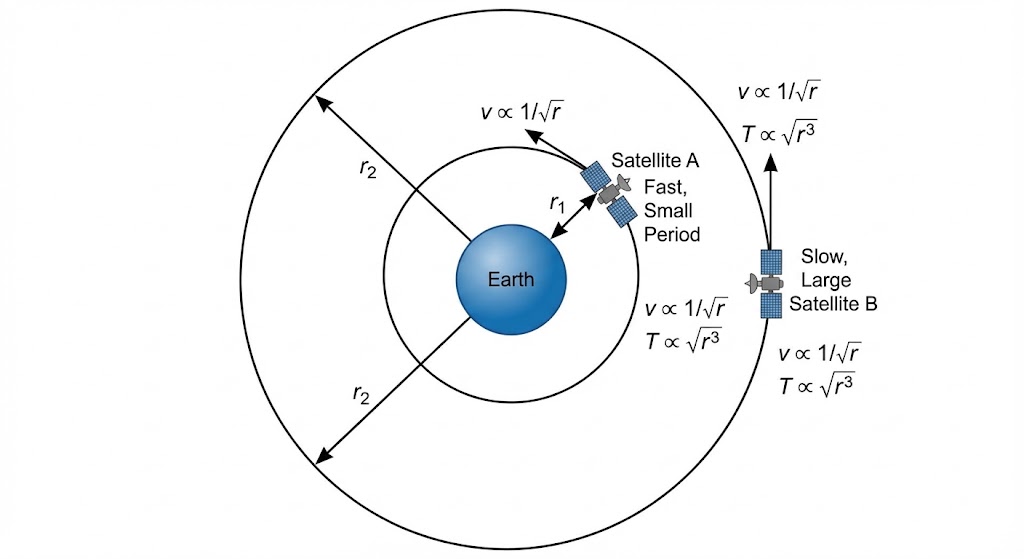
**Key Conclusion**: As orbital radius $r$ increases:
* Velocity $v = \sqrt{\frac{GM}{r}}$ $\downarrow$ (Decreases)
* Period $T = \sqrt{\frac{4\pi^2 r^3}{GM}}$ $\uparrow$ (Increases)
#### C. Golden Substitution
On a planet's surface, Gravity $\approx$ Gravitational Force:
$$G \frac{Mm}{R^2} = mg \quad \Rightarrow \quad GM = gR^2$$
* Used to eliminate $M$ when $g$ and $R$ are known.
#### D. First Cosmic Velocity
The orbital speed close to Earth's surface.
$$v_1 = \sqrt{\frac{GM}{R}} = \sqrt{gR} \approx 7.9 \, \text{km/s}$$
4. Typical Examples
**Example 1: Conical Pendulum**
**Problem**: String length $L$, mass $m$, angle $\theta$. Find velocity $v$.
**Solution**:
$F_{net} = m g \tan\theta$.
$m g \tan\theta = m \frac{v^2}{r}$ where $r = L \sin\theta$.
$v = \sqrt{g L \sin\theta \tan\theta}$.
**Example 2: Orbit Change**
**Problem**: Satellite moves from Low Orbit to High Orbit. How do KE and Period change?
**Solution**:
* $r$ increases $\to$ $v$ decreases $\to$ **KE decreases**.
* $r$ increases $\to$ **Period $T$ increases**.
**Example 3: Golden Substitution**
**Problem**: Planet radius is 2x Earth, Mass is 8x Earth. Find ratio of First Cosmic Velocity.
**Solution**:
$v = \sqrt{\frac{GM}{R}}$.
Ratio = $\sqrt{8 \cdot \frac{1}{2}} = \sqrt{4} = 2$.