Free Fall Motion
CSCA Free Fall Motion study guide organized around the publicly available CSCA syllabus. Practice Physics questions on aicsca.com.
Before planning this topic, check the CSCA Exam Guide 2026 for exam dates, registration, fees, and subject requirements.
Syllabus Alignment
This study guide is organized around the publicly available CSCA syllabus for international undergraduate applicants.
Who It Is For
International students preparing for CSCA Math, Physics, Chemistry, or Chinese exams.
Related Practice
CSCA Practice · Go to questions
Past papers and worked video solutions · Timed mock exams · All subject video lessons
Practice by Topic
Jump from this tutorial to filtered practice questions for the same knowledge point.
Related formulas, concepts, and glossary terms
Physics Formula & Concept Reference
- Free Fall Velocity-Displacement Relation
- Free Fall Displacement Formula (with Initial Velocity)
- Free Fall Displacement Formula
- Free Fall Final Velocity Formula
Physics Exam Glossary
Tutorial Content
Topic: Free Fall Motion
#### 1. Core Definition & Conditions
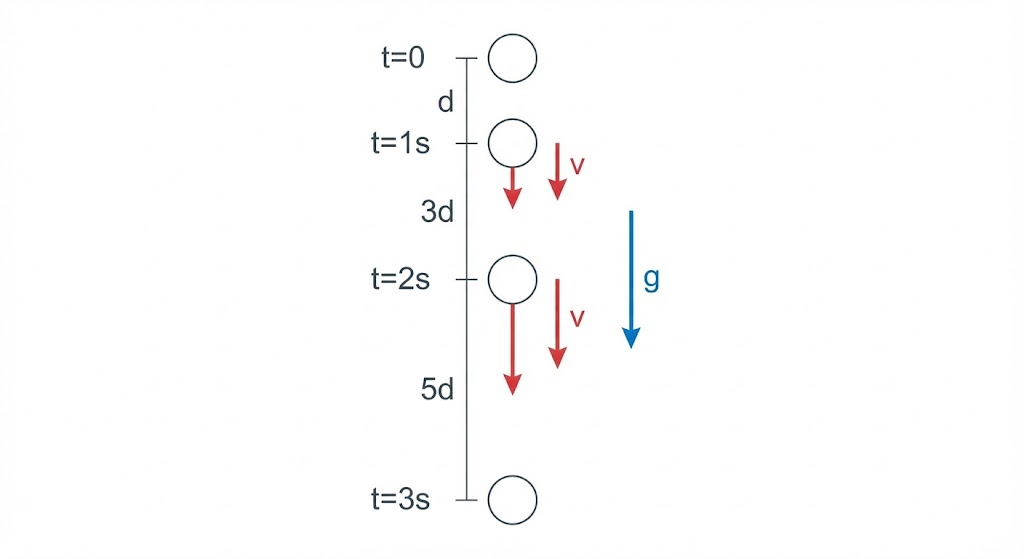
Free fall is a specific type of **Uniformly Accelerated Linear Motion** with zero initial velocity, where the acceleration is the constant gravitational acceleration $g$.
* **Ideal Conditions**:
1. **Initial Velocity is Zero** ($v_0 = 0$).
2. **Gravity Only**: Air resistance is neglected. If air resistance is significant, it is NOT free fall.
* **Acceleration due to Gravity ($g$)**:
* **Direction**: Vertically Downward.
* **Magnitude**: Usually $g \approx 9.8 m/s^2$ or simplified to $10 m/s^2$ (Check exam instructions).
#### 2. Core Formulas
Free fall is a special case where $v_0=0, a=g$. We usually define **downward as positive**.
| Quantity | Formula | Note |
| :--- | :--- | :--- |
| **Velocity** | $$v = gt$$ | Velocity is proportional to time |
| **Displacement (Height)** | $$h = \frac{1}{2}gt^2$$ | Height is proportional to time squared |
| **Velocity-Height** | $$v^2 = 2gh$$ | Best choice when time $t$ is unknown |
**Important Inferences (Shortcuts)**:
* **Time to Fall**: $t = \sqrt{\frac{2h}{g}}$ (Depends only on height).
* **Impact Velocity**: $v = \sqrt{2gh}$ (Independent of mass, depends only on height).
#### 3. Proportional Patterns
For uniformly accelerated motion starting from rest, these ratios are useful for quick solving:
* **Velocity at end of $1T, 2T, 3T...$**:
$$v_1 : v_2 : v_3 = 1 : 2 : 3$$
* **Total Displacement in $1T, 2T, 3T...$**:
$$h_1 : h_2 : h_3 = 1^2 : 2^2 : 3^2 = 1 : 4 : 9$$
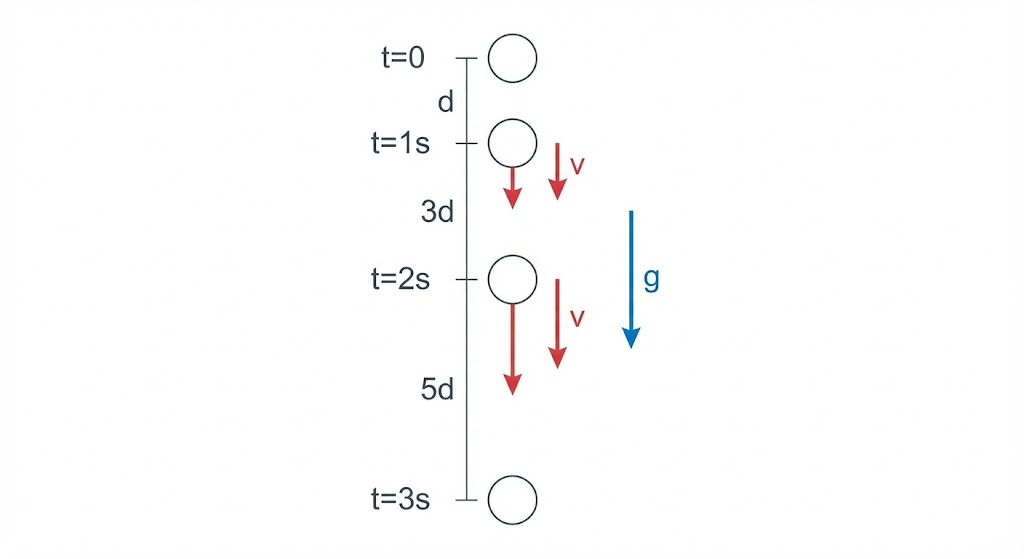
* **Displacement during 1st, 2nd, 3rd interval...**:
$$\Delta h_I : \Delta h_{II} : \Delta h_{III} = 1 : 3 : 5$$
#### 4. Typical Example: Reaction Time Test
**Problem**: Student A holds the top of a $30cm$ ruler. Student B is ready at the $0$ mark at the bottom. A drops it, and B catches it at the $20cm$ mark. Find B's reaction time. ($g=10 m/s^2$)
**Solution**:
The ruler undergoes free fall. Distance $h = 0.2 m$.
From $h = \frac{1}{2}gt^2$:
$$t = \sqrt{\frac{2h}{g}} = \sqrt{\frac{2 \times 0.2}{10}} = \sqrt{0.04} = 0.2s$$
**Common Mistakes**:
* "Distance in the last second": Do not substitute $t=1$. You must set total time as $t$ and solve the equation.
* **Galileo's Experiment**: Heavy and light objects fall at the same rate (in vacuum). If air resistance exists, heavier objects often fall faster (relative effect of resistance is smaller).