Ampere's Force
CSCA Ampere's Force study guide organized around the publicly available CSCA syllabus. Practice Physics questions on aicsca.com.
Before planning this topic, check the CSCA Exam Guide 2026 for exam dates, registration, fees, and subject requirements.
Syllabus Alignment
This study guide is organized around the publicly available CSCA syllabus for international undergraduate applicants.
Who It Is For
International students preparing for CSCA Math, Physics, Chemistry, or Chinese exams.
Related Practice
CSCA Practice · Go to questions
Past papers and worked video solutions · Timed mock exams · All subject video lessons
Practice by Topic
Jump from this tutorial to filtered practice questions for the same knowledge point.
Related formulas, concepts, and glossary terms
Physics Formula & Concept Reference
- Force on a Current Element in a Magnetic Field
- Ampere Force Formula
- Ampere Force Formula (Force on a Current Element in a Magnetic Field)
- Ampere Force on a Finite Straight Wire in a Uniform Magnetic Field
- Magnitude of Ampere Force (General Case)
- Determining the Direction of Ampere Force (Left-Hand Rule)
- Magnetic Torque on a Current Loop in a Uniform Magnetic Field
Physics Exam Glossary
Tutorial Content
Topic: Electromagnetism > Magnetic Field > Ampere's Force
1. Core Concept: Ampere's Force
**Ampere's Force** is the force exerted by a magnetic field on a **current-carrying wire**. It is the macroscopic manifestation of the Lorentz force and the driving principle behind electric motors.
**CSCA Exam Focus**:
* Applicable conditions for $F=BIL$.
* Using the **Left-Hand Rule** (3D spatial visualization).
* Solving **Equilibrium** and **Dynamics** problems involving Ampere's force.
---
2. Core Formulas
(1) Magnitude
$$F = B I L \sin\theta$$
* **$B$**: Magnetic Flux Density (T).
* **$I$**: Current (A).
* **$L$**: **Effective Length** of the wire (m).
* *Straight wire*: Actual length inside the field.
* *Curved wire*: The **straight-line distance** between the two endpoints (in a uniform field).
* **$\theta$**: Angle between **Current direction** and **B-field direction**.
**Special Cases**:
* **$I \perp B$** ($\theta = 90^\circ$): $F = BIL$ (**Max**).
* **$I \parallel B$** ($\theta = 0^\circ$): $F = 0$ (**Min**).
(2) Direction: Left-Hand Rule
Distinguish carefully: **Left Hand for Force**, Right Hand for Field generation.
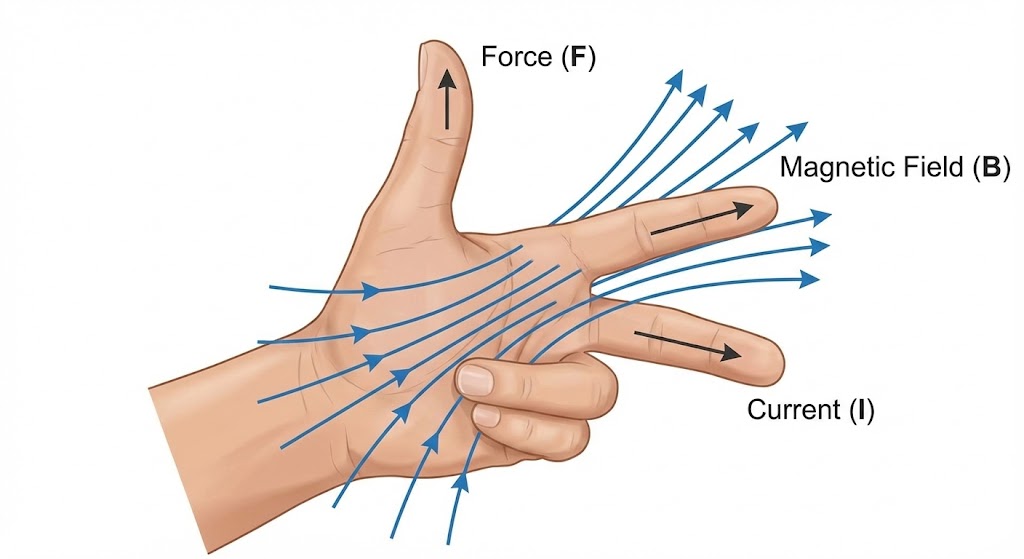
* **Step 1**: Open your **Left Hand**, thumb $\perp$ fingers.
* **Step 2**: Let Magnetic Field lines ($B$) **pierce the palm**.
* **Step 3**: Fingers point in the direction of **Current** ($I$).
* **Step 4**: **Thumb** points to **Ampere's Force** ($F$).
---
3. Problem-Solving Models
Model 1: 2D Cross-Section Analysis
Convert 3D diagrams into **2D cross-sections**.
* Current: $\odot$ (Out of page), $\otimes$ (Into page).
* Field: $\times$ (In), $\cdot$ (Out), or Arrows.
Model 2: Effective Length Method
For curved wires (e.g., a semi-circle), use the **chord length** connecting the ends as $L$.
---
4. Typical Examples
**Example 1: Basic Calculation**
**Problem**: Wire $L=0.5m$, $I=4A$, in field $B=0.2T$.
(1) If $I \perp B$, find $F$.
(2) If angle between $I$ and $B$ is $30^\circ$, find $F$.
**Solution**:
(1) $F = BIL = 0.4 N$.
(2) $F = BIL \sin30^\circ = 0.2 N$.
**Example 2: Equilibrium on Inclined Plane (Tricky)**
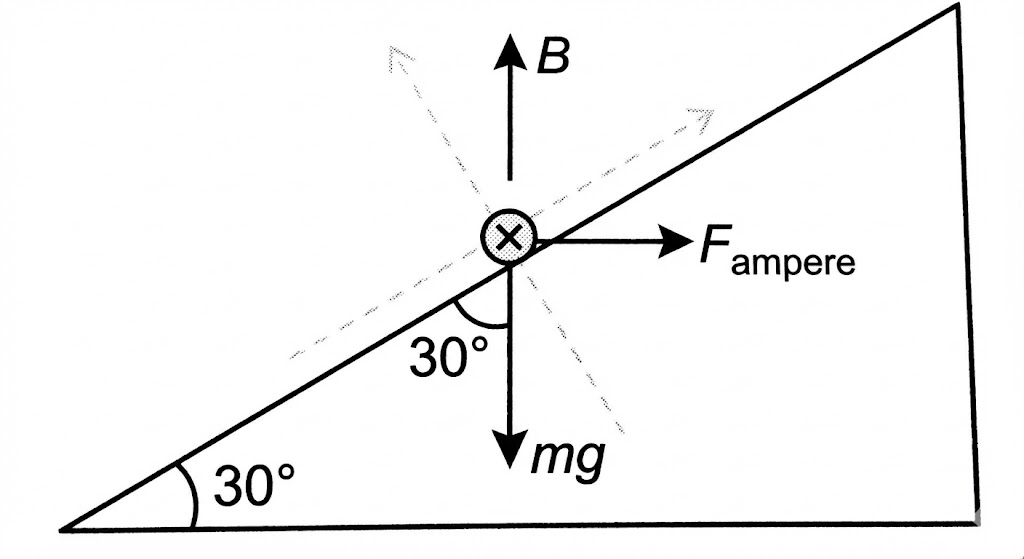
**Problem**: Smooth slope $\theta=30^\circ$. Wire mass $m=0.01kg$, $L=0.2m$, $I=5A$ (Into page). Field $B=0.4T$ is **Vertically Upward**. Determine motion ($g=10m/s^2$).
**Solution**:
1. **Direction of F**:
* $B$ Up (Palm down), $I$ In (Fingers in) $\rightarrow$ **Thumb points Right**. Force is **Horizontal Right**.
2. **Magnitude**: $F = BIL = 0.4 N$ (since $B \perp I$).
3. **Decomposition (Along slope)**:
* Gravity component (down slope): $mg \sin30^\circ = 0.05 N$.
* Ampere component (up slope): Force is horizontal, angle with slope is $30^\circ$. $F_x = F \cos30^\circ \approx 0.346 N$.
4. **Result**:
Upward force ($0.346N$) > Downward force ($0.05N$).
The wire accelerates **up the slope**.
5. **Acceleration**: $a = (0.346 - 0.05) / 0.01 = 29.6 m/s^2$.
**Example 3: Parallel Wires**
**Problem**: Two parallel wires carry current in the **same** direction. Do they attract or repel?
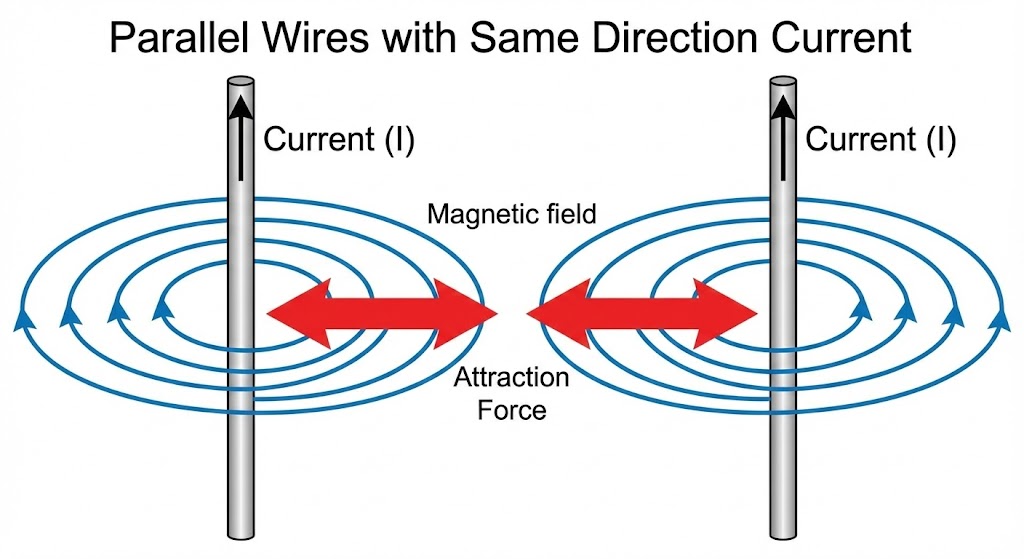
**Solution**: **Attract**. (Same direction attracts, Opposite repels).
---
5. CSCA Common Pitfalls
1. **Meaning of $L$**: Always find the "Effective Length". A closed loop in a uniform field has net force = 0.
2. **Drawing Diagrams**: Always draw a **Side View (Cross-section)** for inclined plane or rail problems.
3. **Angles**: When decomposing horizontal forces onto a slope, ensure you use the correct trig function (usually $\cos\theta$ for horizontal force along the slope).