Law of Refraction
CSCA Law of Refraction study guide organized around the publicly available CSCA syllabus. Practice Physics questions on aicsca.com.
Before planning this topic, check the CSCA Exam Guide 2026 for exam dates, registration, fees, and subject requirements.
Syllabus Alignment
This study guide is organized around the publicly available CSCA syllabus for international undergraduate applicants.
Who It Is For
International students preparing for CSCA Math, Physics, Chemistry, or Chinese exams.
Related Practice
CSCA Practice · Go to questions
Past papers and worked video solutions · Timed mock exams · All subject video lessons
Practice by Topic
Jump from this tutorial to filtered practice questions for the same knowledge point.
Related formulas, concepts, and glossary terms
Physics Formula & Concept Reference
- Relationship between Refractive Index and Speed of Light
- Critical Angle Formula (Condition for Total Internal Reflection)
- Law of Refraction (Snell's Law)
- Critical Angle for Total Internal Reflection
- Definition of Refractive Index
Physics Exam Glossary
Tutorial Content
Topic: Optics > Geometrical Optics > Law of Refraction
Law of Refraction (Snell's Law)
1. Conceptual Definition
The phenomenon where the direction of light changes when it passes **obliquely** from one medium into another. It is the basis for lenses, mirages, and fiber optics.
2. Core Law
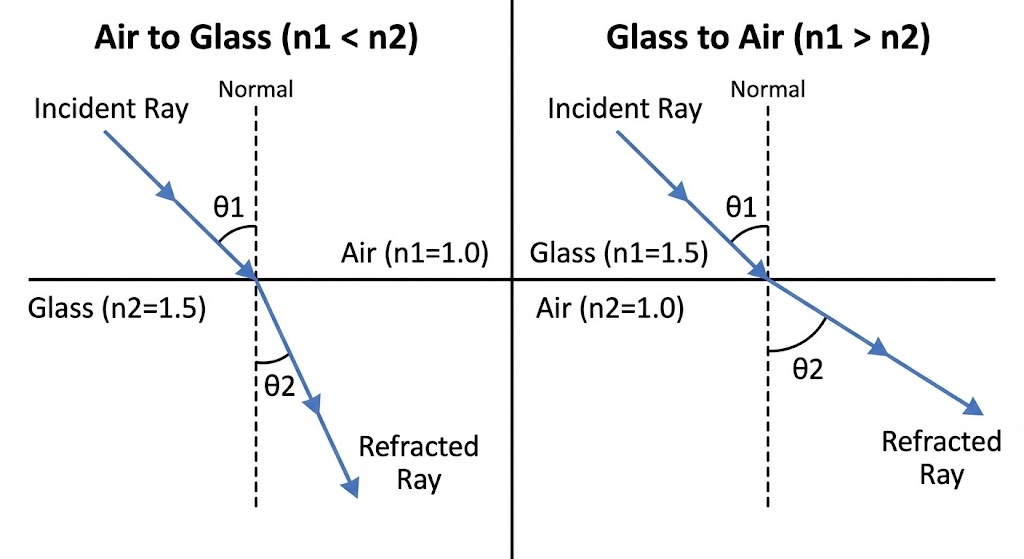
#### A. Snell's Law
This is the **single most important formula** for refraction problems. Memorize the product form to avoid fraction errors:
$$n_1 \sin\theta_1 = n_2 \sin\theta_2$$
* $n_1, n_2$: **Absolute refractive indices** of the two media.
* $\theta_1, \theta_2$: Angles relative to the **Normal** (Angle of Incidence and Refraction, respectively).
#### B. Refractive Index
A measure of how much a medium slows down light.
* **Definition**: $$n = \frac{c}{v}$$
* $c$: Speed of light in vacuum ($3.0 \times 10^8 m/s$).
* $v$: Speed of light in the medium.
* **Rule**: Higher $n$ means slower light speed (**Optically Denser**); Lower $n$ means faster light speed (**Optically Rarer**).
3. Bending Rules
1. **Rare $\rightarrow$ Dense** ($n_1 < n_2$, e.g., Air to Water): Light slows down, ray bends **Towards the Normal** ($\theta_2 < \theta_1$).
2. **Dense $\rightarrow$ Rare** ($n_1 > n_2$, e.g., Water to Air): Light speeds up, ray bends **Away from the Normal** ($\theta_2 > \theta_1$).
* **Warning**: Always check for **Total Internal Reflection** (if $\theta_1 > \theta_c$) in this case.
4. Typical Models
#### Model 1: Apparent Depth
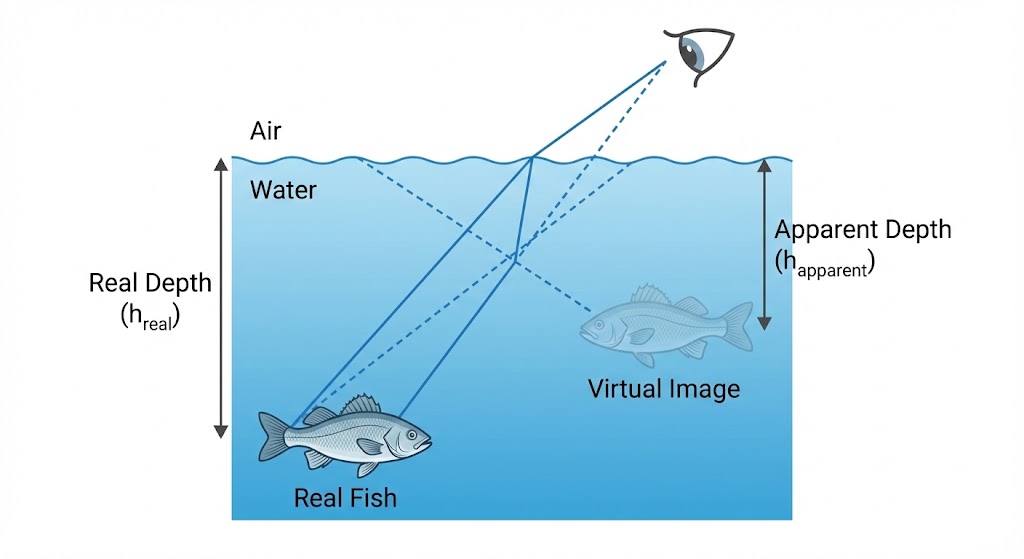
When observing an underwater object vertically from air, the object appears shallower than it actually is.
* **Formula**: $$h_{apparent} \approx \frac{h_{real}}{n}$$
* $h_{real}$: Actual depth.
* $n$: Refractive index of water (assuming observer is in air, $n_{air}\approx 1$).
#### Model 2: Parallel Glass Slab
When light passes through a parallel glass slab, the emergent ray is **parallel** to the incident ray but undergoes a **Lateral Displacement**.
5. Problem Solving Steps
1. **Draw Normal**: This is the reference for all angles.
2. **Identify Media**: Define which is side 1 (Incident) and side 2 (Refracted).
3. **Equation**: Substitute directly into $n_1 \sin\theta_1 = n_2 \sin\theta_2$.
4. **Calculator**: Ensure your calculator is in "Degree Mode (DEG)".