Momentum, Impulse, and Conservation of Momentum
CSCA Momentum, Impulse, and Conservation of Momentum study guide organized around the publicly available CSCA syllabus. Practice Physics questions on aicsca.com.
Before planning this topic, check the CSCA Exam Guide 2026 for exam dates, registration, fees, and subject requirements.
Syllabus Alignment
This study guide is organized around the publicly available CSCA syllabus for international undergraduate applicants.
Who It Is For
International students preparing for CSCA Math, Physics, Chemistry, or Chinese exams.
Related Practice
CSCA Practice · Go to questions
Past papers and worked video solutions · Timed mock exams · All subject video lessons
Practice by Topic
Jump from this tutorial to filtered practice questions for the same knowledge point.
Related formulas, concepts, and glossary terms
Physics Formula & Concept Reference
- Definition of Momentum
- Law of Conservation of Momentum
- Impulse-Momentum Theorem
- Velocity Formulas for 1D Elastic Collision
- Definition of Impulse
Physics Exam Glossary
Tutorial Content
Momentum, Impulse, and Conservation of Momentum
1. Momentum & Impulse
#### A. Momentum
* **Definition**: A measure of the "inertia" of motion.
* **Formula**: $$\vec{p} = m\vec{v}$$
* **Nature**: **State Quantity**, **Vector** (same direction as $\vec{v}$).
#### B. Impulse
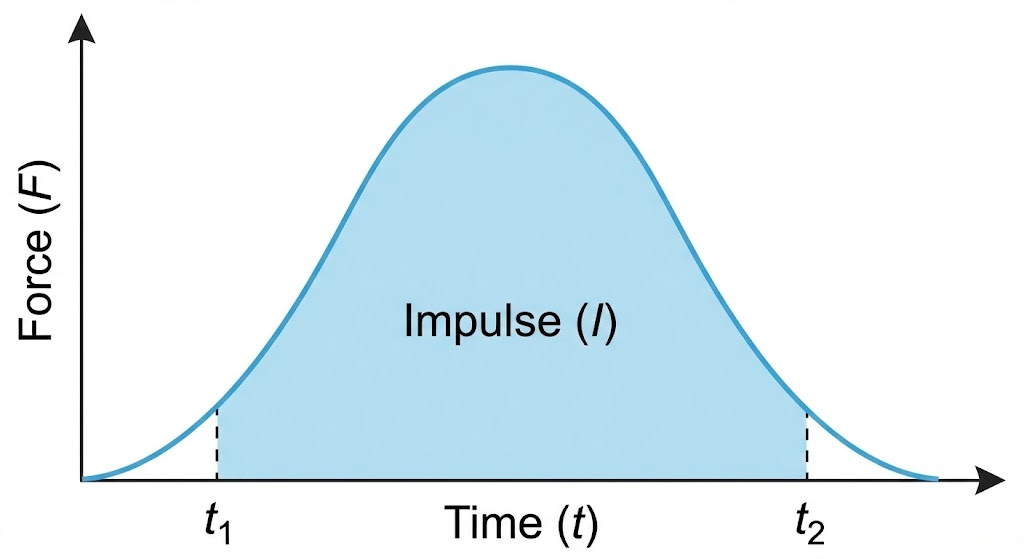
* **Definition**: The cumulative effect of force over time.
* **Formula**: $$\vec{I} = \vec{F} \cdot \Delta t$$ (Constant Force)
* **Nature**: **Process Quantity**, **Vector** (same direction as $\vec{F}$).
* **Graphical Meaning**: The **Area** under the Force-Time ($F-t$) graph represents Impulse.
2. Impulse-Momentum Theorem
The core tool for collision/impact problems.
* **Statement**: The impulse of the net force equals the change in momentum.
* **Formula**:
$$\vec{I}_{\text{net}} = \Delta \vec{p} = \vec{p}_2 - \vec{p}_1 = m\vec{v}_2 - m\vec{v}_1$$
**⚠️ CSCA Exam Trap (Vector Nature)**:
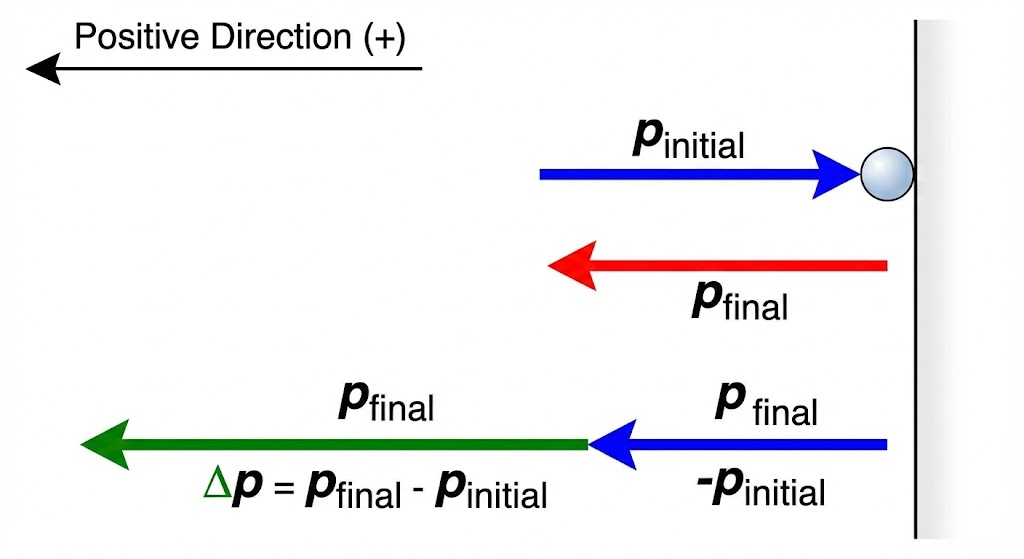
This is a vector equation. You MUST define a **positive direction**, especially for "rebound" problems.
Example: A ball hits a wall at $v$ and rebounds at $v$. The change is NOT 0. It is $\Delta p = m(v) - m(-v) = 2mv$ (assuming rebound is positive).
3. Conservation of Momentum
#### A. Conditions for Conservation
1. **No external forces** (Ideal).
2. **Net external force is zero** (Common, e.g., smooth surface).
3. **Internal forces >> External forces** (Approximate, e.g., explosions, collisions).
4. **Net force is zero in one direction** (Momentum is conserved in that direction).
#### B. Collision Models
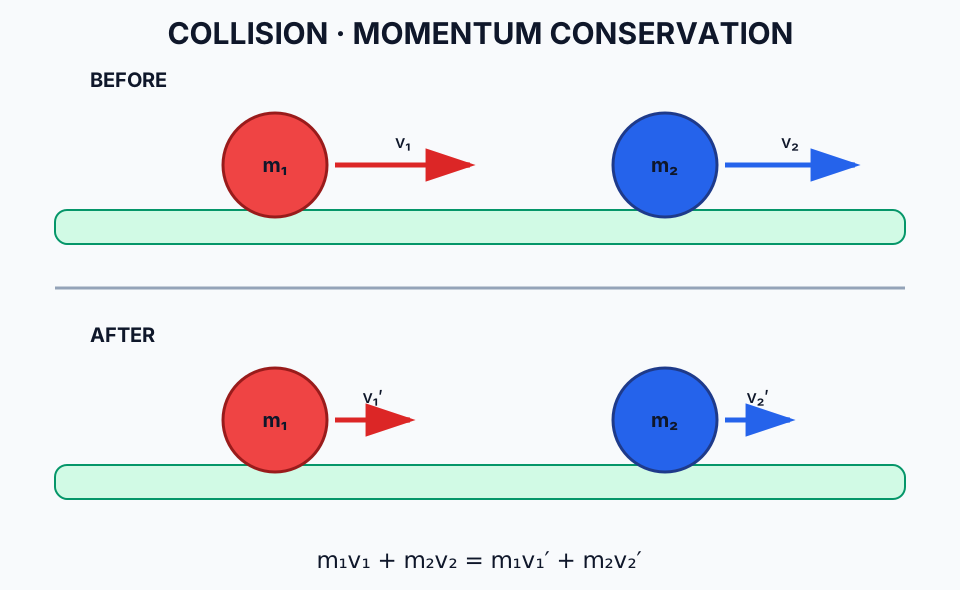
* **Elastic Collision**: Momentum conserved + Kinetic Energy conserved.
* **Inelastic Collision**: Momentum conserved + Kinetic Energy lost.
* **Perfectly Inelastic**: Momentum conserved + Max Kinetic Energy lost (stick together, $v_1 = v_2$).
4. Classic Model: The Man-Boat Model (Recoil)
A standard "Recoil" problem in Chinese curricula, often appearing in CSCA.
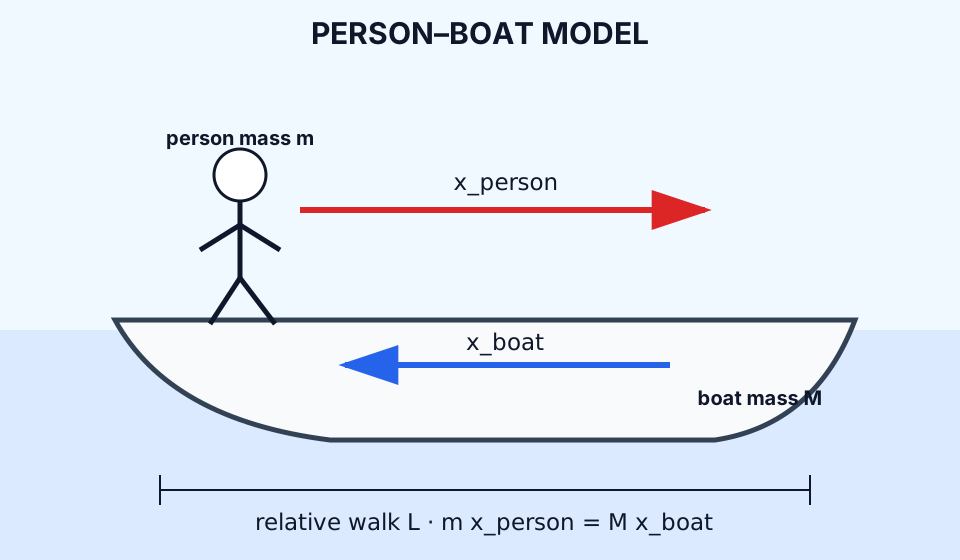
**Scenario**: A boat (mass $M$) floats on still water. A person (mass $m$) walks from the bow to the stern (relative distance $L$). Ignore water resistance.
**Conclusion**: The center of mass of the system remains stationary. Displacement is inversely proportional to mass.
* **Displacement Relationship**:
$$m x_{\text{man}} = M x_{\text{boat}}$$
$$x_{\text{man}} + x_{\text{boat}} = L$$
* **Shortcut Formula (Boat's Displacement)**:
$$x_{\text{boat}} = \frac{m}{M+m} L$$
(Mnemonic: To find *this* object's displacement, put the *other* object's mass in the numerator)
5. Typical Examples
**Example 1: Rebound (Impulse Theorem)**
**Problem**: A $0.5\text{kg}$ ball hits a wall at $10\text{m/s}$ and rebounds at $8\text{m/s}$. Contact time $0.1\text{s}$. Find the average force.
**Solution**:
Define **Rebound Direction** as positive.
$v_1 = -10\text{m/s}, \quad v_2 = +8\text{m/s}$
$\Delta p = m v_2 - m v_1 = 0.5 \times [8 - (-10)] = 0.5 \times 18 = 9 \text{kg} \cdot \text{m/s}$
Using $F \Delta t = \Delta p$:
$F = \frac{9}{0.1} = 90\text{N}$, directed away from the wall.
**Example 2: Man-Boat Application**
**Problem**: A $40\text{kg}$ person stands on a $60\text{kg}$, $5\text{m}$ long boat. The person walks to the other end. How far does the boat move?
**Solution**: Use the shortcut formula.
$$x_{\text{boat}} = \frac{m_{\text{person}}}{M_{\text{boat}} + m_{\text{person}}} L = \frac{40}{60+40} \times 5 = \frac{40}{100} \times 5 = 2\text{m}$$