Series and Parallel Circuits
CSCA Series and Parallel Circuits study guide organized around the publicly available CSCA syllabus. Practice Physics questions on aicsca.com.
Before planning this topic, check the CSCA Exam Guide 2026 for exam dates, registration, fees, and subject requirements.
Syllabus Alignment
This study guide is organized around the publicly available CSCA syllabus for international undergraduate applicants.
Who It Is For
International students preparing for CSCA Math, Physics, Chemistry, or Chinese exams.
Related Practice
CSCA Practice · Go to questions
Past papers and worked video solutions · Timed mock exams · All subject video lessons
Practice by Topic
Jump from this tutorial to filtered practice questions for the same knowledge point.
Related formulas, concepts, and glossary terms
Physics Formula & Concept Reference
- Total Resistance in Series Circuit
- Current Divider Formula in Parallel Circuit
- Total Voltage in Series Circuit
- Total Resistance in Parallel Circuit
- Voltage Divider Formula in Series Circuit
- Total Current in Parallel Circuit
Physics Exam Glossary
Tutorial Content
Topic: Electromagnetism > DC Circuits > Series and Parallel Circuits
1. Core Model Comparison: Series vs Parallel
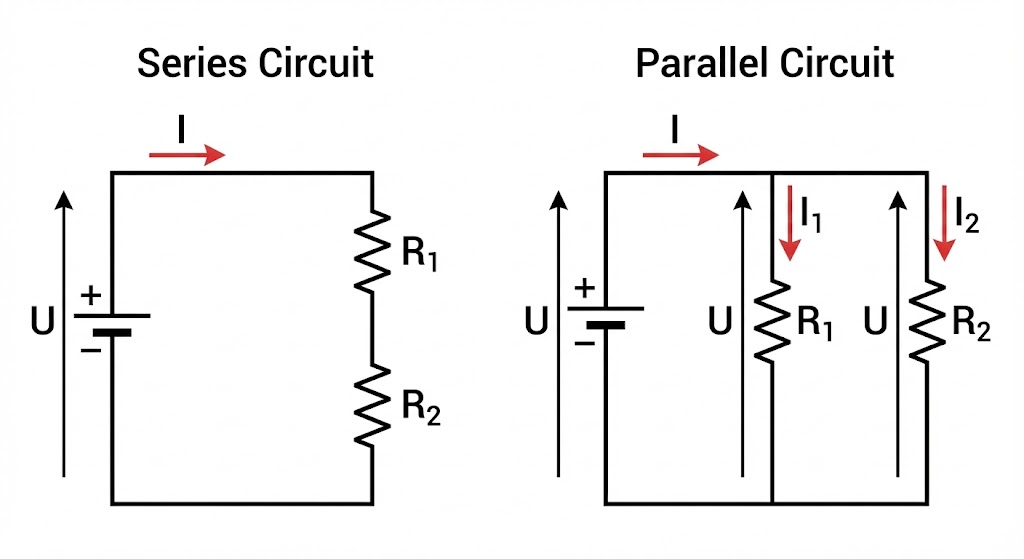
Distinguishing the connection method is the starting point for all circuit problems. Use the diagram below to intuitively understand the difference in current paths.
| Feature | **Series Circuit** | **Parallel Circuit** |
| :--- | :--- | :--- |
| **Connection** | **End-to-End**, no branches | **Head-to-Head, Tail-to-Tail**, branched |
| **Current Path** | Only **ONE** path | **MULTIPLE** paths (Main + Branches) |
| **Break Effect** | One break, **ALL stop** | One branch break, **Others UNAFFECTED** |
---
2. Core Quantitative Rules
This is the foundation for calculation problems in the CSCA exam.
(1) Series Circuit
* **Current**: Same everywhere. $$I = I_1 = I_2$$
* **Voltage**: Total voltage equals sum of individual voltages. $$U = U_1 + U_2$$
* **Resistance**: Total resistance equals sum of individual resistances (Increases). $$R_{eq} = R_1 + R_2$$
* **Key Inference: Voltage Divider**
Voltage is **proportional** to resistance:
$$\frac{U_1}{U_2} = \frac{R_1}{R_2} \quad \Rightarrow \quad U_1 = \frac{R_1}{R_1 + R_2} U$$
(2) Parallel Circuit
* **Voltage**: Same across all branches. $$U = U_1 = U_2$$
* **Current**: Main current equals sum of branch currents. $$I = I_1 + I_2$$
* **Resistance**: Reciprocal of total R equals sum of reciprocals (Decreases).
$$\frac{1}{R_{eq}} = \frac{1}{R_1} + \frac{1}{R_2}$$
**Exam Tip**: For **two** resistors in parallel, use the shortcut: $$R_{eq} = \frac{R_1 R_2}{R_1 + R_2}$$
* **Key Inference: Current Divider**
Current is **inversely proportional** to resistance:
$$\frac{I_1}{I_2} = \frac{R_2}{R_1} \quad \Rightarrow \quad I_1 = \frac{R_2}{R_1 + R_2} I$$
---
3. Typical Examples
**Example 1: Switch Changing Circuit Structure**
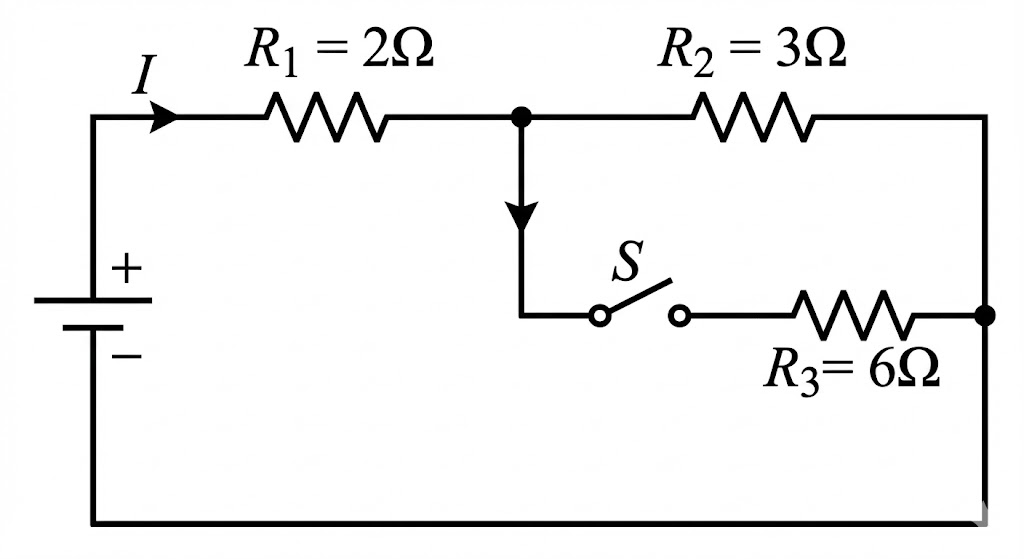
**Problem**: As shown, $R_1 = 2\Omega$, $R_2 = 3\Omega$, $R_3 = 6\Omega$. Find the total resistance when:
(1) Switch S is OPEN.
(2) Switch S is CLOSED.
**Solution**:
1. **S Open**: $R_3$ branch is open (no current). Circuit is $R_1$ and $R_2$ in **Series**.
$$R_{total} = R_1 + R_2 = 2 + 3 = 5\Omega$$
2. **S Closed**: Current flows through $R_1$, then splits into $R_2$ and $R_3$. So, $R_2$ and $R_3$ are in **Parallel**, and this block is in **Series** with $R_1$.
* Parallel part: $R_{23} = \frac{3 \times 6}{3 + 6} = 2\Omega$
* Total: $R_{total} = R_1 + R_{23} = 2 + 2 = 4\Omega$
**Example 2: Mixed Circuit & Ammeter**
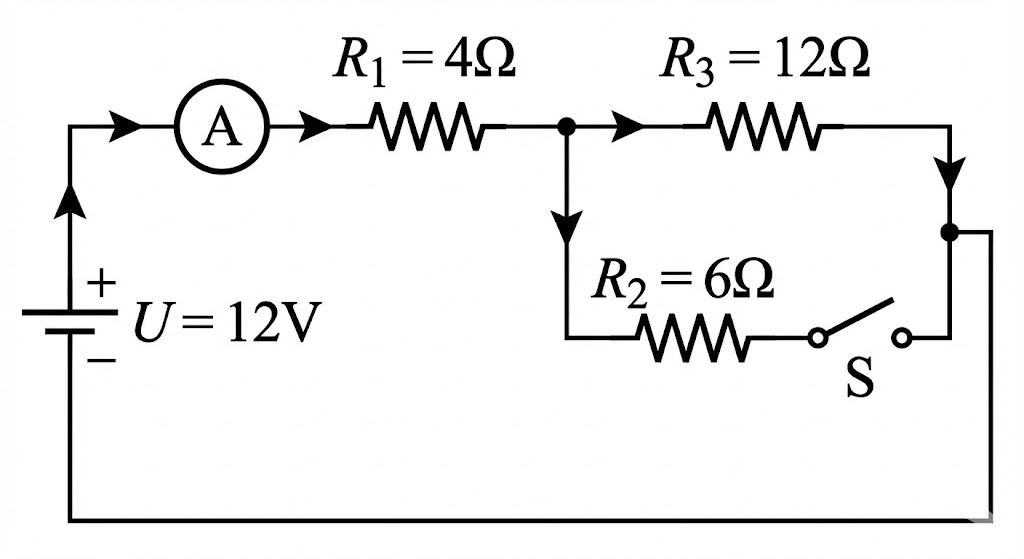
**Problem**: Source $U=12V$, $R_1=4\Omega$, $R_2=6\Omega$, $R_3=12\Omega$. Switch S controls the branch with $R_2$. Find the Ammeter reading (main current) when:
(1) S is OPEN.
(2) S is CLOSED.
**Solution**:
1. **S Open**: $R_2$ is disconnected. Circuit is $R_1$ and $R_3$ in **Series**.
$$I = \frac{U}{R_1 + R_3} = \frac{12}{4 + 12} = 0.75A$$
2. **S Closed**: $R_2$ and $R_3$ in **Parallel**, then in **Series** with $R_1$.
* Parallel R: $R_{23} = \frac{6 \times 12}{6 + 12} = 4\Omega$
* Total R: $R_{total} = R_1 + R_{23} = 4 + 4 = 8\Omega$
* Current: $I' = \frac{U}{R_{total}} = \frac{12}{8} = 1.5A$
**Example 3: Current Divider Application**
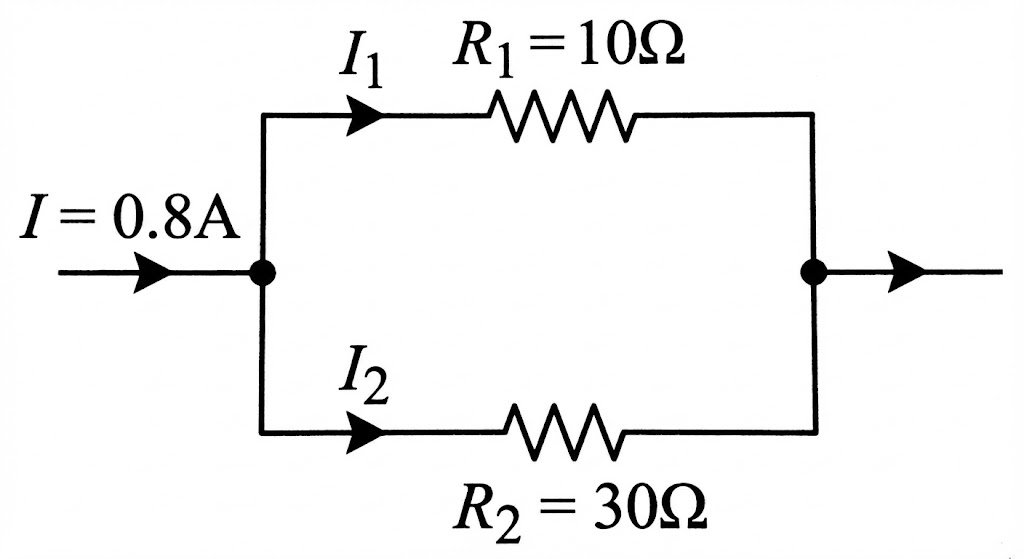
**Problem**: $R_1=10\Omega$ in parallel with $R_2=30\Omega$. Total current $I=0.8A$. Find current $I_1$ through $R_1$.
**Solution**:
Using **Current Divider Rule** (Current splits inversely to resistance):
$$I_1 = \frac{R_2}{R_1 + R_2} \times I$$
$$I_1 = \frac{30}{10 + 30} \times 0.8 = 0.6A$$
---
4. CSCA Common Pitfalls
1. **Parallel R Calculation**: Don't forget to invert the result ($1/R$). Check: **Total Parallel R < Smallest Branch R**.
2. **Circuit ID**: For complex circuits, trace the **current path**. Treat ideal Voltmeters as open gaps and Ammeters as wires.
3. **Formula Confusion**: Voltage divides proportionally ($R \uparrow \Rightarrow U \uparrow$), Current divides inversely ($R \uparrow \Rightarrow I \downarrow$).