Periodicity of Functions
CSCA Periodicity of Functions study guide organized around the publicly available CSCA syllabus. Practice Mathematics questions on aicsca.com.
Before planning this topic, check the CSCA Exam Guide 2026 for exam dates, registration, fees, and subject requirements.
Syllabus Alignment
This study guide is organized around the publicly available CSCA syllabus for international undergraduate applicants.
Who It Is For
International students preparing for CSCA Math, Physics, Chemistry, or Chinese exams.
Related Practice
CSCA Practice · Go to questions
Past papers and worked video solutions · Timed mock exams · All subject video lessons
Practice by Topic
Jump from this tutorial to filtered practice questions for the same knowledge point.
Related formulas, concepts, and glossary terms
Mathematics Formula & Concept Reference
- Period of Sine and Cosine Functions
- Basic Property of Periodic Functions
- Period of the Function f(ax + b)
- Definition of Periodic Function
- Period of Sum/Difference of Periodic Functions
- Period of Tangent Function
Mathematics Exam Glossary
Tutorial Content
Periodicity of Functions
1. Concept
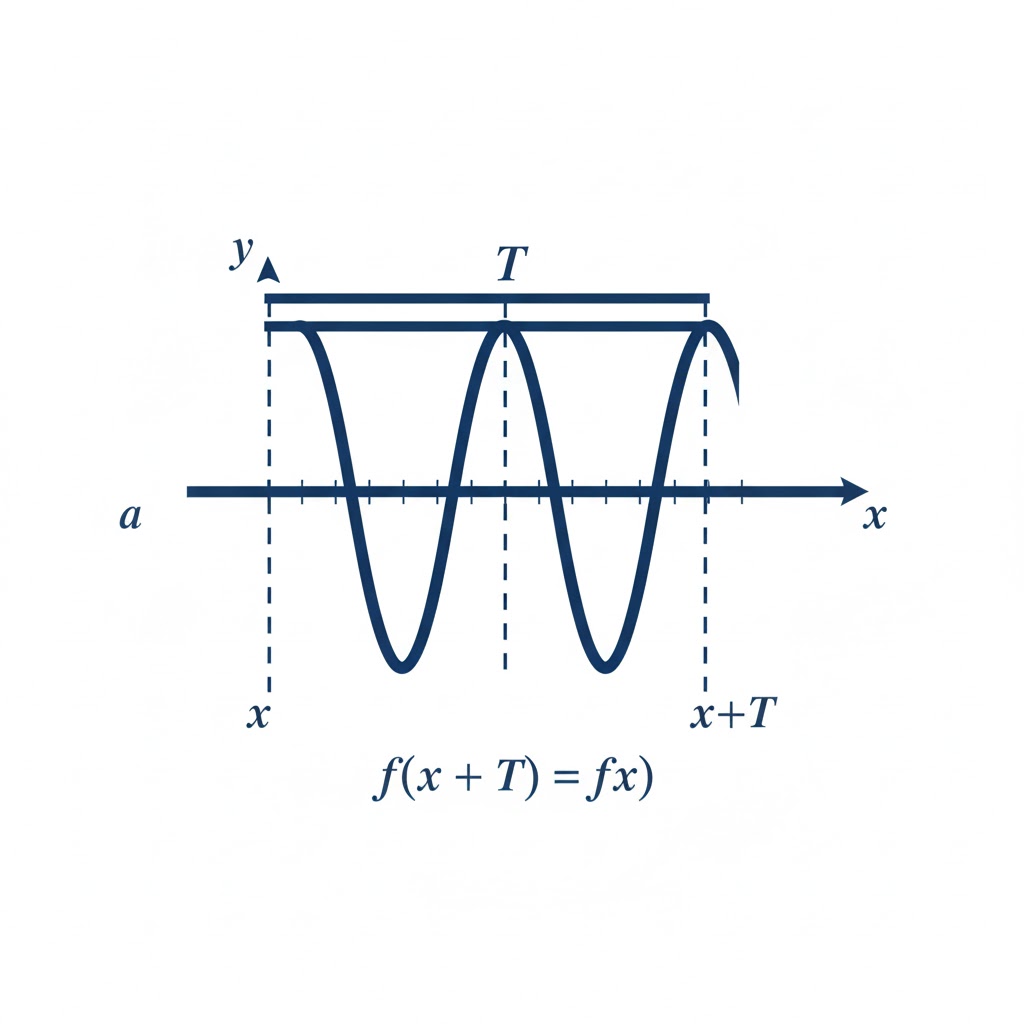
**Periodicity** describes the repeating pattern of a function.
**Definition**: Let the domain of $f(x)$ be $D$. If there exists a **non-zero constant** $T$ such that for **any** $x \in D$:
1. $x+T \in D$
2. $f(x+T) = f(x)$ holds true
Then $f(x)$ is a **Periodic Function**, and $T$ is a **Period**.
* **Fundamental Period (Least Positive Period)**: The smallest positive value among all periods. Unless specified otherwise, "period" usually refers to this fundamental period.
---
2. Core Formulas & Properties
#### (1) Formulas for Trigonometric Functions
| Function Type | Expression | Period Formula (Fundamental) |
| :--- | :--- | :--- |
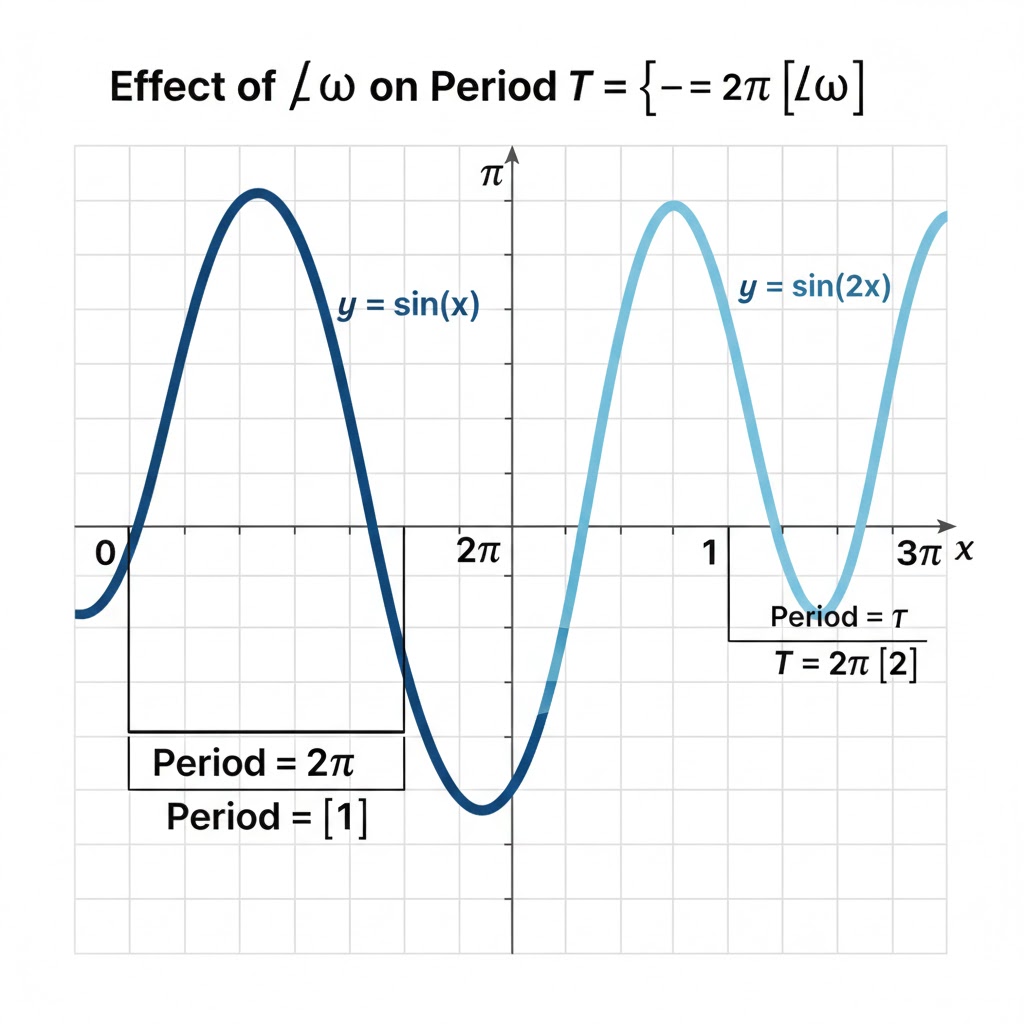
| **Sin/Cos** | $y = \sin(\omega x + \phi)$ or $\cos(\omega x + \phi)$ | $T = \frac{2\pi}{|\omega|}$ |
| **Tan** | $y = \tan(\omega x + \phi)$ | $T = \frac{\pi}{|\omega|}$ |
| **Absolute Sin** | $y = |\sin x|$ | $T = \pi$ |
#### (2) Abstract Function Models (Common in CSCA)
If the following hold for all $x$ in the domain:
* **Model A**: $f(x+a) = -f(x) \Rightarrow T = 2a$
* *Derivation*: $f(x+2a) = f((x+a)+a) = -f(x+a) = -[-f(x)] = f(x)$.
* **Model B**: $f(x+a) = \frac{1}{f(x)} \Rightarrow T = 2a$
* **Model C**: Graph symmetric about lines $x=a$ and $x=b$ $\Rightarrow T = 2|a-b|$
---
3. Typical Examples
**Example 1: Basic Trig Function**
Find the period of $y = 2\sin(3x - \frac{\pi}{4})$.
**Solution**:
Using the formula $T = \frac{2\pi}{|\omega|}$, here $\omega = 3$.
So, $T = \frac{2\pi}{3}$.
**Example 2: Power Reduction**
Find the period of $f(x) = \sin^2 x$.
**Solution**:
Use the half-angle identity: $f(x) = \frac{1 - \cos 2x}{2}$.
The function depends on $\cos 2x$, where $\omega = 2$.
So, $T = \frac{2\pi}{2} = \pi$.
**Example 3: Abstract Function**
Given $f(x+2) = -f(x)$ for all real $x$, and $f(1)=5$, find $f(2025)$.
**Solution**:
From $f(x+2) = -f(x)$, we know the period $T = 2 \times 2 = 4$.
Reduce the argument using the period:
$2025 \div 4 = 506$ with a remainder of 1.
$f(2025) = f(4 \times 506 + 1) = f(1) = 5$.
---
4. Common Pitfalls
* **Ignoring Absolute Value**: When calculating period, always use $|\omega|$. The period of $y = \sin(-2x)$ is $\pi$, not $-\pi$.
* **Confusion with Symmetry**:
* $f(a+x) = f(a-x) \Rightarrow$ Symmetric about line $x=a$ (Not periodic).
* $f(x+a) = f(x) \Rightarrow$ Periodic with period $a$ (Translation).