Arithmetic Sequence: Formula & Summation
CSCA Arithmetic Sequence: Formula & Summation study guide organized around the publicly available CSCA syllabus. Practice Mathematics questions on aicsca.com.
Before planning this topic, check the CSCA Exam Guide 2026 for exam dates, registration, fees, and subject requirements.
Syllabus Alignment
This study guide is organized around the publicly available CSCA syllabus for international undergraduate applicants.
Who It Is For
International students preparing for CSCA Math, Physics, Chemistry, or Chinese exams.
Related Practice
CSCA Practice · Go to questions
Past papers and worked video solutions · Timed mock exams · All subject video lessons
Practice by Topic
Jump from this tutorial to filtered practice questions for the same knowledge point.
Related formulas, concepts, and glossary terms
Mathematics Formula & Concept Reference
- Sum of the First n Terms of an Arithmetic Sequence (Formula 1)
- General Term Formula of Arithmetic Sequence
- Sum of the First n Terms of an Arithmetic Sequence (Formula 2)
Mathematics Exam Glossary
Tutorial Content
Arithmetic Sequence: Formula & Summation
1. Core Concepts
**Definition**: A sequence is called an **Arithmetic Sequence** if the difference between any term (from the 2nd term) and its preceding term is a constant. This constant is called the **Common Difference ($d$)**.
**Mathematical Expression**:
$$a_{n} - a_{n-1} = d \quad (n \ge 2)$$
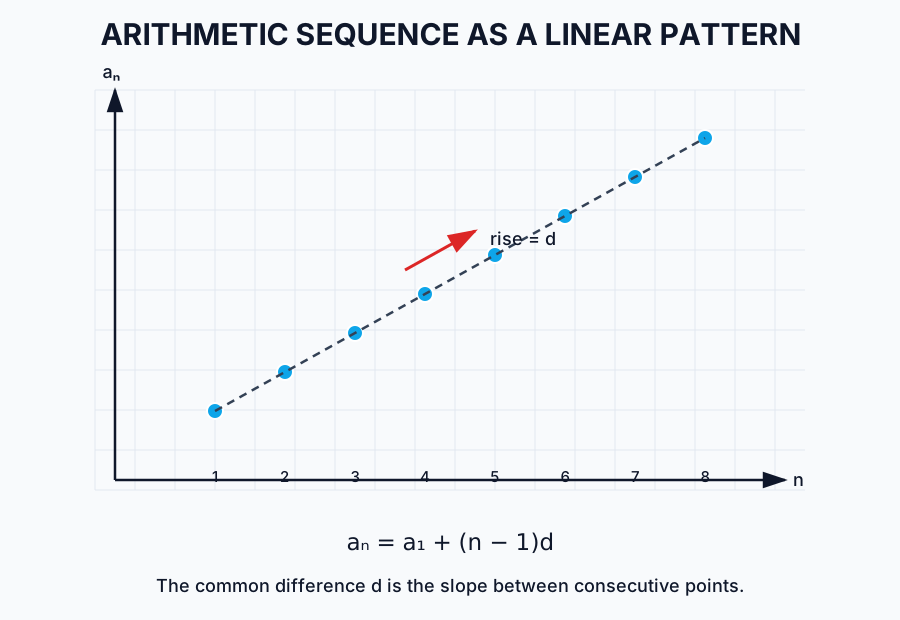
**Functional Perspective**:
The general term $a_n = dn + (a_1 - d)$ is a linear function of $n$. The graph of an arithmetic sequence consists of **discrete points** lying on the line $y = dx + (a_1-d)$. The common difference $d$ is the **slope**.
---
2. Key Formulas
#### (1) General Term Formula
$$a_n = a_1 + (n-1)d$$
* **Generalized Form**: $a_n = a_m + (n-m)d$ (Useful for finding terms without needing $a_1$ first).
#### (2) Summation Formulas ($S_n$)
Let $S_n = a_1 + a_2 + \dots + a_n$.
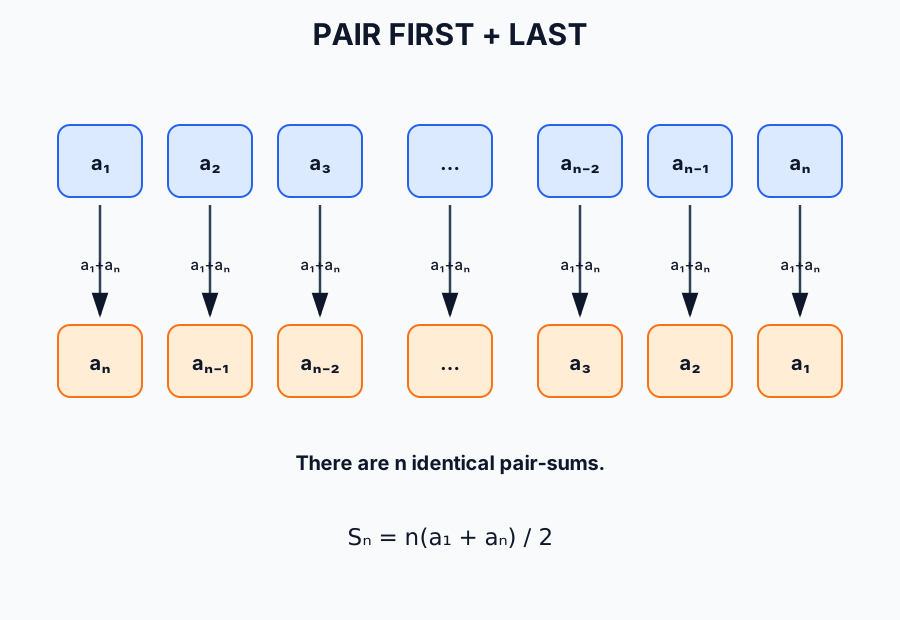
* **Formula 1 (First & Last Term)**:
$$S_n = \frac{n(a_1 + a_n)}{2}$$
*Intuition*: (First + Last) $\times$ Count $\div 2$. Similar to the area of a trapezoid.
* **Formula 2 (First Term & Difference)**:
$$S_n = na_1 + \frac{n(n-1)}{2}d$$
**Derivation Logic (Reverse and Add)**:
Write the sum forwards, then write it backwards underneath. Add them vertically. Each column sums to $(a_1 + a_n)$. This method is often tested in CSCA.
---
3. Key Properties
Using properties is often faster than formulas:
1. **Arithmetic Mean**: If $a, b, c$ form an arithmetic sequence, then $2b = a + c$.
2. **Index Sum Property**: If $m + n = p + q$, then $a_m + a_n = a_p + a_q$.
* E.g., $a_1 + a_{10} = a_3 + a_8$.
* Special case: If $m+n=2k$, then $a_m + a_n = 2a_k$.
3. **Partial Sum Property**: $S_n, S_{2n}-S_n, S_{3n}-S_{2n}, \dots$ also form an arithmetic sequence (Difference is $n^2d$).
---
4. Typical Examples
**Example 1: Using Generalized Formula**
Given $a_3 = 8$ and $a_7 = 20$, find $a_{15}$.
**Solution**:
Use $a_7 = a_3 + (7-3)d$.
$20 = 8 + 4d \Rightarrow 4d = 12 \Rightarrow d = 3$.
Then $a_{15} = a_7 + (15-7)d = 20 + 8 \times 3 = 44$.
**Example 2: Using Index Sum Property**
Given $a_4 + a_8 = 16$ in an arithmetic sequence, find $S_{11}$.
**Solution**:
Formula: $S_{11} = \frac{11(a_1 + a_{11})}{2}$.
Since $1 + 11 = 4 + 8 = 12$, we have $a_1 + a_{11} = a_4 + a_8 = 16$.
Substitute: $S_{11} = \frac{11 \times 16}{2} = 88$.
**Example 3: Reverse and Add Application**
Let $f(x) = \frac{1}{1+2^x}$. Find sum $S = f(-5) + \dots + f(5)$.
**Solution**:
Notice $f(x) + f(-x) = 1$. This pairs terms like an arithmetic sum.
Pairs: $(-5,5), (-4,4) \dots$. There are 5 pairs and $f(0)$.
Sum $= 5 \times 1 + f(0) = 5 + 0.5 = 5.5$.
---
5. Common Pitfalls
* **Counting Terms**: When calculating $S_n$, ensure $n$ is correct. From 3rd to 8th term is $8-3+1=6$ terms.
* **Confusion**: Don't confuse the $n$-th term ($a_n$) with the sum of $n$ terms ($S_n$).
* **Negative Difference**: Remember $d$ can be negative (decreasing sequence).