Spatial Geometry
CSCA Spatial Geometry study guide organized around the publicly available CSCA syllabus. Practice Mathematics questions on aicsca.com.
Before planning this topic, check the CSCA Exam Guide 2026 for exam dates, registration, fees, and subject requirements.
Syllabus Alignment
This study guide is organized around the publicly available CSCA syllabus for international undergraduate applicants.
Who It Is For
International students preparing for CSCA Math, Physics, Chemistry, or Chinese exams.
Related Practice
CSCA Practice · Go to questions
Past papers and worked video solutions · Timed mock exams · All subject video lessons
Practice by Topic
Jump from this tutorial to filtered practice questions for the same knowledge point.
Related formulas, concepts, and glossary terms
Mathematics Formula & Concept Reference
- Volume Formula of a Cone
- Surface Area Formula of a Sphere
- Volume Formula of a Sphere
- Surface Area Formula of a Cube
- Volume Formula of a Rectangular Prism
- Volume Formula of a Cylinder
- Distance Formula Between Two Points in 3D Cartesian Coordinate System
- Midpoint Coordinate Formula for a Line Segment in Space
Mathematics Exam Glossary
Tutorial Content
Spatial Geometry
Spatial geometry extends mathematics from the 2D plane to 3D space. In the CSCA exam, the focus is on **basic calculations in the spatial coordinate system** (distance, midpoint), **formulas for solids** (prism, cone, sphere), and the simple **equation of a sphere**.
1. Spatial Rectangular Coordinate System
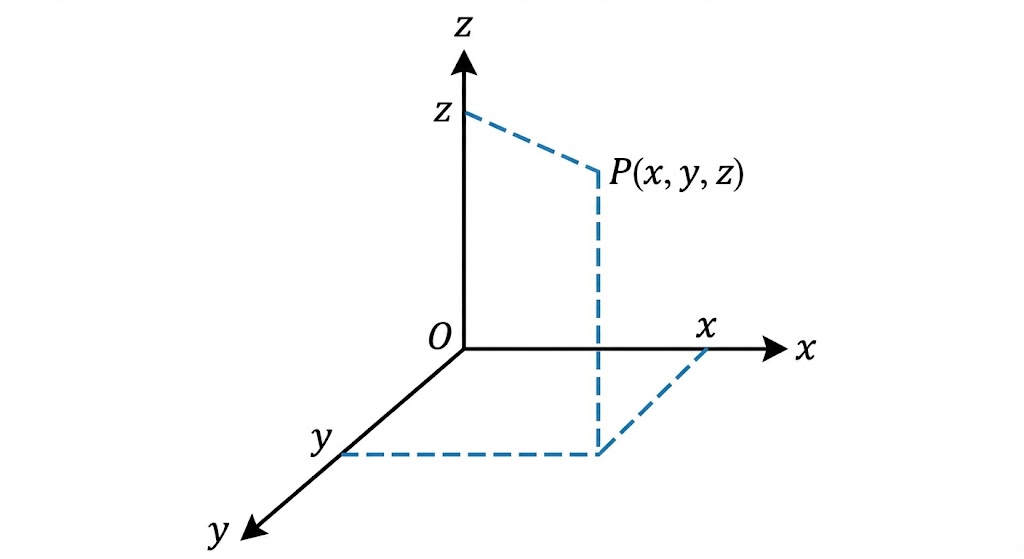
To determine positions in space, we establish a system with three mutually perpendicular axes ($x, y, z$). The origin is $O$.
* **Coordinates of Point P**: $(x, y, z)$.
* **Basic Formulas**:
Let $A(x_1, y_1, z_1)$ and $B(x_2, y_2, z_2)$.
1. **Distance Formula**: An extension of the planar distance formula.
$$|AB| = \sqrt{(x_2 - x_1)^2 + (y_2 - y_1)^2 + (z_2 - z_1)^2}$$
2. **Midpoint Formula**: The midpoint $M$ of segment $AB$ is $(\frac{x_1+x_2}{2}, \frac{y_1+y_2}{2}, \frac{z_1+z_2}{2})$.
2. Solids and Formulas
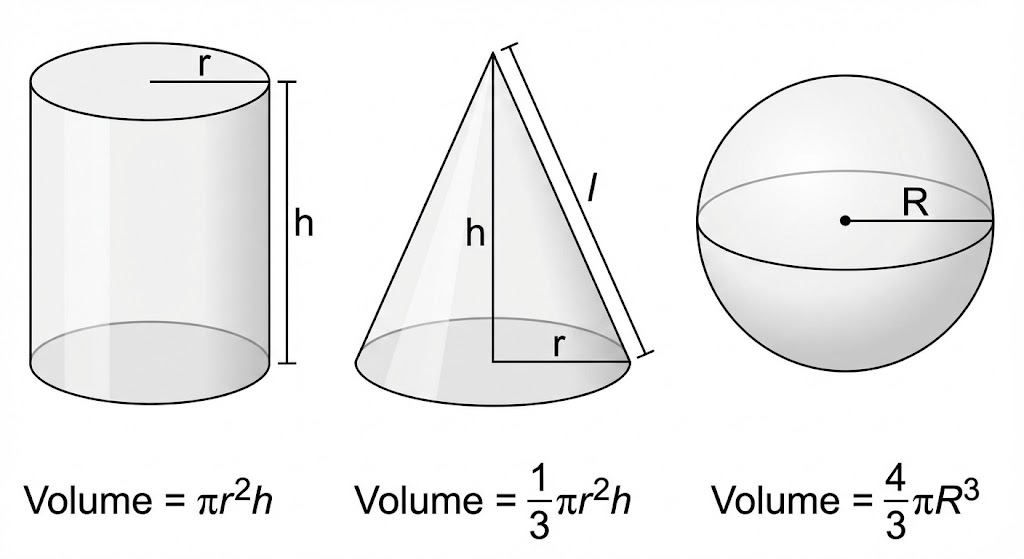
This is a high-frequency topic for calculation problems. Memorize the Volume ($V$) and Surface Area ($S$) formulas.
| Type | Solid | Volume Formula ($V$) | Lateral/Surface Area ($S$) |
| :--- | :--- | :--- | :--- |
| **Prism/Cylinder** | Cylinder, Prism | $$V = S_{\text{base}} \cdot h$$ | $S_{\text{cyl_lateral}} = 2\pi rh$ |
| **Pyramid/Cone** | Cone, Pyramid | $$V = \frac{1}{3} S_{\text{base}} \cdot h$$ | $S_{\text{cone_lateral}} = \pi rl$ ($l$ is slant height) |
| **Sphere** | Sphere | $$V = \frac{4}{3}\pi R^3$$ | $$S = 4\pi R^2$$ |
3. Equation of a Sphere
The set of points in space at a fixed distance (Radius) from a fixed point (Center).
* **Standard Equation**:
Center $(a, b, c)$, Radius $R$:
$$(x-a)^2 + (y-b)^2 + (z-c)^2 = R^2$$
* **Special Case**: If the center is at the origin $(0,0,0)$, the equation is $x^2 + y^2 + z^2 = R^2$.
4. Spatial Vector Basics
Operations for spatial vectors $\vec{a} = (x, y, z)$ are analogous to plane vectors:
* **Magnitude**: $|\vec{a}| = \sqrt{x^2+y^2+z^2}$.
* **Add/Sub**: Add or subtract corresponding coordinates.
* **Dot Product**: $\vec{a} \cdot \vec{b} = x_1x_2 + y_1y_2 + z_1z_2$.
* **Perpendicularity**: $\vec{a} \perp \vec{b} \iff \vec{a} \cdot \vec{b} = 0$.
5. Practice Examples
**Example 1**: Find the distance from point $A(1, 2, 3)$ to the origin $O$.
**Solution**: $|AO| = \sqrt{1^2 + 2^2 + 3^2} = \sqrt{1 + 4 + 9} = \sqrt{14}$.
**Example 2**: A sphere has its center at $(1, -2, 0)$ and radius 3. Find its equation and check if $P(3, 0, 1)$ lies on it.
**Solution**:
Equation: $(x-1)^2 + (y+2)^2 + z^2 = 9$.
Substitute $P(3, 0, 1)$: $(3-1)^2 + (0+2)^2 + 1^2 = 4 + 4 + 1 = 9$.
Since $9 = 9$, point $P$ is on the sphere.
**Example 3**: A cone has a base radius of 3 and a height of 4. Find its volume.
**Solution**:
Base Area $S_{\text{base}} = \pi r^2 = 9\pi$.
Volume $V = \frac{1}{3} S_{\text{base}} h = \frac{1}{3} \cdot 9\pi \cdot 4 = 12\pi$.