Classical Probability and Probability Calculation
CSCA Classical Probability and Probability Calculation study guide organized around the publicly available CSCA syllabus. Practice Mathematics questions on aicsca.com.
Before planning this topic, check the CSCA Exam Guide 2026 for exam dates, registration, fees, and subject requirements.
Syllabus Alignment
This study guide is organized around the publicly available CSCA syllabus for international undergraduate applicants.
Who It Is For
International students preparing for CSCA Math, Physics, Chemistry, or Chinese exams.
Related Practice
CSCA Practice · Go to questions
Past papers and worked video solutions · Timed mock exams · All subject video lessons
Practice by Topic
Jump from this tutorial to filtered practice questions for the same knowledge point.
Related formulas, concepts, and glossary terms
Mathematics Formula & Concept Reference
- Addition Rule for Mutually Exclusive Events
- Classical Probability Formula
- General Addition Rule (Inclusion-Exclusion Principle)
- Probability of Complementary Events
- Probability of Complementary Event
- General Addition Rule for Probability
- Addition Rule for Mutually Exclusive Events
Mathematics Exam Glossary
Tutorial Content
Classical Probability and Probability Calculation
Core Concepts
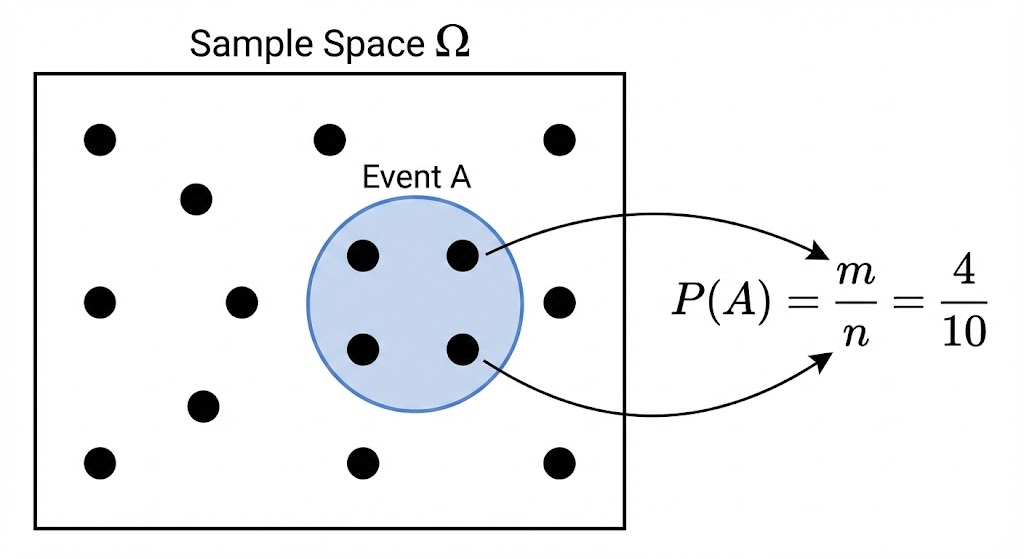
The **Classical Probability Model** is the most fundamental model in probability theory. It strictly applies to random experiments satisfying two conditions:
1. **Finiteness**: The total number of possible outcomes (i.e., **sample points**) is finite, denoted as $n$.
2. **Equiprobability**: Each sample point is equally likely to occur.
For such experiments, if an event $A$ consists of $m$ sample points (called **favorable outcomes**), its probability is defined as:
$$P(A) = \frac{\text{Number of favorable outcomes (m)}}{\text{Total number of possible outcomes (n)}} = \frac{m}{n}$$
Key Steps for Solving Problems
1. **Identify the Model**: Confirm the experiment satisfies both "finiteness" and "equiprobability." **Never** use this formula for non-uniform scenarios (e.g., a biased coin).
2. **Determine Sample Space (n)**: List all possible mutually exclusive basic outcomes. Common tools include **listing**, **tree diagrams**, or **permutations and combinations**.
3. **Determine Event (m)**: Count the number of outcomes that satisfy the specific condition.
4. **Calculate**: Apply the formula $m/n$.
Classic Example
**Problem**: Roll a fair six-sided die once. Find the probability of rolling an odd number.
**Solution**:
* **Sample Space**: $\Omega = \{1, 2, 3, 4, 5, 6\}$, so $n = 6$.
* **Target Event**: $A = \{\text{Odd number}\} = \{1, 3, 5\}$, so $m = 3$.
* **Calculation**: $P(A) = \frac{3}{6} = \frac{1}{2}$.
Common Mistakes
* **Misjudging Equiprobability**: For example, thinking the probability of rain is 50% simply because there are two options (Rain/No Rain). This is incorrect because weather events are not equally likely random outcomes.
* **Inconsistent Counting**: When using permutations or combinations to find $m$ and $n$, ensure you use the same counting standard (e.g., ordered vs. unordered) for both the numerator and denominator.