Spatial Rectangular Coordinate System
CSCA Spatial Rectangular Coordinate System study guide organized around the publicly available CSCA syllabus. Practice Mathematics questions on aicsca.com.
Before planning this topic, check the CSCA Exam Guide 2026 for exam dates, registration, fees, and subject requirements.
Syllabus Alignment
This study guide is organized around the publicly available CSCA syllabus for international undergraduate applicants.
Who It Is For
International students preparing for CSCA Math, Physics, Chemistry, or Chinese exams.
Related Practice
CSCA Practice · Go to questions
Past papers and worked video solutions · Timed mock exams · All subject video lessons
Practice by Topic
Jump from this tutorial to filtered practice questions for the same knowledge point.
Related formulas, concepts, and glossary terms
Mathematics Formula & Concept Reference
- Distance Formula Between Two Points in 3D Cartesian Coordinate System
- Midpoint Coordinate Formula for a Line Segment in Space
- Distance from a Point to a Coordinate Plane in 3D Cartesian Coordinate System
- Midpoint Formula of a Line Segment in 3D Cartesian Coordinate System
- Distance Formula Between Two Points in Space
- Coordinate Representation of a Point in 3D Cartesian Coordinate System
Mathematics Exam Glossary
Tutorial Content
Spatial Rectangular Coordinate System
The Spatial Rectangular Coordinate System is the cornerstone of analytic geometry. In the CSCA exam, you need not only to calculate distances but also to possess strong **spatial visualization skills** (e.g., projections of points, symmetry relationships).
1. Establishing the System
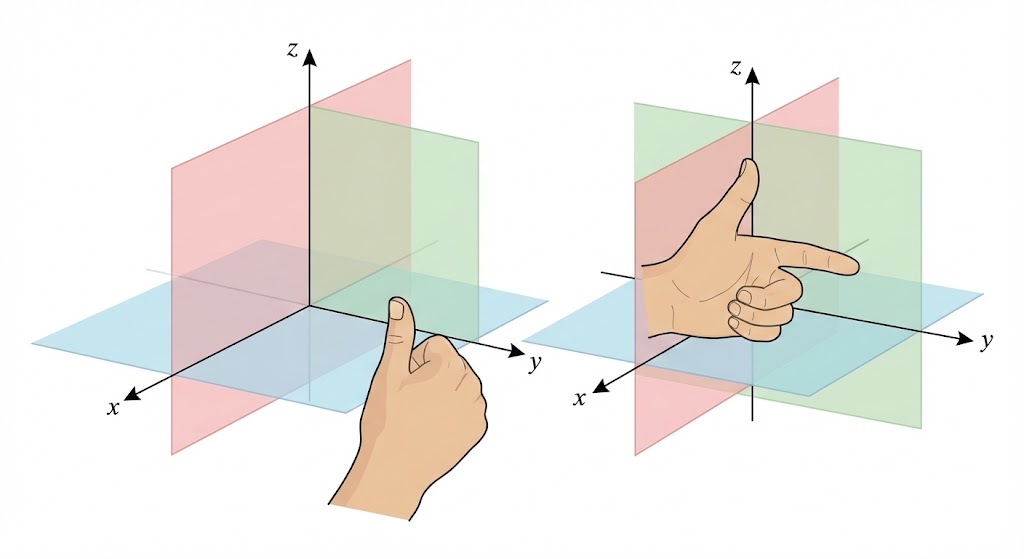
* **Three Elements**: Origin $O$, three axes ($x, y, z$), and three coordinate planes ($xOy, yOz, zOx$).
* **Right-Hand Rule**: The standard for drawing and determining direction. Extend your right hand: thumb points to the $x$-axis, index finger to the $y$-axis, and middle finger to the $z$-axis. The fingers are mutually perpendicular.
* **Octants**: The planes divide space into 8 parts. The region where $x, y, z$ are all positive is the **First Octant**.
2. Coordinates and Geometric Meaning
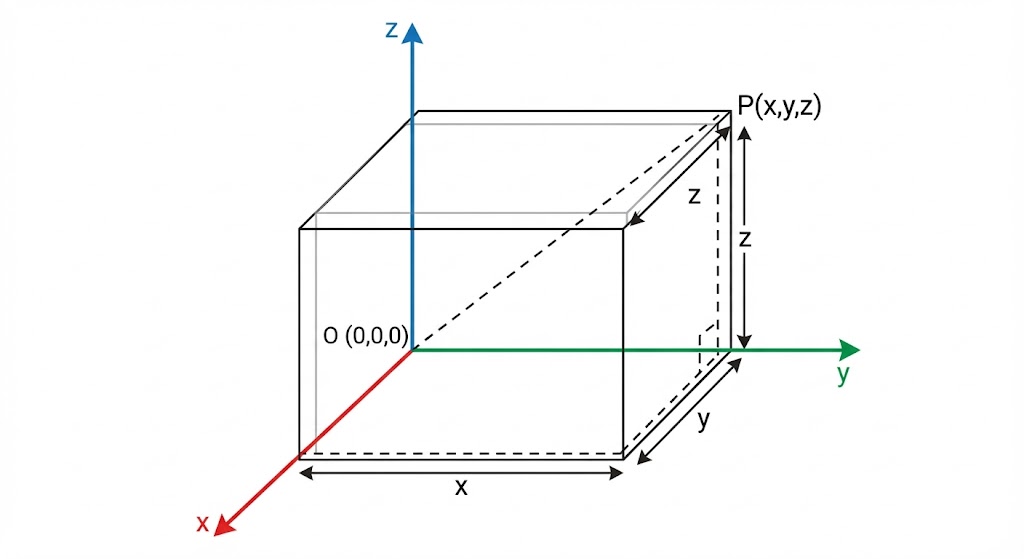
The coordinates of a point $P(x, y, z)$ correspond to its "signed distances" to the three coordinate planes.
* **Rectangular Box Method**: The best way to visualize coordinates is to imagine a rectangular box (cuboid) with the origin $O$ and point $P$ as opposite diagonal vertices.
* $x$: Distance from $P$ to the $yOz$ plane (signed).
* $y$: Distance from $P$ to the $zOx$ plane (signed).
* $z$: Distance from $P$ to the $xOy$ plane (signed).
3. Key Formulas and Properties
#### 3.1 Distance Formula
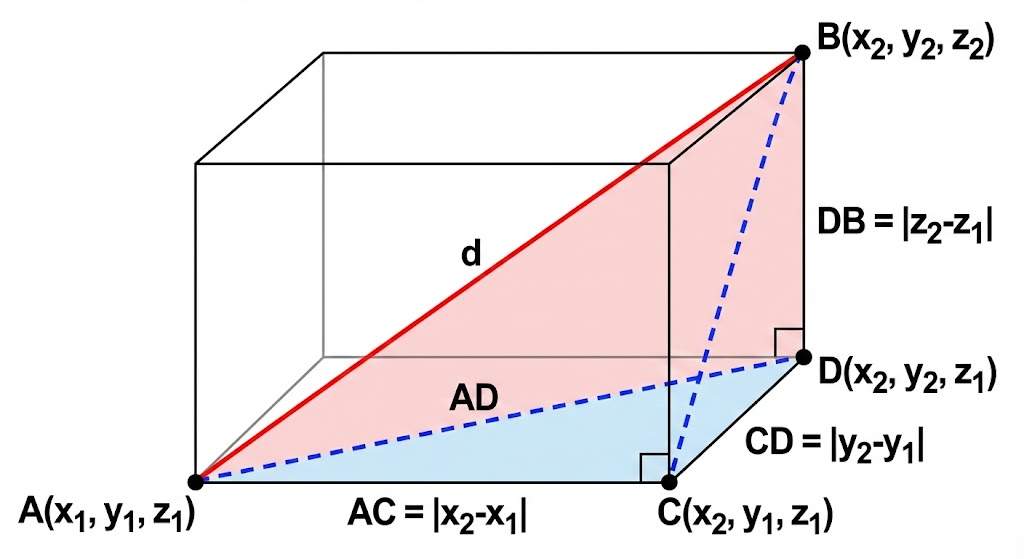
Let $A(x_1, y_1, z_1)$ and $B(x_2, y_2, z_2)$. The distance is:
$$|AB| = \sqrt{(x_2 - x_1)^2 + (y_2 - y_1)^2 + (z_2 - z_1)^2}$$
* **Special Case**: Distance from $P(x,y,z)$ to the origin is $|OP| = \sqrt{x^2+y^2+z^2}$.
#### 3.2 Symmetry (**High-Frequency Topic**)
For a point $P(x, y, z)$, the symmetric point with respect to:
* **Origin**: $(-x, -y, -z)$ (All signs change)
* **$x$-axis**: $(x, -y, -z)$ (Only $x$ remains unchanged)
* **$xOy$ plane**: $(x, y, -z)$ (Only $z$ changes sign)
4. Typical Examples
**Example 1** (Distance and Symmetry): Given point $P(3, -4, 5)$.
(1) Find the distance from $P$ to the origin.
(2) Find the coordinates of the point symmetric to $P$ with respect to the $z$-axis.
**Solution**:
(1) $|OP| = \sqrt{3^2 + (-4)^2 + 5^2} = \sqrt{9+16+25} = \sqrt{50} = 5\sqrt{2}$.
(2) Symmetric w.r.t the $z$-axis means $z$ stays the same, $x, y$ change signs. The point is $(-3, 4, 5)$.
**Example 2** (Geometric Features): Point $M$ is on the $y$-axis, and its distance to $A(1, 0, 2)$ is $\sqrt{5}$. Find the coordinates of $M$.
**Solution**:
Since $M$ is on the $y$-axis, let $M(0, y, 0)$.
Using the distance formula:
$$|MA| = \sqrt{(0-1)^2 + (y-0)^2 + (0-2)^2} = \sqrt{1 + y^2 + 4} = \sqrt{y^2+5}$$
Set $\sqrt{y^2+5} = \sqrt{5}$, solving gives $y^2 = 0$, so $y=0$.
Thus, $M$ is $(0, 0, 0)$, which is the Origin.
**Example 3** (Application of Distance): Point $P$ is on the $yOz$ plane. Its distance to the $y$-axis is 3, and to the $z$-axis is 5. Find the coordinates of $P$.
**Solution**:
Let $P(0, y, z)$ (Since it's on $yOz$, $x=0$).
* Distance to $y$-axis is $\sqrt{x^2+z^2} = |z|$. Given $|z|=3$, so $z = \pm 3$.
* Distance to $z$-axis is $\sqrt{x^2+y^2} = |y|$. Given $|y|=5$, so $y = \pm 5$.
Therefore, there are four possible coordinates: $(0, 5, 3), (0, 5, -3), (0, -5, 3), (0, -5, -3)$.
5. Study Tips
* **Distinguish Concepts**: Do not confuse distance to an "Axis" (sqrt of sum of squares of other two) with distance to a "Plane" (absolute value of the other one).
* **Symmetry Trick**: If symmetric with respect to something, that coordinate stays the same; the others change signs.