Equations and Properties of Lines
CSCA Equations and Properties of Lines study guide organized around the publicly available CSCA syllabus. Practice Mathematics questions on aicsca.com.
Before planning this topic, check the CSCA Exam Guide 2026 for exam dates, registration, fees, and subject requirements.
Syllabus Alignment
This study guide is organized around the publicly available CSCA syllabus for international undergraduate applicants.
Who It Is For
International students preparing for CSCA Math, Physics, Chemistry, or Chinese exams.
Related Practice
CSCA Practice · Go to questions
Past papers and worked video solutions · Timed mock exams · All subject video lessons
Practice by Topic
Jump from this tutorial to filtered practice questions for the same knowledge point.
Related formulas, concepts, and glossary terms
Mathematics Formula & Concept Reference
- General Form of a Line Equation
- Conditions for Parallel and Perpendicular Lines
- Point-Slope Form of a Line
- Distance from a Point to a Line
- Slope Relationship of Two Parallel Lines
- Slope-Intercept Form of a Line
- Slope Relationship of Two Perpendicular Lines
- Two-Point Form of a Line Equation
Mathematics Exam Glossary
Tutorial Content
Equations and Properties of Lines
The straight line is the cornerstone of analytic geometry. For the CSCA exam, you must not only master the five forms of linear equations but also flexibly handle positional relationships (parallel, perpendicular) and distance problems.
1. Inclination and Slope
These are the core parameters describing the "direction" of a line.
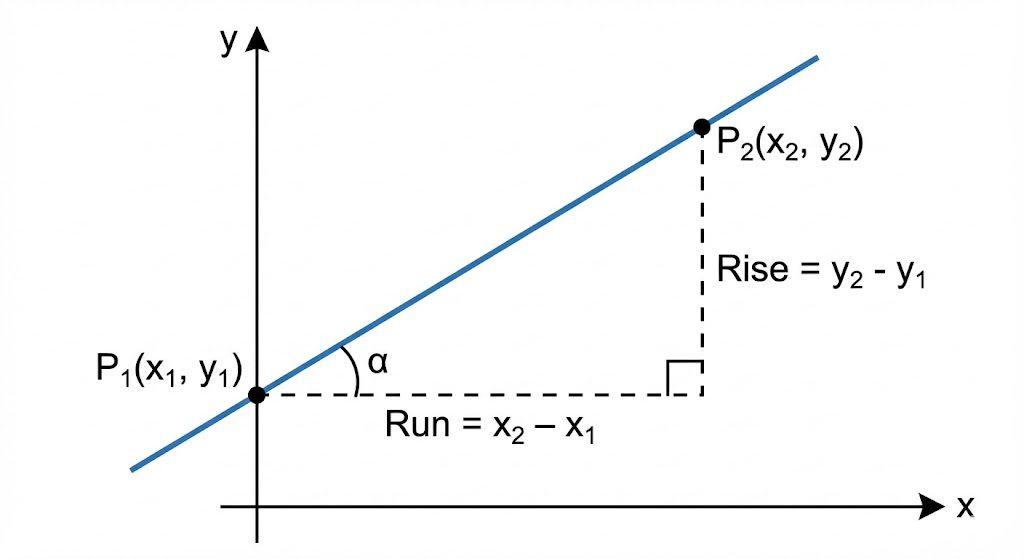
* **Inclination Angle ($\alpha$)**: The smallest positive angle the line makes with the positive $x$-axis ($0^\circ \le \alpha < 180^\circ$).
* **Slope ($k$)**: The tangent of the inclination angle, i.e., $k = \tan \alpha$. (*Note: Slope is undefined when $\alpha = 90^\circ$, as the line is vertical*)
* **Slope Formula**: Given two points $P_1(x_1, y_1), P_2(x_2, y_2)$:
$$k = \frac{y_2 - y_1}{x_2 - x_1} \quad (x_1 \neq x_2)$$
2. Five Forms of Linear Equations
Select the fastest form based on the given conditions:
| Name | Equation | Condition |
| :--- | :--- | :--- |
| **Point-Slope** | $y - y_0 = k(x - x_0)$ | Given point $(x_0, y_0)$ and slope $k$. **Most common**. |
| **Slope-Intercept** | $y = kx + b$ | Given slope $k$ and y-intercept $b$. |
| **Two-Point** | $\frac{y - y_1}{y_2 - y_1} = \frac{x - x_1}{x_2 - x_1}$ | Given two points ($x_1 \neq x_2, y_1 \neq y_2$). |
| **Intercept** | $\frac{x}{a} + \frac{y}{b} = 1$ | Given x-intercept $a$ and y-intercept $b$ (non-zero). |
| **General** | $Ax + By + C = 0$ | **Universal**. All lines can be expressed this way. |
3. Positional Relationships
Given two lines $l_1: A_1x + B_1y + C_1 = 0$ and $l_2: A_2x + B_2y + C_2 = 0$, with slopes $k_1, k_2$.
* **Parallel ($l_1 // l_2$)**:
* Slope relation: $k_1 = k_2$
* Coefficient relation: $A_1B_2 - A_2B_1 = 0$ and $C_1 \neq C_2$ (i.e., $\frac{A_1}{A_2} = \frac{B_1}{B_2} \neq \frac{C_1}{C_2}$)
* **Perpendicular ($l_1 \perp l_2$)**:
* Slope relation: $k_1 \cdot k_2 = -1$
* Coefficient relation: $A_1A_2 + B_1B_2 = 0$
4. Distance Formulas
A high-frequency topic in CSCA exams. Memorize these.
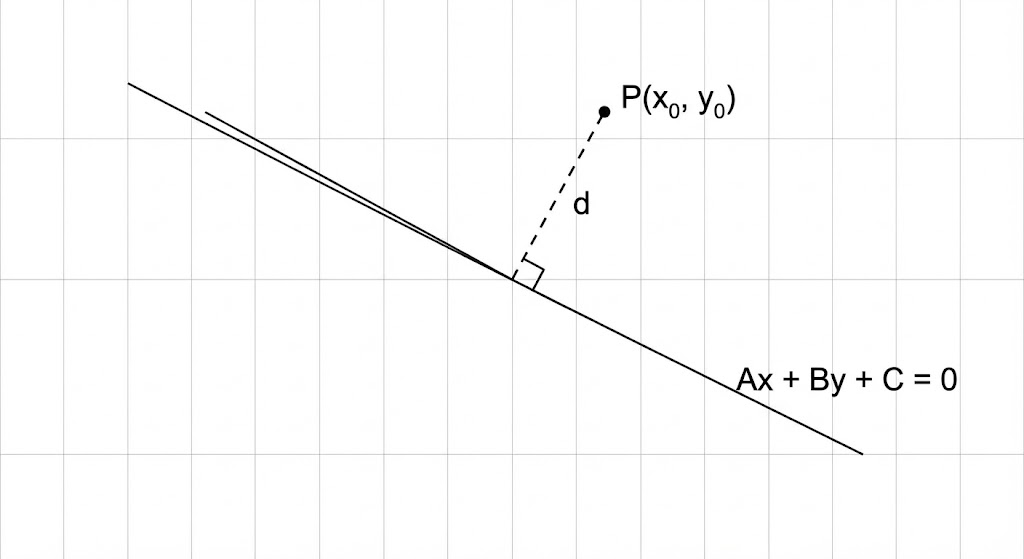
* **Distance from Point to Line**: Distance $d$ from point $P(x_0, y_0)$ to line $Ax + By + C = 0$:
$$d = \frac{|Ax_0 + By_0 + C|}{\sqrt{A^2 + B^2}}$$
* **Distance between Parallel Lines**: Distance $d$ between $Ax + By + C_1 = 0$ and $Ax + By + C_2 = 0$:
$$d = \frac{|C_1 - C_2|}{\sqrt{A^2 + B^2}}$$
*Note: Before using this, ensure the $x, y$ coefficients of both lines are identical.*
5. Practice Example
**Example**: Find the distance from point $P(2, -1)$ to the line $l: 3x - 4y + 5 = 0$.
**Solution**:
Apply the point-to-line distance formula directly. Here $A=3, B=-4, C=5$, and point $(x_0, y_0) = (2, -1)$.
$$d = \frac{|3(2) - 4(-1) + 5|}{\sqrt{3^2 + (-4)^2}} = \frac{|6 + 4 + 5|}{\sqrt{25}} = \frac{15}{5} = 3$$
Thus, the distance is 3.