Geometric Meaning of Derivative
CSCA Geometric Meaning of Derivative study guide organized around the publicly available CSCA syllabus. Practice Mathematics questions on aicsca.com.
Before planning this topic, check the CSCA Exam Guide 2026 for exam dates, registration, fees, and subject requirements.
Syllabus Alignment
This study guide is organized around the publicly available CSCA syllabus for international undergraduate applicants.
Who It Is For
International students preparing for CSCA Math, Physics, Chemistry, or Chinese exams.
Related Practice
CSCA Practice · Go to questions
Past papers and worked video solutions · Timed mock exams · All subject video lessons
Practice by Topic
Jump from this tutorial to filtered practice questions for the same knowledge point.
Related formulas, concepts, and glossary terms
Mathematics Formula & Concept Reference
Mathematics Exam Glossary
Tutorial Content
Geometric Meaning of Derivative
1. Core Concepts
**Geometric Meaning**:
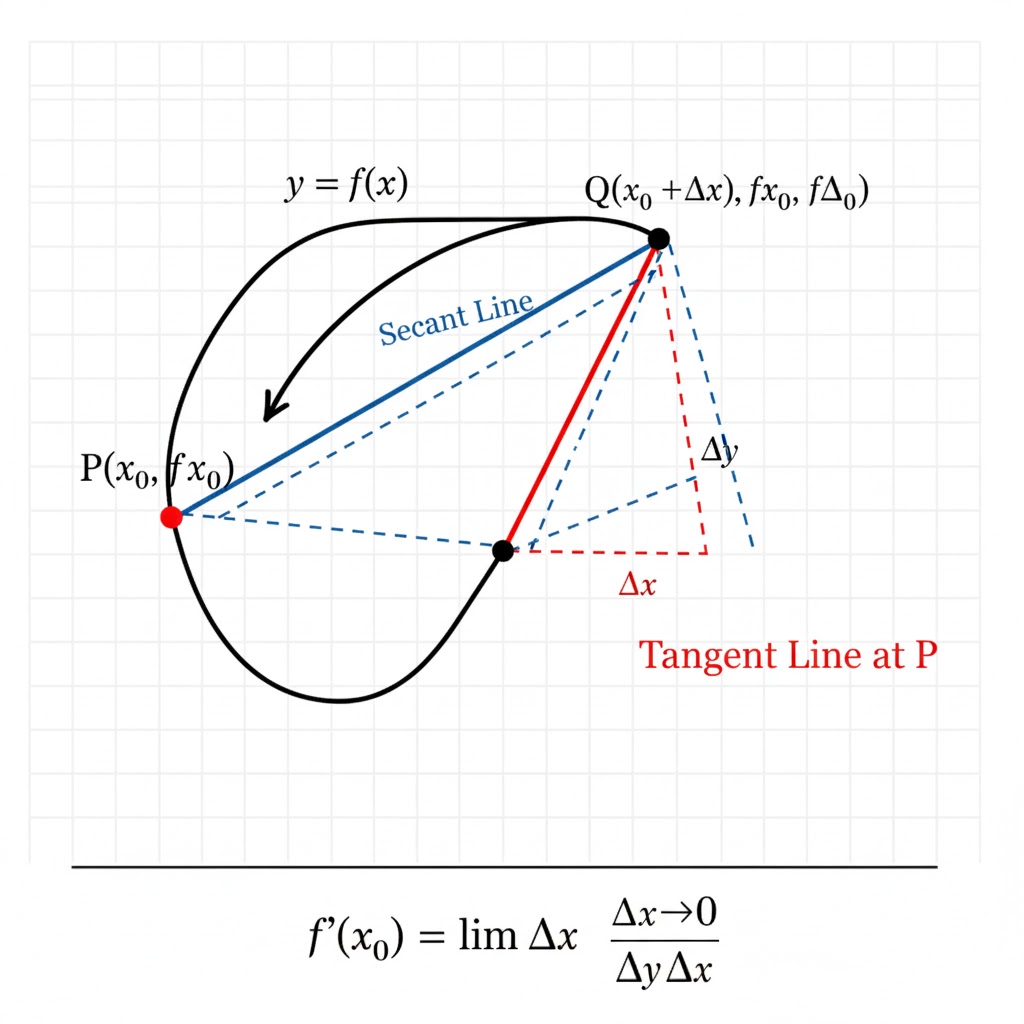
The derivative $f'(x_0)$ of a function $y=f(x)$ at $x_0$ represents the **Slope of the Tangent Line** to the curve at the point $P(x_0, f(x_0))$.
$$ k_{\text{tangent}} = f'(x_0) $$
**Visual Intuition**:
Let $P$ be a fixed point and $Q$ be a moving point on the curve. As $Q$ approaches $P$ infinitely, the **Secant Line** $PQ$ approaches the **Tangent Line**. The derivative quantifies this limit.
---
2. Equations of Tangent and Normal Lines
Let the point of tangency be $P(x_0, y_0)$, where $y_0 = f(x_0)$.
#### (1) Tangent Line Equation
Using the point-slope form:
$$ y - y_0 = f'(x_0)(x - x_0) $$
#### (2) Normal Line Equation
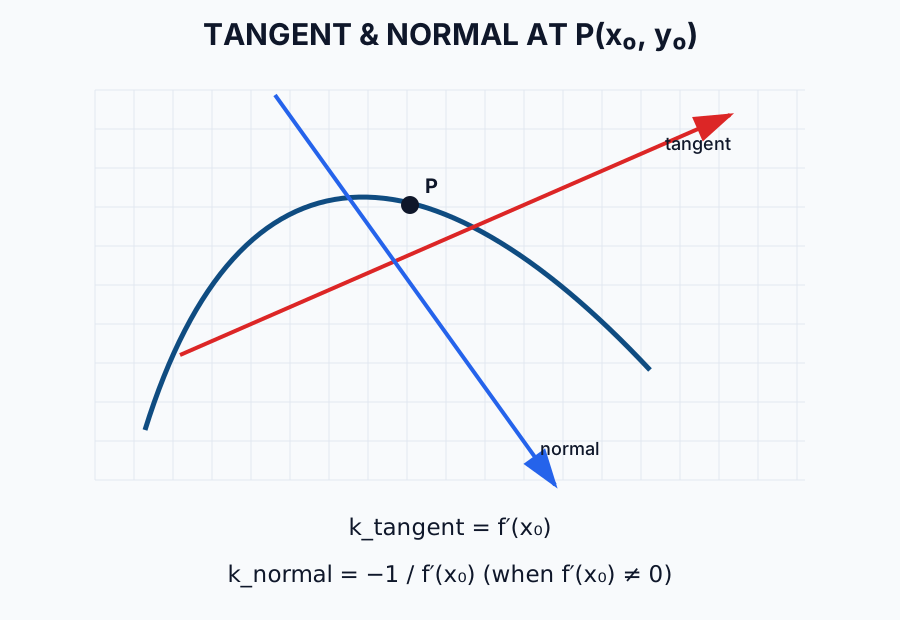
The **Normal Line** is perpendicular to the tangent line at the point of tangency.
* **Slope Relationship**: If tangent slope $k = f'(x_0) \neq 0$, then normal slope $k_{\text{norm}} = -\frac{1}{f'(x_0)}$.
* **Equation**:
$$ y - y_0 = -\frac{1}{f'(x_0)}(x - x_0) $$
---
3. Typical Examples
**Example 1: Finding Tangent and Normal**
Find the tangent and normal lines to $y = x^2$ at $(1, 1)$.
**Solution**:
1. **Derivative (Slope)**: $y' = 2x$. At $x=1$, tangent slope $k = 2$.
2. **Tangent**: $y - 1 = 2(x - 1) \Rightarrow y = 2x - 1$.
3. **Normal Slope**: $k_{\text{norm}} = -\frac{1}{2}$.
4. **Normal**: $y - 1 = -\frac{1}{2}(x - 1) \Rightarrow y = -\frac{1}{2}x + \frac{3}{2}$.
**Example 2: Finding Tangency Point from Slope**
Find the tangent line to $y = x^3$ with slope 3.
**Solution**:
1. **Set Point**: Let tangency point be $(x_0, y_0)$.
2. **Solve**: $f'(x_0) = 3x_0^2 = 3 \Rightarrow x_0 = \pm 1$.
3. **Two Cases**:
* $x_0 = 1, y_0 = 1 \Rightarrow y = 3x - 2$.
* $x_0 = -1, y_0 = -1 \Rightarrow y = 3x + 2$.
**Example 3: Tangent Passing Through a Point (Trap)**
Find the tangent line to $y = x^2$ passing through $A(2, 0)$.
**Solution**:
*Note: $A(2,0)$ is NOT on the curve. It is an external point.*
1. **Set Tangency Point**: Let point be $P(t, t^2)$.
2. **Slope**: $k = 2t$.
3. **Equation**: $y - t^2 = 2t(x - t)$.
4. **Substitute A**: Plug in $(2, 0)$:
$0 - t^2 = 2t(2 - t) \Rightarrow t^2 - 4t = 0$.
5. **Solve**: $t = 0$ or $t = 4$.
* $t=0 \Rightarrow y=0$.
* $t=4 \Rightarrow y = 8x - 16$.
---
4. Common Pitfalls
* **"At the point" vs "Through the point"**:
* "At P": P is the tangency point. Use $f'(x_P)$ directly.
* "Through A": A might not be the tangency point. You MUST **assume a tangency point $(t, f(t))$** first.
* **Normal Slope**: Remember it is the **Negative Reciprocal**.
* **Tangency Condition**: The point satisfies both the curve equation and the line equation.