Vector Operations
CSCA Vector Operations study guide organized around the publicly available CSCA syllabus. Practice Mathematics questions on aicsca.com.
Before planning this topic, check the CSCA Exam Guide 2026 for exam dates, registration, fees, and subject requirements.
Syllabus Alignment
This study guide is organized around the publicly available CSCA syllabus for international undergraduate applicants.
Who It Is For
International students preparing for CSCA Math, Physics, Chemistry, or Chinese exams.
Related Practice
CSCA Practice · Go to questions
Past papers and worked video solutions · Timed mock exams · All subject video lessons
Practice by Topic
Jump from this tutorial to filtered practice questions for the same knowledge point.
Related formulas, concepts, and glossary terms
Mathematics Formula & Concept Reference
- Vector Product (Cross Product)
- Magnitude (Length) of a Vector
- Vector Addition
- Dot Product (Inner Product) of Vectors
- Cross Product (Outer Product, 3D only)
- Scalar Multiplication of a Vector
- Vector Addition (Parallelogram Law)
- Scalar Multiplication of Vectors
Mathematics Exam Glossary
Tutorial Content
Vector Operations
Vector operations are not just calculation tools but core methods for solving geometric problems. In the CSCA exam, the focus is on **coordinate calculations** and the **conditions for parallelism and perpendicularity**.
1. Basic Concepts
* **Definition**: A quantity with both magnitude and direction. Usually denoted by a directed line segment $\vec{AB}$ or a lowercase letter $\vec{a}$.
* **Coordinate Representation**: In a Cartesian coordinate system, if $\vec{a}$ starts at the origin and ends at $(x, y)$, it is denoted as $\vec{a} = (x, y)$.
* **Modulus (Magnitude)**: The length of the vector, denoted as $|\vec{a}|$.
$$|\vec{a}| = \sqrt{x^2 + y^2}$$
2. Linear Operations
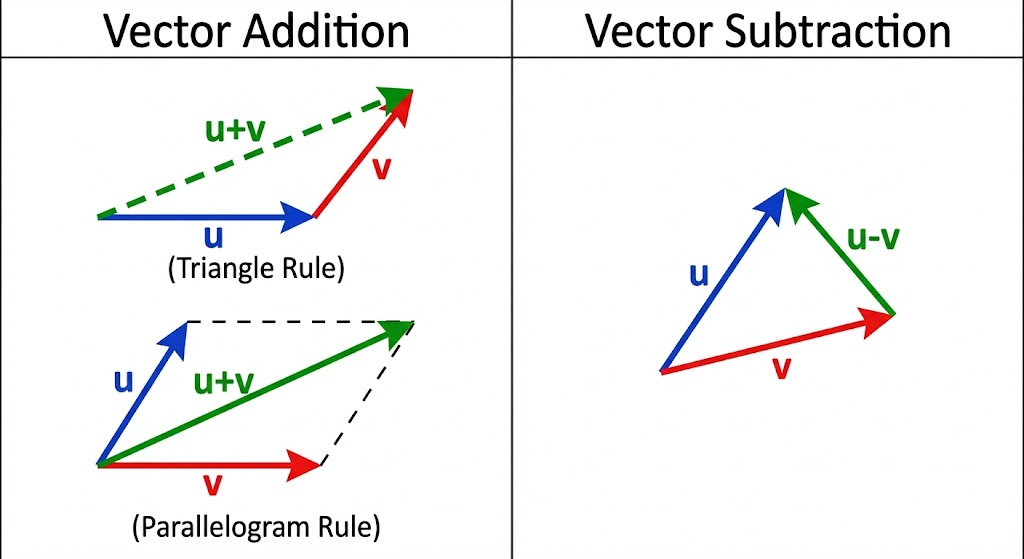
Linear operations include addition, subtraction, and scalar multiplication. We must master both their **geometric meaning** (drawing) and **coordinate formulas** (calculation).
| Operation | Geometric Rule | Coordinate Formula | Note |
| :--- | :--- | :--- | :--- |
| **Addition** $\vec{a}+\vec{b}$ | **Parallelogram Rule** or **Triangle Rule** (Head-to-Tail) | $(x_1+x_2, y_1+y_2)$ | Commutative and associative |
| **Subtraction** $\vec{a}-\vec{b}$ | **Triangle Rule** (Common tail, pointing to minuend) | $(x_1-x_2, y_1-y_2)$ | Inverse of addition |
| **Scalar Multiplication** $\lambda\vec{a}$ | $\lambda$ scales length, sign changes direction | $(\lambda x, \lambda y)$ | $\lambda > 0$ same dir; $\lambda < 0$ opposite dir |
3. Two Important Conditions (Parallel & Perpendicular)
This is a crucial topic for the exam. Distinguish carefully:
Let $\vec{a}=(x_1, y_1), \vec{b}=(x_2, y_2)$, and $\vec{b} \neq \vec{0}$.
1. **Parallel (Collinear)**:
$$\vec{a} // \vec{b} \iff x_1y_2 - x_2y_1 = 0$$
*(Mnemonic: Cross-products are equal)*
2. **Perpendicular**:
$$\vec{a} \perp \vec{b} \iff \vec{a} \cdot \vec{b} = 0 \iff x_1x_2 + y_1y_2 = 0$$
*(Mnemonic: Sum of product of corresponding coords is zero)*
4. Dot Product (Scalar Product)
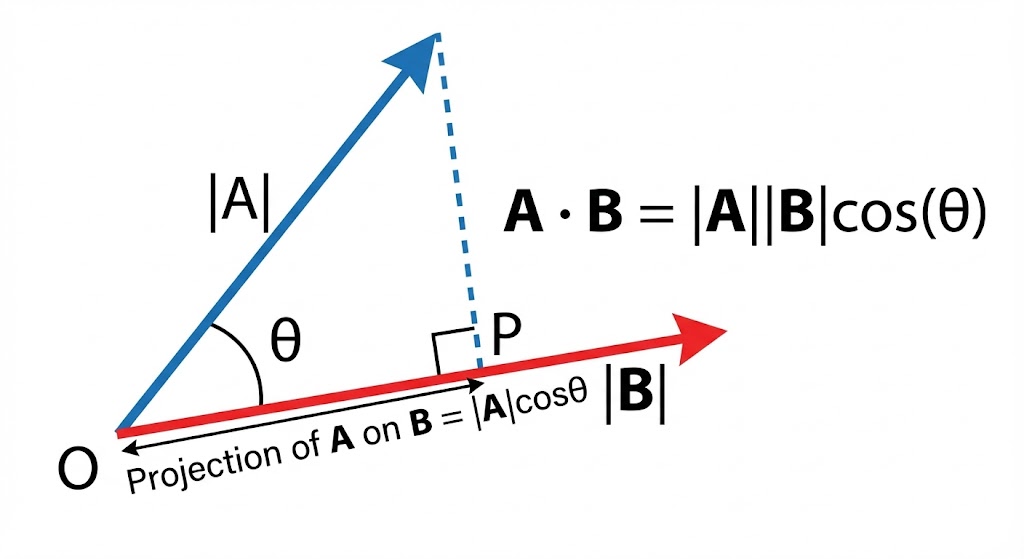
The result of a dot product is a **Real Number (Scalar)**, not a vector.
* **Definition Formula**:
$$\vec{a} \cdot \vec{b} = |\vec{a}| |\vec{b}| \cos\theta$$
Where $\theta$ is the angle between the two vectors ($0 \le \theta \le \pi$).
* **Coordinate Formula**:
$$\vec{a} \cdot \vec{b} = x_1x_2 + y_1y_2$$
* **Key Applications**:
1. **Finding Angle**: $\cos\theta = \frac{\vec{a} \cdot \vec{b}}{|\vec{a}| |\vec{b}|} = \frac{x_1x_2 + y_1y_2}{\sqrt{x_1^2+y_1^2}\sqrt{x_2^2+y_2^2}}$
2. **Finding Modulus**: $|\vec{a}|^2 = \vec{a} \cdot \vec{a}$, i.e., $|\vec{a}| = \sqrt{\vec{a} \cdot \vec{a}}$.
5. Typical Examples
**Example 1** (Linear Ops): Given $\vec{a}=(1, 2), \vec{b}=(-3, 1)$, find the coordinates and modulus of $2\vec{a} - \vec{b}$.
**Solution**:
$2\vec{a} - \vec{b} = 2(1, 2) - (-3, 1) = (2, 4) - (-3, 1) = (5, 3)$.
Modulus $|2\vec{a} - \vec{b}| = \sqrt{5^2 + 3^2} = \sqrt{25+9} = \sqrt{34}$.
**Example 2** (Parallel & Perpendicular): Given $\vec{a}=(k, 2), \vec{b}=(1, -3)$.
(1) If $\vec{a} // \vec{b}$, find $k$; (2) If $\vec{a} \perp \vec{b}$, find $k$.
**Solution**:
(1) Parallel condition: $x_1y_2 - x_2y_1 = 0 \Rightarrow k(-3) - 1(2) = 0 \Rightarrow -3k = 2 \Rightarrow k = -\frac{2}{3}$.
(2) Perpendicular condition: $x_1x_2 + y_1y_2 = 0 \Rightarrow k(1) + 2(-3) = 0 \Rightarrow k - 6 = 0 \Rightarrow k = 6$.
**Example 3** (Finding Angle): Given $|\vec{a}|=2, |\vec{b}|=3$, and $\vec{a} \cdot \vec{b} = -3$, find the angle $\theta$ between $\vec{a}$ and $\vec{b}$.
**Solution**:
$\cos\theta = \frac{\vec{a} \cdot \vec{b}}{|\vec{a}| |\vec{b}|} = \frac{-3}{2 \times 3} = -\frac{1}{2}$.
Since $0 \le \theta \le \pi$ and $\cos\theta = -\frac{1}{2}$, we have $\theta = \frac{2\pi}{3}$ ($120^\circ$).