Sets and Inequalities
CSCA Sets and Inequalities study guide organized around the publicly available CSCA syllabus. Practice Mathematics questions on aicsca.com.
Before planning this topic, check the CSCA Exam Guide 2026 for exam dates, registration, fees, and subject requirements.
Syllabus Alignment
This study guide is organized around the publicly available CSCA syllabus for international undergraduate applicants.
Who It Is For
International students preparing for CSCA Math, Physics, Chemistry, or Chinese exams.
Related Practice
CSCA Practice · Go to questions
Past papers and worked video solutions · Timed mock exams · All subject video lessons
Practice by Topic
Jump from this tutorial to filtered practice questions for the same knowledge point.
Related formulas, concepts, and glossary terms
Mathematics Formula & Concept Reference
- Set Difference
- Union
- Complement
- Intersection
- De Morgan's Laws
- De Morgan's Laws (Set Form)
- Application of Basic Inequality: Minimum Sum
- Solution Set Mnemonic for Quadratic Inequalities ( a > 0, Δ > 0 )
Mathematics Exam Glossary
Tutorial Content
Sets and Inequalities
1. Module Introduction
This module forms the cornerstone of the CSCA Mathematics exam. **Sets** are the universal language of modern mathematics for describing problems, while **Inequalities** are the core tools for analyzing quantitative ranges. Mastering these topics is a prerequisite for solving problems in functions (domains), probability, and linear programming.
2. Key Concepts Preview
2.1 Set Operations & Venn Diagrams
Sets are not just collections of elements; the operations between them are crucial: **Intersection ($\cap$)**, **Union ($\cup$)**, and **Complement ($\complement_U A$)**. The most intuitive way to understand these operations is through Venn diagrams.
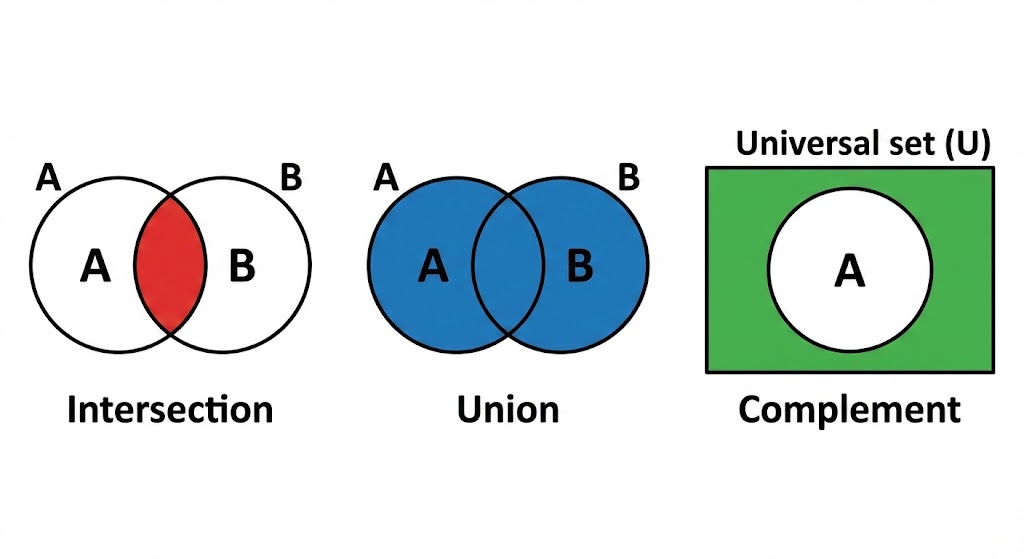 * **Intersection ($A \cap B$)**: The common part shared by two sets.
* **Union ($A \cup B$)**: All elements contained in both sets.
* **Complement ($\{x | x \in U, x \notin A\}$)**: The part of the universal set that does not belong to A.
2.2 Inequalities & Interval Notation
In the CSCA exam, solution sets for inequalities are often required to be expressed in **Interval Notation** or set notation. Understanding the geometric representation on the number line is essential.
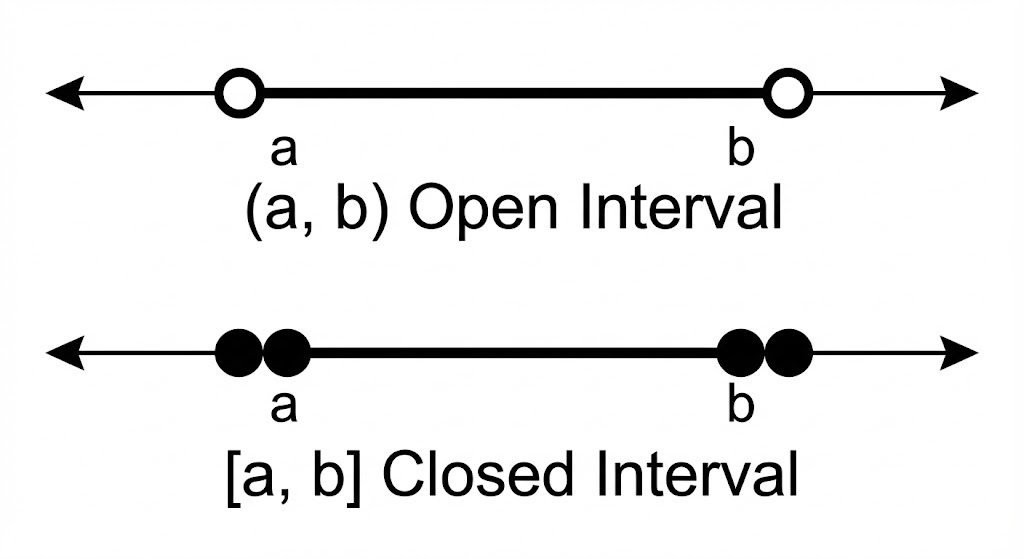 * **Open Interval**: $(a, b)$, represented by hollow circles on the number line, excluding endpoints.
* **Closed Interval**: $[a, b]$, represented by solid dots on the number line, including endpoints.
2.3 Quadratic Inequalities
This is a high-frequency topic in the exam. The core strategy for solving a quadratic inequality $ax^2+bx+c > 0$ is **"combining numbers and shapes"**, which means using the graph of the quadratic function $y=ax^2+bx+c$ to determine the range of $x$.
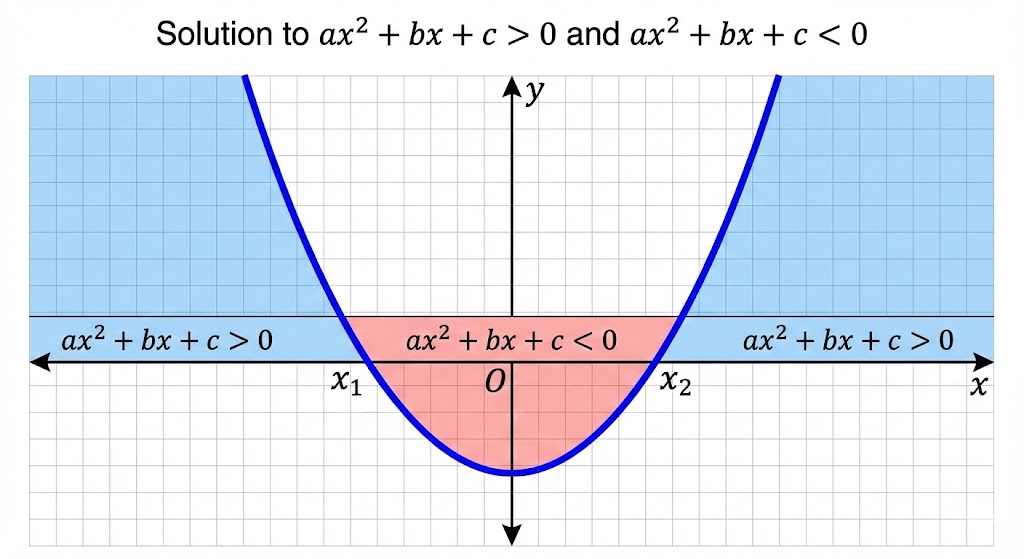 * When the graph is above the x-axis, the function value is $>0$.
* When the graph is below the x-axis, the function value is $<0$.
3. Exam Focus
1. **Conversion between Set Representations**: Switching between set-builder notation $\{x|P(x)\}$, roster method, and intervals.
2. **Operational Accuracy**: Pay special attention to endpoints (open vs. closed) when finding complements and intersections, as this is a common error prone area.
3. **Graphing Methods**: Proficiently use graphing methods to quickly solve quadratic and rational inequalities.