Symmetry of Functions
CSCA Symmetry of Functions study guide organized around the publicly available CSCA syllabus. Practice Mathematics questions on aicsca.com.
Before planning this topic, check the CSCA Exam Guide 2026 for exam dates, registration, fees, and subject requirements.
Syllabus Alignment
This study guide is organized around the publicly available CSCA syllabus for international undergraduate applicants.
Who It Is For
International students preparing for CSCA Math, Physics, Chemistry, or Chinese exams.
Related Practice
CSCA Practice · Go to questions
Past papers and worked video solutions · Timed mock exams · All subject video lessons
Practice by Topic
Jump from this tutorial to filtered practice questions for the same knowledge point.
Related formulas, concepts, and glossary terms
Mathematics Formula & Concept Reference
- Function Symmetric about the Point (a, b)
- Definition of Even Function
- Relationship between Periodic Functions and Symmetry
- Definition of Odd Function
- Function Symmetric about the Line x = a
Mathematics Exam Glossary
Tutorial Content
Symmetry of Functions
1. Concept
**Symmetry** describes the mirroring or rotational relationship of a function's graph.
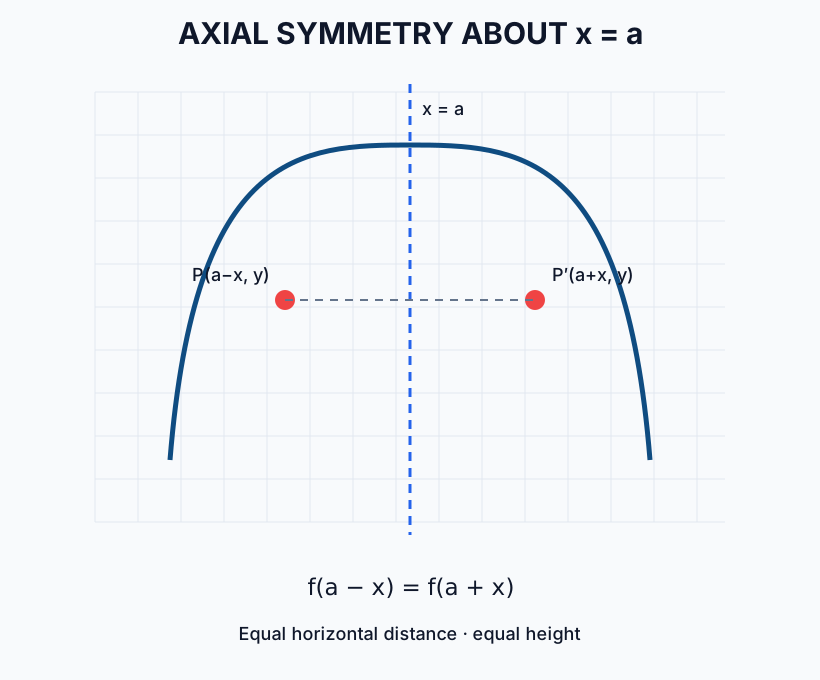
* **Axial Symmetry (Reflection)**: The graph is symmetric about a vertical line $x=a$. (e.g., Even functions correspond to the axis $x=0$).
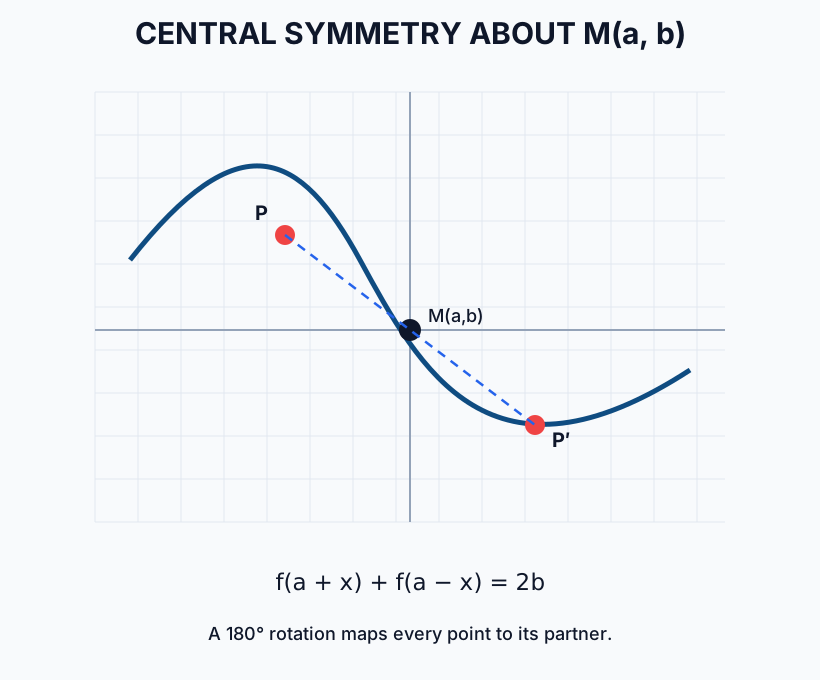
* **Central Symmetry (Rotation)**: The graph is symmetric about a point $(a, b)$. (e.g., Odd functions correspond to the center $(0,0)$).
 ---
---
2. Mathematical Formulas
Let the domain of $f(x)$ be $D$.
#### (1) Symmetry about line $x=a$
* **Geometric Meaning**: Any point on the graph has a mirror image across the line $x=a$ at the same height.
* **Formula**:
$$f(a+x) = f(a-x)$$
Or equivalently:
$$f(x) = f(2a-x)$$
* **Special Case**: If $a=0$, $f(x)=f(-x)$ (Even Function).
#### (2) Symmetry about point $(a, b)$
* **Geometric Meaning**: The graph matches itself if rotated $180^{\circ}$ around $(a, b)$.
* **Formula**:
$$f(a+x) + f(a-x) = 2b$$
Or equivalently:
$$f(x) + f(2a-x) = 2b$$
* **Special Case**: If $(a, b)=(0,0)$, $f(x)+f(-x)=0 \Rightarrow f(-x)=-f(x)$ (Odd Function).
 ---
---
3. Relation to Periodicity (Important Inference)
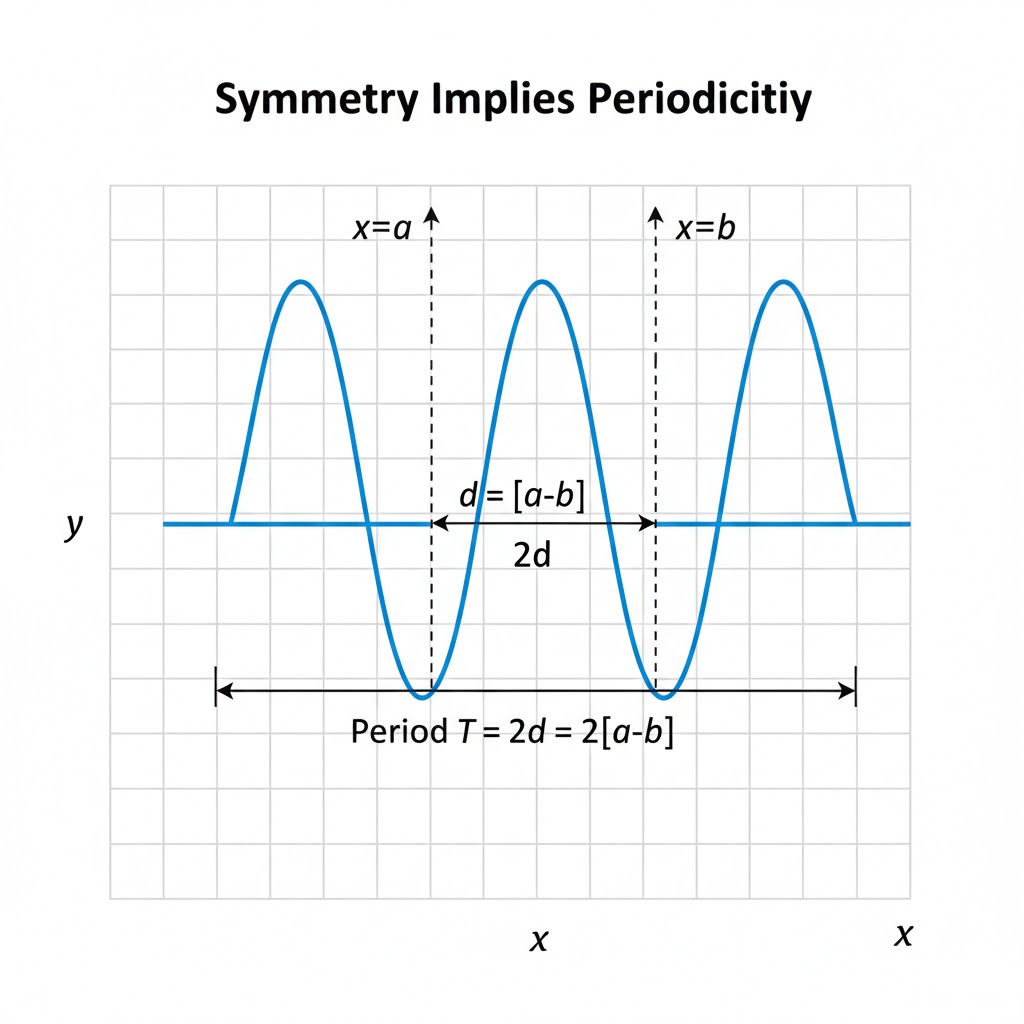
If a function has **two** distinct symmetries, it implies periodicity.
* **Two Axes**: Symmetric about $x=a$ and $x=b$ $\Rightarrow$ Periodic with $T = 2|a-b|$.
* **Two Centers**: Symmetric about $(a, 0)$ and $(b, 0)$ $\Rightarrow$ Periodic with $T = 2|a-b|$.
* **One Axis + One Center**: Symmetric about $x=a$ and $(b, 0)$ $\Rightarrow$ Periodic with $T = 4|a-b|$.
 ---
---
4. Typical Examples
**Example 1: Proving Axial Symmetry**
Prove $f(x) = (x-1)^2$ is symmetric about $x=1$.
**Proof**:
Check if $f(1+x) = f(1-x)$.
LHS $= [(1+x)-1]^2 = x^2$.
RHS $= [(1-x)-1]^2 = (-x)^2 = x^2$.
Since LHS = RHS, it is symmetric about $x=1$.
**Example 2: Using Central Symmetry**
$f(x)$ is symmetric about $(1, 2)$, and $f(0)=3$. Find $f(2)$.
**Solution**:
Formula: $f(1+x) + f(1-x) = 2(2) = 4$.
Let $x=1$: $f(2) + f(0) = 4$.
$f(2) + 3 = 4 \Rightarrow f(2) = 1$.
**Example 3: Symmetry to Periodicity**
$f(x)$ is symmetric about lines $x=1$ and $x=2$. Prove it is periodic.
**Proof**:
1. Symmetry about $x=2 \Rightarrow f(x) = f(4-x)$.
2. Symmetry about $x=1 \Rightarrow f(4-x) = f(2-(4-x)) = f(x-2)$.
3. Therefore, $f(x) = f(x-2)$.
This fits the definition of a periodic function with $T=2$.
---
5. Common Pitfalls
* **Confusing Formulas**: Axial symmetry implies equality ($f(a+x)=f(a-x)$), while central symmetry involves a sum ($f(a+x)+f(a-x)=2b$).
* **Domain Issues**: Symmetry requires the domain itself to be symmetric about the axis or center.
* **Misinterpreting Periodicity**: Just because $f(1+x) = f(1-x)$ does NOT mean the period is 1 or 2. That is symmetry, not translation.