Concepts and Properties of Functions
CSCA Concepts and Properties of Functions study guide organized around the publicly available CSCA syllabus. Practice Mathematics questions on aicsca.com.
Before planning this topic, check the CSCA Exam Guide 2026 for exam dates, registration, fees, and subject requirements.
Syllabus Alignment
This study guide is organized around the publicly available CSCA syllabus for international undergraduate applicants.
Who It Is For
International students preparing for CSCA Math, Physics, Chemistry, or Chinese exams.
Related Practice
CSCA Practice · Go to questions
Past papers and worked video solutions · Timed mock exams · All subject video lessons
Practice by Topic
Jump from this tutorial to filtered practice questions for the same knowledge point.
Related formulas, concepts, and glossary terms
Mathematics Formula & Concept Reference
- Parity of Functions After Operations
- Definition of Periodicity of a Function
- Range of the Radical Function √(ax + b)
- Range of an Inverse Proportional Function
- Monotonicity of Composite Functions (Same Increase/Decrease)
- Definition of Even and Odd Functions
- Definition of Odd and Even Functions
- Definition of Monotonicity of a Function
Mathematics Exam Glossary
Tutorial Content
Concepts and Properties of Functions
1. Core Concept: What is a Function?
**Definition**: Let $A$ and $B$ be two non-empty sets of real numbers. If, according to a definite correspondence rule $f$, for **every** element $x$ in set $A$, there is a **uniquely determined** element $f(x)$ in set $B$ corresponding to it, then $f: A o B$ is called a function from set $A$ to set $B$. It is denoted as:
$$y = f(x), \quad x \in A$$
* **Domain**: The set $A$ of all possible input values.
* **Range**: The set of all output values $\{ f(x) | x \in A \}$.
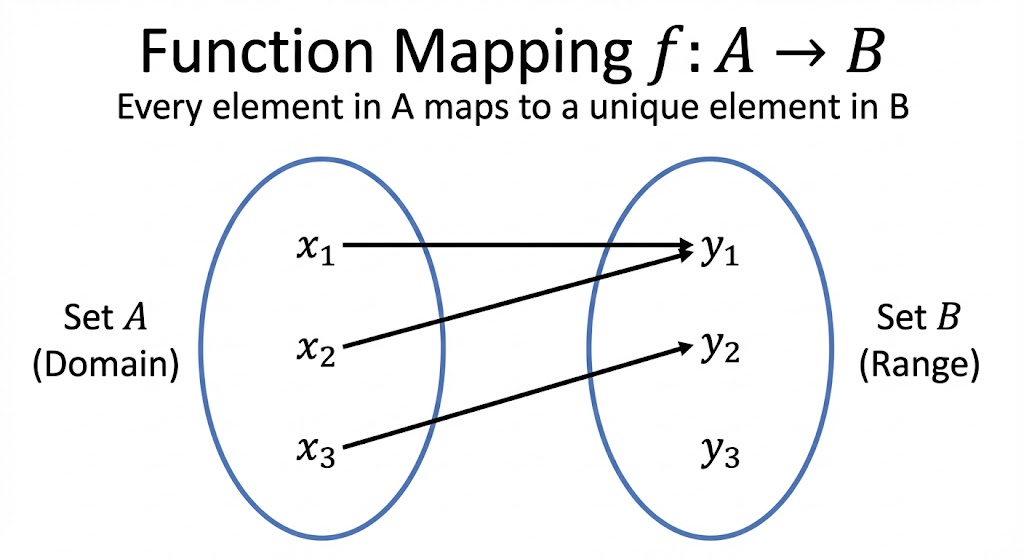
**Note**: The key is "Uniqueness". One $x$ maps to only one $y$ (single-valued), but different $x$'s can map to the same $y$ (many-to-one).
---
2. Four Fundamental Properties
Analyzing these properties is crucial for the CSCA exam.
#### (1) Monotonicity
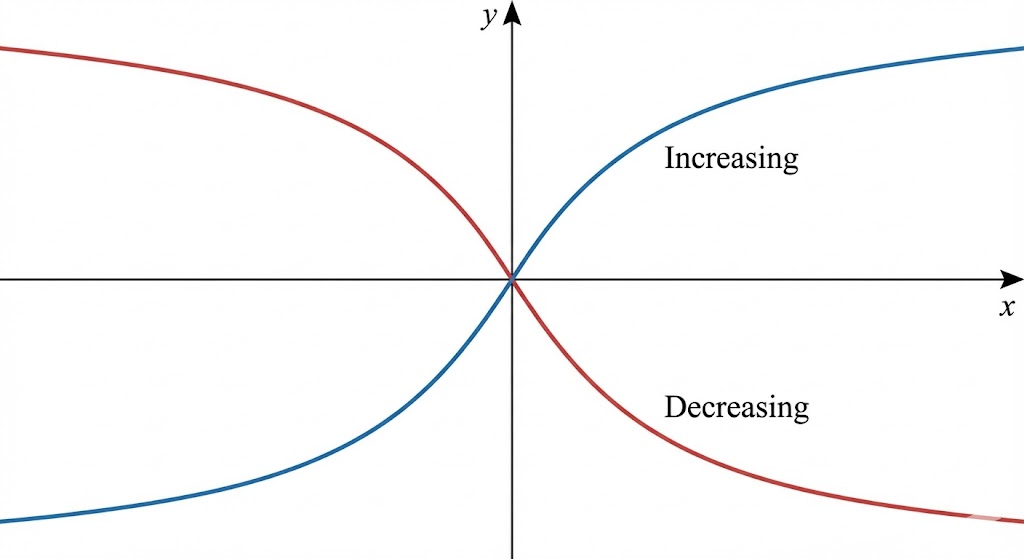
Describes the trend of the function. Let interval $I$ be part of the domain:
* **Monotonically Increasing**: For any $x_1 < x_2$ in $I$, $f(x_1) < f(x_2)$.
* **Monotonically Decreasing**: For any $x_1 < x_2$ in $I$, $f(x_1) > f(x_2)$.
#### (2) Parity (Even/Odd)
Describes the symmetry of the graph.
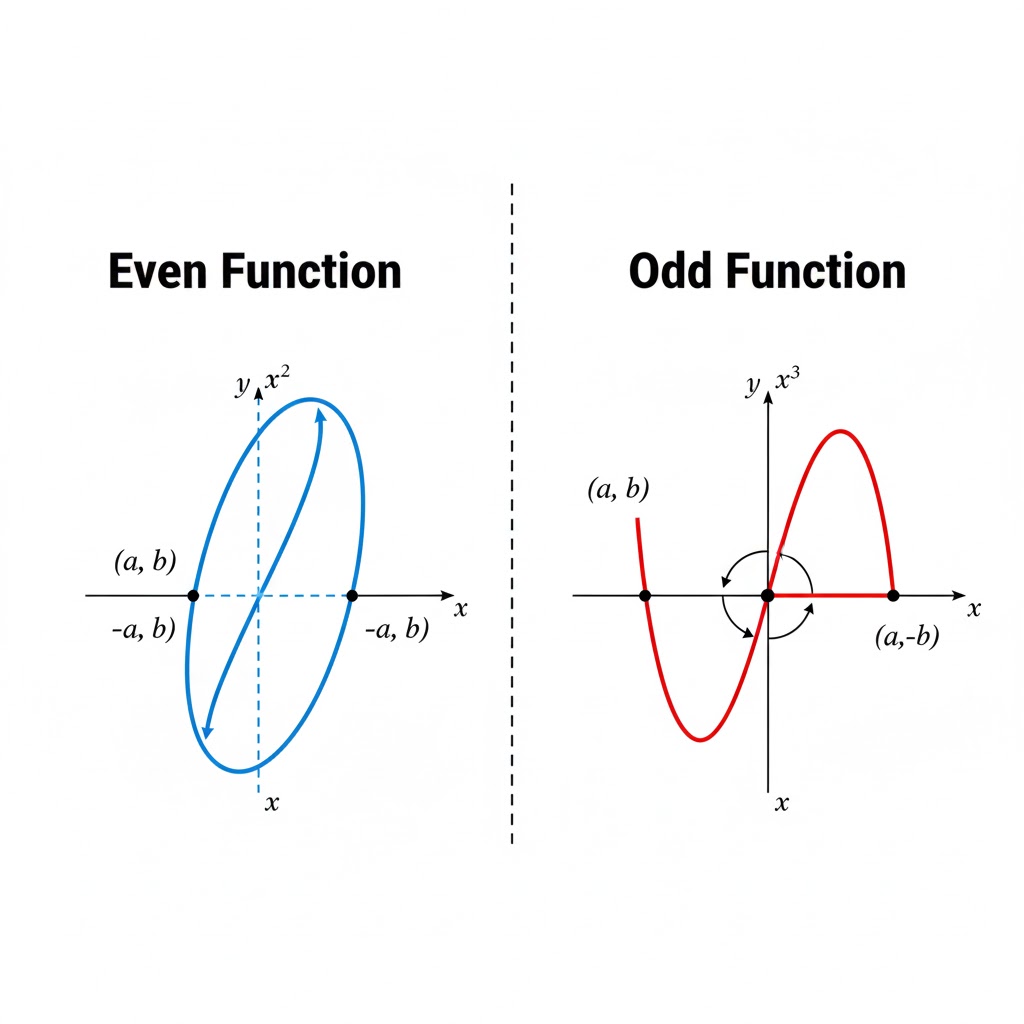
**Prerequisite**: The domain must be **symmetric about the origin**.
* **Even Function**: Satisfies $f(-x) = f(x)$. Graph is symmetric about the **y-axis** (e.g., $y=x^2, y=\cos x$).
* **Odd Function**: Satisfies $f(-x) = -f(x)$. Graph is symmetric about the **origin** (e.g., $y=x^3, y=\sin x$).
#### (3) Periodicity
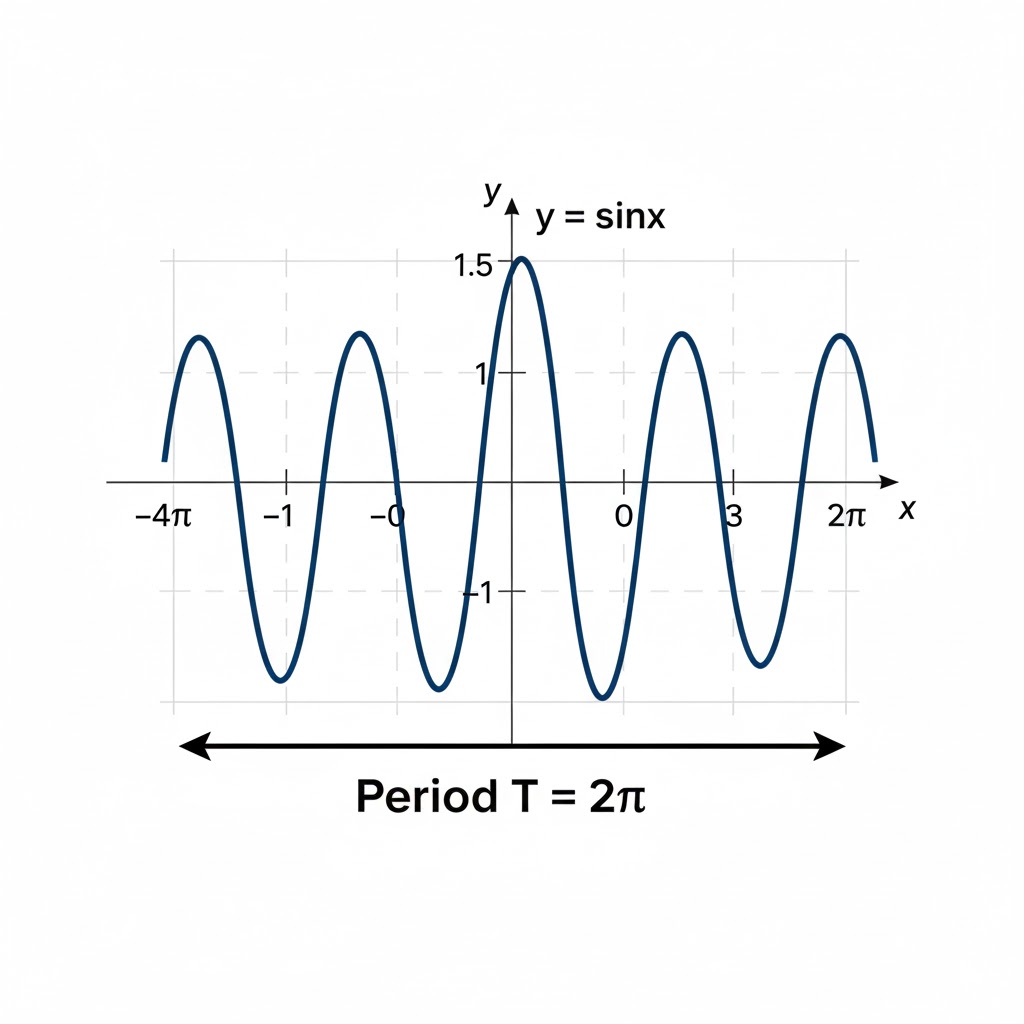
If there exists a non-zero constant $T$ such that $f(x+T) = f(x)$ holds for all $x$, then $f(x)$ is a periodic function. The smallest positive $T$ is called the **Fundamental Period**.
* **Example**: The period for $y = \sin x$ and $y = \cos x$ is $2\pi$.