Rational Inequalities
Solve rational inequalities with sign charts, denominator restrictions, and endpoint checks. Includes three worked examples and common mistakes to avoid.
Before planning this topic, check the CSCA Exam Guide 2026 for exam dates, registration, fees, and subject requirements.
Syllabus Alignment
This study guide is organized around the publicly available CSCA syllabus for international undergraduate applicants.
Who It Is For
International students preparing for CSCA Math, Physics, Chemistry, or Chinese exams.
Related Practice
CSCA Practice · Go to questions
Past papers and worked video solutions · Timed mock exams · All subject video lessons
Practice by Topic
Jump from this tutorial to filtered practice questions for the same knowledge point.
Related formulas, concepts, and glossary terms
Mathematics Formula & Concept Reference
- Basic Form of Rational Inequality
- Equivalent Condition for (P(x))/(Q(x)) > 0
- Equivalent Condition for (P(x))/(Q(x)) < 0
- Equivalent Condition for (P(x))/(Q(x)) ≤ 0
- Equivalent Condition for (P(x))/(Q(x)) ≥ 0
Mathematics Exam Glossary
Tutorial Content
Rational Inequalities
A rational inequality compares a fraction containing a variable with another expression. Before solving it, exclude every value that makes an original denominator zero. Then move all terms to one side, combine them into a single fraction, and compare that fraction with zero.
1. Keep track of the domain
For polynomials and , consider
The fraction and the product have the same sign wherever . One way to see this is to multiply by , which is positive on the domain.
- For a strict inequality, is equivalent to . The corresponding rule also works for .
- For a non-strict inequality, keep the denominator restriction explicitly: requires both and . The same applies to .
These rules do not restore values excluded from the original expression. If you cancel a common factor, its original denominator restriction still applies.
2. Use a sign chart
- Factor the numerator and denominator.
- Mark the numerator's zeros and all excluded denominator values on a number line.
- Choose a test value in each interval to determine the sign of the fraction.
- Select the intervals with the required sign. Include a numerator zero only if equality is allowed and the original expression is defined there.
A zero of the denominator is always excluded. It may be a vertical asymptote or a removable hole, so calling every such point a “pole” is not accurate.
Do not assume that signs alternate at every marked point. A factor with even multiplicity does not change sign as you cross its root. Testing one value in each interval avoids this mistake.
3. Why multiplying by an unknown denominator needs care
For , multiplying both sides by without considering its sign is not a valid step: a negative multiplier reverses the inequality.
Instead, write
The critical values are and . The fraction is positive only between them, so the solution is . Both endpoints are excluded: is undefined, and gives equality.
4. Worked examples
Example 1: A strict inequality
Solve .
The original domain excludes . The numerator and denominator have the same sign when or . Therefore,
Example 2: Rearranging and including an endpoint
Solve .
First exclude , then move the right-hand side to the left:
| Interval | Sign of | Sign of | Sign of the fraction |
|---|---|---|---|
| Negative | Negative | Positive | |
| Positive | Negative | Negative | |
| Positive | Positive | Positive |
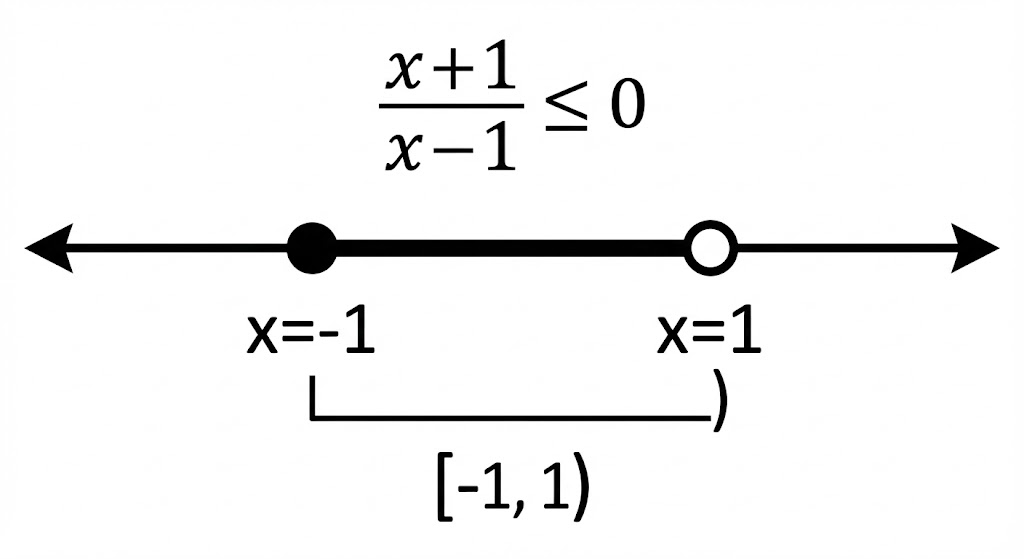
At , the fraction is zero, so this endpoint is included. At , the denominator is zero, so it is excluded. The solution is .
Example 3: Several factors
Solve .
Factor the numerator:
The critical values are , , and . From left to right, the interval signs are negative, positive, negative, and positive. Include and , where the numerator is zero, but exclude , where the denominator is zero:
Before you submit an answer
Check the original denominator restrictions, the sign in each chosen interval, and whether each endpoint belongs in the solution. A sign chart is a way to justify these decisions, not a rule to alternate signs automatically.
Further reading
Content reviewed: 9 September 2026.